

Plan the Job Analysis
The first step in the job design process is to plan the job analysis that sets the stage for all subsequent activities. A Guide to the Business Analysis Body of Knowledge (BABOK Guide) defines Technique 10.34 Process Analysis as: “the assessment of a process for its efficiency and effectiveness, as well as its ability to identify opportunities for change.”1 This technique can be applied to the business analysis job design initiative to build the future state of the specific job.
The gap identification approach assists in uncovering potential process improvements with the following steps:
- Identify gaps between the current and desired future state
- Identify which gaps and areas are value and non-value-added
- Understand pain points and the challenges of the process from multiple points of view
- Understand opportunities to improve the process from multiple points of view
- Align the gaps and areas with the strategic direction of the organization
- Understand the relationship of the gaps and areas with enterprise changes2
Figure 1 provides a general process approach to support the job design improvement effort in a sequential manner. Even though the job design is not a business process, the same analysis and process steps can be employed to architect its future state. It’s useful to think of the general process approach as a roadmap to your desired end state.
Figure 1: General Process Approach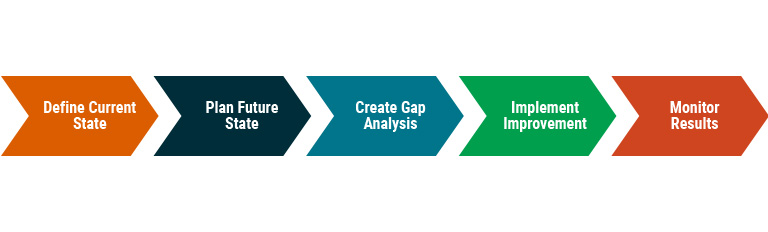
Conduct Interviews
Effective job design begins with a comprehensive job analysis. It’s usually best to start with organizational assets rather than reinvent the wheel and start from scratch. While organizational assets may not have been updated recently, most of the content will be useful from a current state perspective.
Usually, the hiring manager or a human resources generalist can locate the current job description for the business analyst role. After you review the current job description, conduct multiple interviews with different stakeholders to paint a 360-degree picture of the job.
| Type | Purpose |
| Manager | Elicit the managerial perspective of the role, including departmental goals and business relationship management aspects |
| Team Leader | Elicit the team perspective of the role, including project assignments and team development aspects |
| Incumbent | Elicit the tactical perspective of the role, including primary responsibilities, challenges, insights, wishes, and a core task list |
| Peer | Elicit the complementary perspective of the role, including detailed accountabilities, responsibilities, and tasks |
| Stakeholder | Elicit the business perspective of the role, including relationship dynamics, project responsibilities, and production support efforts |
Review Sources
As a supplement to the internal interviews, review occupational information for the Computer Systems Analyst job using the O*NET OnLine website provided by the United States Department of Labor3 and similar resources from other government agencies.
The Computer Systems Analyst job title is generic, but it covers the business systems analyst role that many business analysts execute daily within the technology sector. Several details are broken out by each topic: tasks, technology skills, work activities, skills, knowledge, education, abilities, interests, work values, and work styles. The details can be explored for further analysis.
Despite the bleak outlook for the US economy in combination with labour shortages, “the Computer Systems Analysts occupation has a bright outlook with an expected high growth rate.”4 This might be because organizations are realizing they need to look internally for driving and sustaining performance improvements.
When focusing on the job specifications, pay special attention to Chapter 9 of the BABOK Guide, titled “Underlying Competencies,” which includes: “a description of the behaviours, characteristics, knowledge, and personal qualities that support the practice of business analysis.”5 These competencies are important to the overall success of an employee in the business analyst role.
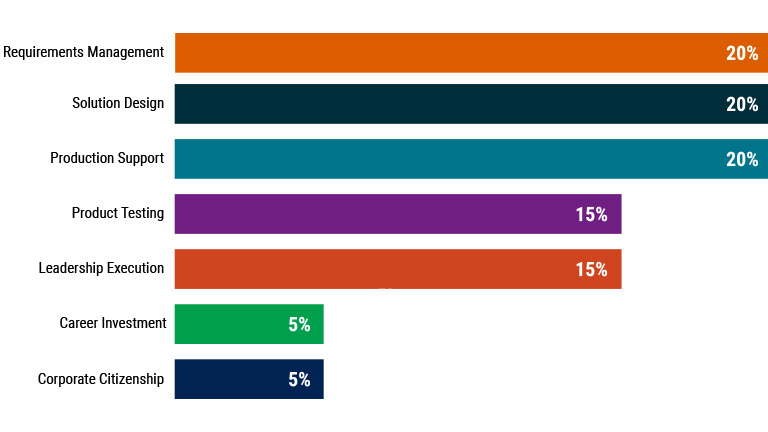
In addition, I find it helpful to brainstorm the macro-level groupings of work to which each task should belong. Figure 2 provides a sample allocation of different work types for a lead, supervisor, or manager of business analysis from an information technology perspective.
Figure 2: Sample Business Analysis Work Groupings
Prioritize Results
Once you compile the data from internal and external sources, your next step is to work with the key individuals to prioritize each core task in case there’s not enough time to define an exhaustive list.
A simple approach is to rank each core task and trim the list to 10 critical tasks that underpin the business analyst role. Score each task using a 1 to 5 scoring range, with 1 meaning the least weighted aspect and 5 meaning the most weighted aspect for the Frequency, Importance, and Difficulty dimensions. Then, create a task matrix to rank the core tasks and calculate the Criticality using the following formula: Frequency x Importance x Difficulty = Criticality. Finally, sort the task list in descending order based on the calculated Criticality score. Any task not meeting your definition of “critical enough to be included” should be removed from your final task list.
For example, a coaching task is associated with a Frequency of 4 (perform regularly), an Importance of 4 (high), and a Difficulty of 3 (somewhat difficult). Therefore, the calculated Criticality is 48.
| Frequency | Importance | Difficulty | Criticality |
| 4 | 4 | 3 | 48 |
Develop Knowledge, Skills, Abilities, and Other Characteristics
The most time-consuming task within the job design process is applying categorical details to your final task list. At this point, you will associate relevant knowledge, skills, abilities, and other characteristics to each core task, commonly referred to as the KSAO specification.
The sample coaching task below shows the level of detail required for each category.
| Category | Description |
| Task #1 | Coach individuals and teams to improve performance and increase overall effectiveness |
| Knowledge | Knowledge of models, practices, principles, research, and theories within the coaching practice |
| Skill | Skill in actively listening to an individual by focusing on verbal statements, non-verbal cues, voice intonation, and emotions |
| Ability | Ability to think creatively, critically, and tactically when coaching individuals and teams in a variety of situations |
| Other Characteristics | Proficiency in resolving conflict using coaching methods tailored for the specific situation |
Compile Job Description and Job Specifications
After the KSAO specification is defined for each task on the final task list, the next step is to append the job specifications (KSAOs) to the future state job description. In most cases, the KSAO specifications will necessitate a revision of the job description. The job description is typically comprised of the job title, role summary, educational requirements, certification preferences, experience requirements, and KSAOs.
Once approval has been obtained from the key stakeholders, the job analysis portion of the job design is complete and serves as the gold standard. However, both the job description and the job specifications should evolve over time as new capabilities, methods, tools, technologies, and organizational structures are introduced.
Extend the Gold Standard
While the job description and job specifications may be approved at this stage of the process, the journey has only just begun. Strategic human resource management can be paraphrased as: “the development and alignment of human capital to organizational objectives resulting in positive business outcomes.”6
As the hub for all human resource-related activities, an effective job design essentially becomes the measuring stick by which all other activities are compared. This includes but is not limited to the following actions: posting, selecting, interviewing, evaluating, offering, onboarding, developing, appraising, disciplining, and training.
Consult the HR Experts
For all things related to human resources, consult the available resources from the Society for Human Resource Management (SHRM). SHRM curates the SHRM Body of Applied Skills and Knowledge (SHRM BAS), which “includes nine behavioral competencies as well as one technical competency.”7 SHRM also produces news, blogs, podcasts, and a quarterly HR magazine.
Summary
An effective job design takes time. Yet the realized benefits more than offset the cost, discipline, and time required to perform the job analysis, concluding with an approved job description and the related job specifications used to measure all activities across the strategic human resource management life cycle.
Whether you’re a junior, senior, lead, supervisor, or manager of business analysis, you can contribute to the effectiveness of a comprehensive and sound job design that will allow you to progress within your career and select the right candidate.
This article includes contributions from IIBA Editorial Committee Member Kristyna Samcova. Kristyna is an experienced Senior Business Analyst/Consultant professional with more than 7 years of experience in the fintech/manufacturing industry.
References
- International Institute of Business Analysis. A Guide to the Business Analysis Body of Knowledge (BABOK Guide), Version 2.0. Toronto: International Institute of Business Analysis, 2009, 314–317.
- International Institute of Business Analysis. A Guide to the Business Analysis Body of Knowledge, 315.
- U.S. Department of Labor. “Computer Systems Analysts.” Employment and Training Administration (USDOL/ETA). 2022. https://www.onetonline.org/link/summary/15-1211.00.
- U.S. Department of Labor. “Computer Systems Analysts.”
- International Institute of Business Analysis. A Guide to the Business Analysis Body of Knowledge, 187-216.
- Dessler, Gary. Human Resource Management, 15th ed. Boston: Pearson Education Inc, 2017, 74.
- Society for Human Resource Management. “Body of Applied Skills and Knowledge.” 2022. https://www.shrm.org/certification/decide/Pages/body-of-applied-skills-and-knowledge.aspx.

About the Author
John B. Reeves is a creative business technology leader focused on achieving positive business outcomes through empathic interaction, thoughtful design, and reliable support. He currently serves as a Lead Business Analyst and Supervisor at the City of Charlotte (N.C.).


