

Value Proposition Canvas in a Nutshell
The Value Proposition Canvas is a strategic management tool in business development and product design. It’s used to visualize, design, and analyze a product or service's value proposition. Invented by Alexander Osterwalder, it aims to interpret and articulate a solution's value to customers.
A Value Proposition Canvas offers several advantages:
- It’s a customer-oriented approach that deeply understands customer profiles, needs, pains, and gains
- By consistently delivering value that addresses crucial customer pains and gains, businesses can enhance customer satisfaction and build stronger relationships
- It focuses on understanding customer needs and preferences, so it can significantly reduce the risk of product failure, ensuring business decisions are well-informed and aligned with market demands
- With its simple and universally understandable graphic structure, it fosters inclusivity among all stakeholders, enhancing communication and aligning our collective understanding of our product or service
- It boosts creative thinking and supports innovation
The Customer Profile contains three sections:
- The Customer Jobs section involves the functional, social, and emotional activities or challenges customers seek to address, including problems they aim to solve and needs they wish to fulfil
- The Pains section contains descriptions of negative experiences, feelings, and emotions encountered while accomplishing these jobs
- The Gains section encapsulates the positive experiences, satisfaction levels, and benefits derived
- The Products and Services section describes how the solution helps customers complete their jobs
- The Pain Relievers section outlines strategies to mitigate customer pains
- The Gain Relievers section clarifies the intention of delivering the positive and desired outcomes
The following figure represents the Value Proposition Canvas template.
Figure 1. Value Proposition Canvas template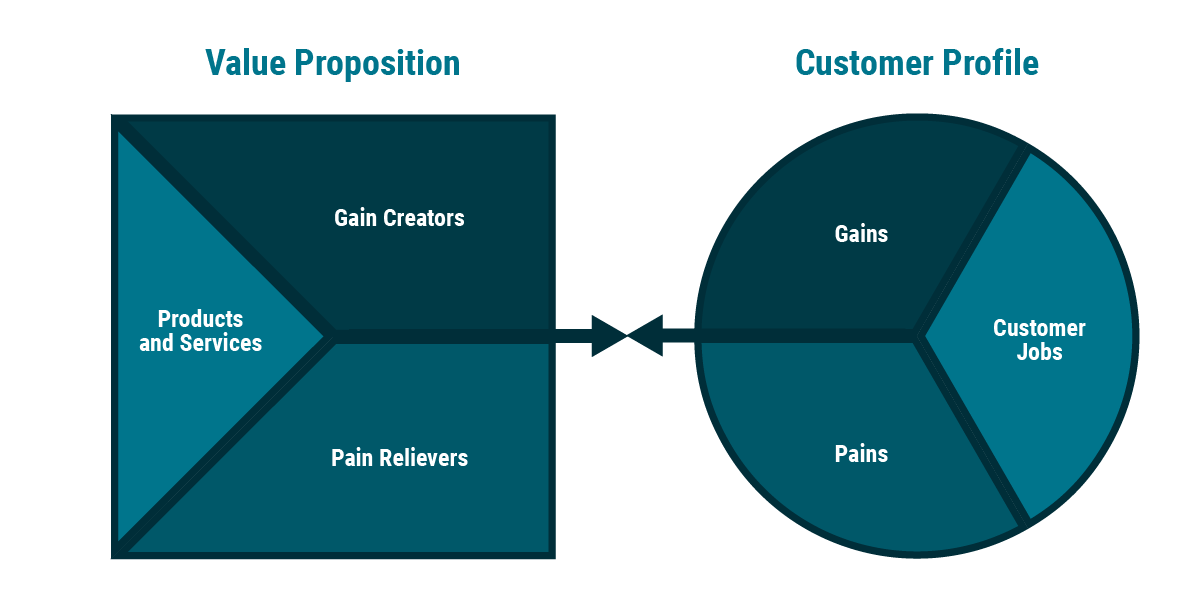
Uber Case Study
The canvas completion process begins with the Customer Profile component. Analyzing the customer segment enables organizations to plan and develop a suitable solution.
Understanding the customer segment is crucial for creating a valuable solution. The following figure represents the completed canvas for the Uber case study for a customer profile called “Passenger.”
Figure 2. Value Proposition Canvas for the Uber Case Study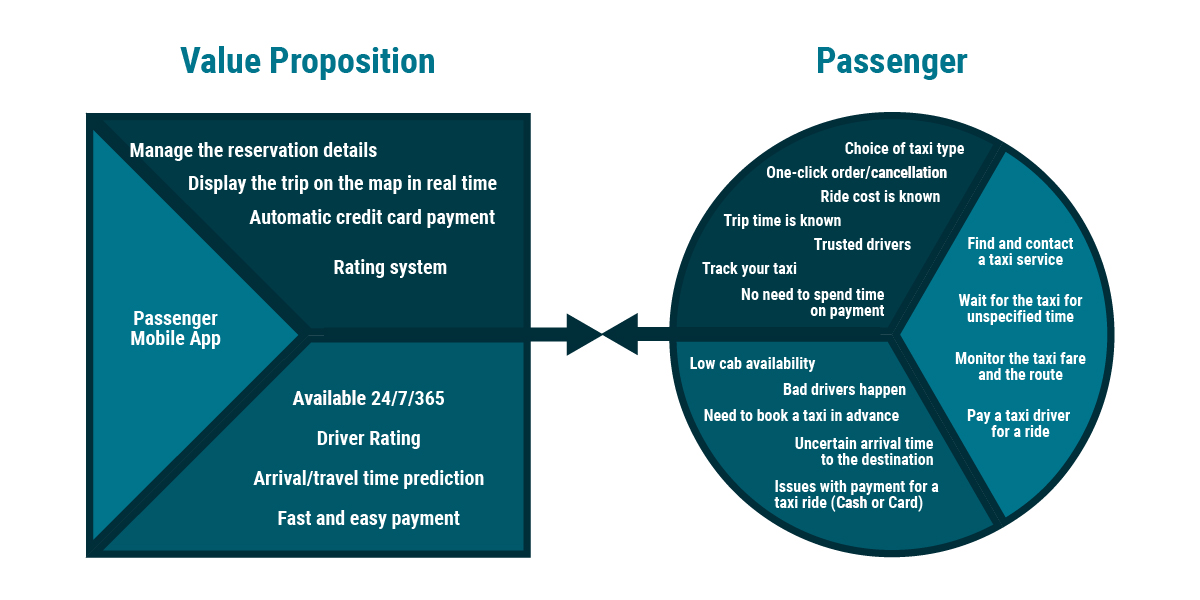
Applying the Value Proposition Canvas to Your Business
Suppose you have already prepared the Value Proposition Canvas for your business. What next?
Customer needs and expectations change. Competitors introduce new solutions and technique advances. You must constantly observe changes across a broad horizon and respond to them to develop a successful solution. These changes may impact your solution. Here are three essential tips to help you deal with it.
1. Conduct Regular Inspections and Update the Canvas
Success in providing a solution requires continuous inspection and adaptation. It's not a one-time event but a recurring process. Making decisions based on outdated information can lead to failure. As a solution provider, you don't want to launch a useless product or service, so planning and conducting inspection and adaptation promptly at your initiative horizon is crucial.
2. Update Value Proposition Canvas and Deliver Value
Any new information associated with a customer segment, external environments, or internal organizational decisions may impact the solution. Thus, it's crucial to regularly review and update the Value Proposition Canvas to ensure it's aligned with these changes. When new customer value occurs, you should map it and deliver it, enhancing your solution's relevance and market position.
3. Accelerate Your Understanding
To understand what makes a solution valuable and manage changes effectively, combine the Value Proposition Canvas with other business analysis techniques, such as customer journey map, Kano Analysis, personas, product-market fit, story mapping, or value stream mapping. This approach can help you understand your customer and market throughout the initiative, ensuring that your solution remains relevant and impactful whenever it's delivered.
Final Thoughts
Product success depends on applying a planning approach and practical techniques that guide a solution from an unclear concept to a valuable product or service. The Value Proposition Canvas offers one such tool that, when regularly reviewed and combined with other business analysis techniques, crafts customer-centric solutions to meet evolving changes in the marketplace.
References
- Emmer, Marc. “95 Percent of New Products Fail. Here Are 6 Steps to Make Sure Yours Don't.” Inc. July 6, 2018. https://www.inc.com/marc-emmer/95-percent-of-new-products-fail-here-are-6-steps-to-make-sure-yours-dont.html.
- CB Insights. “The Top 12 Reasons Startups Fail.” August 3, 2021. https://www.cbinsights.com/research/report/startup-failure-reasons-top/.

About the Author
Milosz Anders is a business and system analyst and an IIBA member with the following certifications: ECBA, IIBA-CPOA, and IIBA-AAC. Focused on delivering maximum outcome with minimum output, Milosz specializes in geographic information systems and location intelligence.


