
What Is Systems Thinking?
Systems thinking is a holistic approach to analysis that focuses on understanding how parts of a system interrelate. It also focuses on how systems work within the context of larger systems. Systems thinking involves moving from observing events or data to identifying patterns of behaviour to surfacing the underlying structures that drive those events and patterns. Rather than examining parts in isolation, systems thinking considers the whole and how elements influence each other.
Why Systems Thinking?
In today's increasingly complex, interconnected and rapidly changing business environment, systems thinking has become a critical competency for business analysis professionals.
Organizations are intricate, multifaceted systems with numerous moving parts. Initiatives in one business area can have unintended ripple effects across the organization. Without a systems perspective, it's easy to miss these critical interdependencies. It leads to making decisions that optimize one part of the system to the detriment of the whole.
For business analysis professionals, applying systems thinking is vital for enabling successful change. It helps identify all impacted groups, functions, processes, policies, and technology components that may be affected by a proposed change.
By understanding these interrelationships, business analysis professionals can surface potential issues and risks early, guiding the design of more holistic solutions.
To illustrate the power of systems thinking in our work, let's revisit John's CRM implementation project with a different approach.
Embracing systems thinking, John initiated a comprehensive change impact assessment before diving into functional requirements. He collaborated with stakeholders across sales, marketing, finance, and customer support to map existing processes and interdependencies.
This holistic approach revealed:
- Potential effects on related systems like websites, landing pages, billing and inventory management
- Need to review and update some transactional documents, reports and digital forms
- Necessary changes to sales team workflows
- Integration requirements with the email marketing platform, social media and advertising platforms
Armed with these insights, John and the project team:
- Developed a phased implementation plan to minimize disruption to daily operations
- Allocated resources for data cleansing and migration well in advance of the go-live date
- Designed a comprehensive training program for the sales team, including hands-on workshops and the creation of quick reference guides
- Collaborated with the IT department to ensure smooth integration with existing systems, particularly the billing software
- Worked with the marketing team to update lead generation and nurturing processes to align with the new CRM capabilities
- Engaged the finance department early to ensure the new system could generate the necessary reports for forecasting, budgeting, and performance analysis
The result? While challenges still arose, they were anticipated and manageable. Three months post-implementation, the company saw increased sales productivity, improved customer satisfaction, and more accurate financial forecasting.
How to Develop and Cultivate Systems Thinking Mindset in Business Analysis
Cultivating a system-thinking mindset as a business analysis professional requires deliberate practice and continuous learning. Some practices to get started include:
- Challenging mental models and assumptions: By examining and questioning underlying beliefs and assumptions, business analysts can identify blind spots and more accurately understand the system's dynamics.
- Engaging diverse perspectives: Gathering insights from a wide range of stakeholders helps build a holistic view of the system and challenges prevailing assumptions.
- Mapping relationships and interactions: Actively seek to understand the interconnections between various organizational elements using techniques like causal loop diagrams.
- Leveraging visual modelling/thinking tools: Modelling techniques like context diagrams, ecosystem maps, and other visual tools can help business analysis professionals map out complex system dynamics and communicate insights effectively.
- Embracing continuous learning and improvement: Business analysis professionals should foster a mindset of ongoing learning, experimentation, and adaptation to deepen their systems thinking capabilities over time.
A Guide to the Business Analysis Body of Knowledge (BABOK Guide) highlights systems thinking as a key skill under the analytical thinking and problem-solving competency. By developing this capability, business analysis professionals can more effectively navigate complexity, identify risks, and enable sustainable change.
Applying Systems Thinking Through Change Impact Assessment
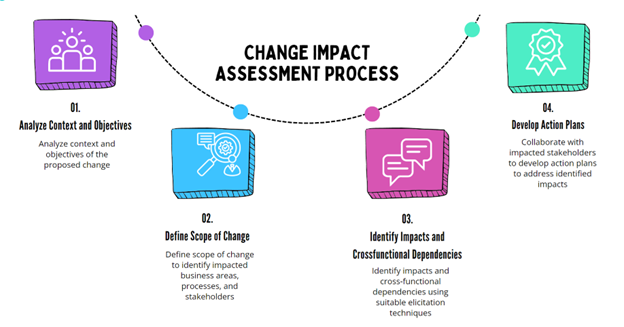
A change impact assessment provides a structured approach for business analysis professionals to apply systems thinking in practice. It involves systematically identifying the people, processes, policies, and technology components that may be affected by a proposed change.
By methodically examining touch points and dependencies, business analysis professionals can surface potential issues and risks that may go unnoticed until much later in the project lifecycle.
A sample change impact assessment process is illustrated with the schematic below:
A change impact assessment can be conducted at multiple points during a change beyond the initiation phase, including:
- During strategic analysis and project initiation to inform scoping decisions
- When assessing change/enhancement requests on existing systems and processes
- Before elaborating and finalizing requirements to identify gaps and risks
- When identifying implementation requirements for re-engineered or improved processes
Change Impact Assessment in an Agile Environment
In Agile projects, change impact analysis during each sprint assesses the effects of the design and implementation of sprint backlog items on systems, processes, and stakeholders.
Some scenarios where change impact analysis is particularly relevant in an Agile context include:
- Sprint planning: During sprint planning, a quick change impact assessment can help the team understand the broader implications of the selected user stories. This ensures the sprint backlog includes all necessary tasks.
- Release planning: Change impact analysis informs release planning for teams working on larger products. It identifies feature dependencies and potential impacts on user groups in live environments or integrations.
By incorporating change impact analysis into Agile techniques, teams can make more informed decisions, reduce unexpected issues, and deliver cohesive, high-quality solutions. Keep analyses lightweight and proportional to the change's size and risk to maintain agility while benefiting from the insights provided.
To conduct change impact analysis effectively, business analysis professionals should:
- Collaborate closely with cross-functional team members to gather diverse perspectives and insights
- Use lightweight documentation and visual models to capture and communicate key impacts and dependencies
- Prioritize and time-box analysis efforts based on the complexity and criticality of the proposed changes
- Continuously review and update impact assessments as new information emerges throughout the project lifecycle
- Foster a culture of open communication and feedback to surface potential impacts and risks early and often
Business analysis professionals can identify risks and guide organizations toward sustainable outcomes by taking a holistic approach, challenging assumptions, and conducting change impact assessments.
Stay tuned for Part 2, where we'll explore how the project team can use the outputs of a change impact assessment for informed decision-making, other downstream tasks, and activities for success.
References
- International Institute of Business Analysis. A Guide to the Business Analysis Body of Knowledge (BABOK Guide), Version 3.0. Toronto: International Institute of Business Analysis, 2015.
- OCM Solution. “Best 2024 Change Impact Assessment With Template, Samples and Reporting.” 2024. https://www.ocmsolution.com/change-impact-assessment/.

About the Author
Oge is a business transformation practitioner with over a decade of experience, across multiple industry domains. She has served as project manager, business analyst, and organizational change manager on diverse transformation projects. She holds several professional certifications; CBAP, PMP, PROSCI, and IIBA-CPOA. She is currently the Director, Professional Development, with the IIBA Nova Scotia Chapter. She is also the Chief Learning Officer at Pollard Learning, an IIBA-endorsed education provider equipping professionals to start and advance their careers in business analysis, change management, and project management.


