
Figure 1.10: The Rock Crusher as Model for Backlog Management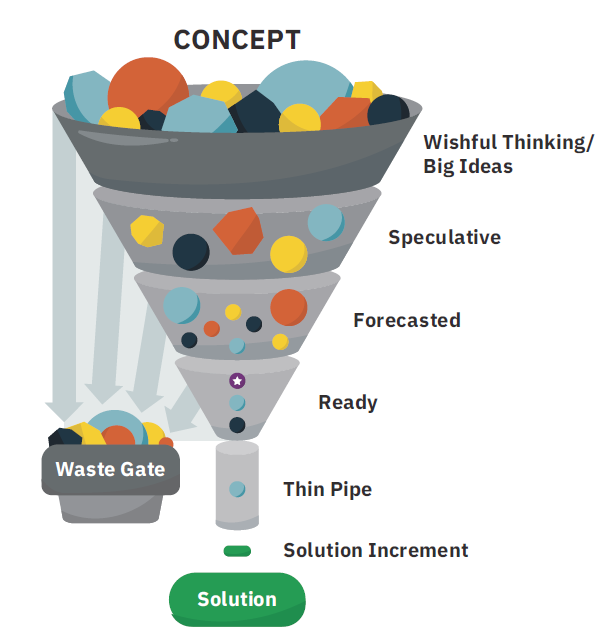
The Rock Crusher is not yet another methodology. It is an integration of common success patterns we have observed numerous teams employ to enhance visualization and effectively manage their work in the context of "getting stories ready." Certain organizations even refer to their processes as "rock crushing." By utilizing these patterns, we gain the ability to visualize and manage all the value-adding steps within our value stream beyond just the coding steps.
The key elements of the Rock Crusher are:
- Rock: Just a cute name for backlog items. A Rock may be a user story, a feature, an epic, a capability, a use case, a defect, an initiative, or whatever local name the team is using for backlog items.
- Funnel: The turbulent flow of Rocks is throttled and stabilized in the funnel. The Rock Crusher funnel shifts our mental model of the backlog from a passive reservoir to an active learning and discovery process that results in a stabilized and throttled flow:
- Stabilized because the backlog is prioritized through forced ranking, with few or no changes taking place in the ranking.
- Throttled because the flow does not exceed the team’s capacity, represented by the Thin Pipe.
- Thin Pipe: A metaphor for the limited capacity of the team. The Thin Pipe can easily clog and create delays if the flow of ready Rocks is not smooth.
- Waste Gate: A critical part of the flow equation: What goes in must come out. In an agile world, not all work entering the backlog will or should be done. The Waste Gate represents our policies for explicitly removing work from the backlog.
- The Village: It takes a village of collaborating roles to stabilize and throttle the flow through the backlog.
The Product Owner Can’t Do It All: It Takes a Village
Figure 2.6: It Takes a Village. One Person Cannot Do It All
Classic backlog management is usually described as a collaboration between an omniscient and omnipotent product owner and a team. The reality is that for most organizations this model does not work because the product owner role is so demanding an individual alone cannot perform it.
The Rock Crusher deconstructs the role of the classic product owner into its seven constituent roles. Roles are categorized as either accountable, responsible, or supporting.
Accountable Roles
Backlog owner: The backlog owner has the final say on the sequencing/prioritizing of work for a team because they are accountable for ensuring the team is always working on the most valuable work.Solution owner: The solution owner is a customer-facing role that is accountable for which features make a Solution but does not have the final say on the prioritization of work for a team.
Responsible Roles
Analyst: The analyst is responsible for transforming the wants, hopes, interests, and aspirations of the customer, stakeholder, and solution owner, as well as the contributions of the subject matter expert, into a shared, clear understanding of precisely what to build. The analyst is responsible for progressively creating a better understanding of precisely what to build: the Solution.
Team: Team members are responsible for collaborating with all roles for deciding precisely what to build and are accountable for delivering on their commitments to the backlog owner.
Supporting Roles
Customer: The customer is the receiver or beneficiary of the Solution. They may be consulted or informed about decisions on precisely what to build.Stakeholder: A stakeholder is any individual who, at a minimum, must be consulted about precisely what is being built and may also have decision-making authority in deciding precisely what to build. A customer may also be a stakeholder if they need to be consulted about decisions on precisely what to build.
Subject matter expert (SME): A SME is someone who has deep knowledge of the relevant problem domain and/or relevant technology and development practices. SMEs use their knowledge to advise other roles on deciding precisely what to build. They are responsible for providing the expertise other roles may need to perform their jobs.
The number of individuals required to perform these roles greatly depends on the size and context of the organization and the development environment.
Summary
Let’s review some of the elements of the Rock Crusher:
- The Rock Crusher is a flow-based model of backlog management that mitigates the deficiencies of the traditional “stacked plates” model of the product backlog.
- The Rock Crusher better captures and visualizes the ambiguity that should be inherent in a backlog.
- The Thin Pipe is a metaphor for the limited capacity of the team to deliver Solution Increments. The effectiveness of the Thin Pipe relies on a steady flow of Ready backlog items.
- Rock Crusher flow is turbulent. Its purpose is to make the processes and work involved in easing that flow visible and manageable.
- The Rock Crusher model acknowledges the difficulty of the product owner role and breaks it out into a village of roles—backlog owner, solution owner, analyst, subject matter expert, stakeholder, and customer.
- A Rock is just a fancy metaphor for a backlog item. A well-formed Rock will have an intent and result in a testable, verifiable model.
- The Waste Gate is an important part of the model and explicitly demonstrates that not all Rocks in the backlog will be pulled through the Thin Pipe.
- The Rock Crusher flow equation is simply: what goes in must come out. Rocks are either pulled through the Thin Pipe or ejected through the Waste Gate.
Learn More About the Rock Crusher
The Rock Crusher offers an agile approach to backlog management, highlighting the power and simplicity of this essential tool in modern agile organizations. This new publication emphasizes the importance of the backlog as a single repository from which a team pulls its next most valuable work item, enabling agility through the ability to add, remove, reprioritize, and visualize potential work for a product.
The Rock Crusher, A Model for Flow-Based Backlog Management, by Steve Adolph, Shane Hastie, and Ryland Leyton, is now available for purchase in the IIBA Bookstore.
References
- Brooks, Frederick P. "No Silver Bullet Essence and Accidents of Software Engineering." Computer 20(4): 10–19, 1987.

About the Author
Steve Adolph started his career in engineering and building telephone switches and railway signaling systems. Around the late 1990s, he moved into management, where he became interested in the outsized influence that ways of working and organizational culture have on enterprise outcomes. Steve became interested in agile when he started collaborating with Pattern Language aficionados at the PLoP conferences. Today, he works as an agile coach with cprime, (Canada). Steve has a Ph.D. in electrical and computer engineering and numerous publication credits, including The Rock Crusher, which he co-authored with Shane Hastie and Ryland Leyton, and Patterns for Effective Use Cases. He was also a member of the core team that developed the Agile Extension to the BABOK Guide, Version 2.


