The Business Analysis Core Concept Model™ (BACCM™)
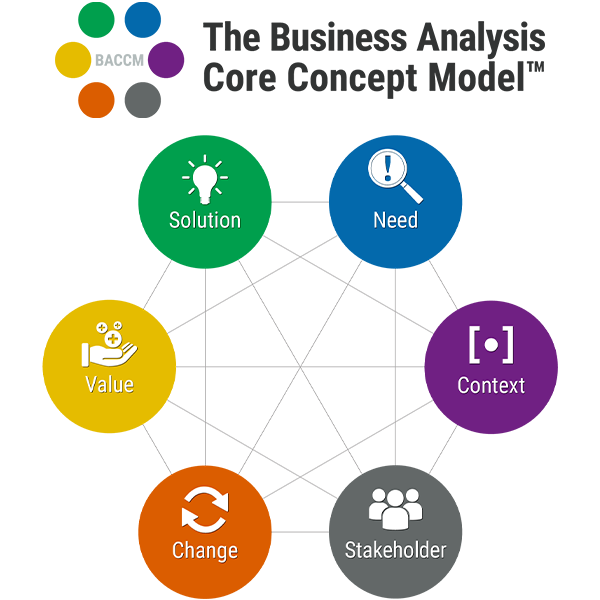
The Business Analysis Core Concept Model™ (BACCM™) is composed of six core concepts that provide a common language and guidance for effective business analysis.
Business Analysis enables change in an enterprise by defining needs and recommending solutions that deliver value to stakeholders, while considering context.
The six core concepts in the BACCM are:

The act of transformation in response to a need.

A problem or opportunity to be addressed.

A specific way of satisfying one or more needs in a context.

The worth, importance, or usefulness of something to a stakeholder within a context.

A group or individual with a relationship to the change, the need, or the solution.

The circumstances that influence, are influenced by, and provide understanding of the change.
Each Core Concept is:
Fundamental to business analysis and is equal and necessary.
Defined by the other five core concepts and cannot be fully understood until all the concepts are understood.
Instrumental to understanding the information elicited, analyzed, or managed in business analysis tasks.
The core concepts can be used to consider the quality and completeness of the work being done. Examples of how the core concepts may be used are described within each of the six Knowledge Areas.
Select a Knowledge Area to Understand How the Core Concepts are Used.






While planning or performing business analysis tasks, consider how each core concept is addressed by asking:
 |
What are the kinds of changes we are doing?
|
 |
What are the needs we are trying to satisfy?
|
 |
What are the solutions we are creating or changing?
|
 |
Who are the stakeholders involved?
|
 |
What do stakeholders consider to be of value?
|
 |
What are the contexts that we and the solution are in?
|
If any of the core concepts experience a change, re-evaluate them and their relationships to value delivery.