5. Requirements Life Cycle Management
BABOK® Guide
Introduction
The Requirements Life Cycle Management knowledge area describes the tasks that business analysts perform in order to manage and maintain requirements and design information from inception to retirement. These tasks describe establishing meaningful relationships between related requirements and designs, assessing changes to requirements and designs when changes are proposed, and analyzing and gaining consensus on changes.
The purpose of requirements life cycle management is to ensure that business, stakeholder, and solution requirements and designs are aligned to one another and that the solution implements them. It involves a level of control over requirements and over how requirements will be implemented in the actual solution to be constructed and delivered. It also helps to ensure that business analysis information is available for future use.
The requirements life cycle:
- begins with the representation of a business need as a requirement,
- continues through the development of a solution, and
- ends when a solution and the requirements that represent it are retired.
The management of requirements does not end once a solution is implemented. Throughout the life of a solution, requirements continue to provide value when they are managed appropriately.
Within the Requirements Life Cycle Management knowledge area, the concept of a life cycle is separate from a methodology or process used to govern business analysis work. Life cycle refers to the existence of various phases or states that requirements pass through as part of any change. Requirements may be in multiple states at one time.
The states listed here are not intended to be a comprehensive listing.
Figure 5.0.1: Requirements Life Cycle Management

The Requirements Life Cycle Management knowledge area includes the following tasks:
- Trace Requirements: analyzes and maintains the relationships between requirements, designs, solution components, and other work products for impact analysis, coverage, and allocation.
- Maintain Requirements: ensures that requirements and designs are accurate and current throughout the life cycle and facilitates reuse where appropriate.
- Prioritize Requirements: assesses the value, urgency, and risks associated with particular requirements and designs to ensure that analysis and/or delivery work is done on the most important ones at any given time.
- Assess Requirements Changes: evaluates new and changing stakeholder requirements to determine if they need to be acted on within the scope of a change.
- Approve Requirements: works with stakeholders involved in the governance process to reach approval and agreement on requirements and designs.
The Core Concept Model in Requirements Life Cycle Management
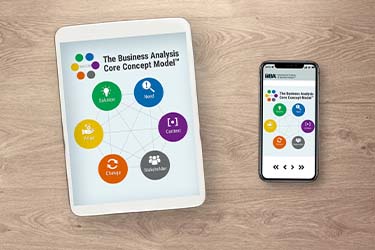
The Business Analysis Core Concept Model™ (BACCM™) describes the relationships among the six core concepts.
The following table describes the usage and application of each of the core concepts within the context of Requirements Life Cycle Management.
Table 5.0.1: The Core Concept Model in Requirements Life Cycle Management
|
Core Concept |
During Requirements Life Cycle Management, business analysts... |
|
Change: the act of transformation in response to a need. |
manage how proposed changes to requirements and designs are evaluated during an initiative. |
|
Need: a problem or opportunity to be addressed. |
trace, prioritize and maintain requirements to ensure that the need is met. |
|
Solution: a specific way of satisfying one or more needs in a context. |
trace requirements and designs to solution components to ensure that the solution satisfies the need. |
|
Stakeholder: a group or individual with a relationship to the change, the need, or the solution. |
work closely with key stakeholders to maintain understanding, agreement, and approval of requirements and designs. |
|
Value: the worth, importance, or usefulness of something to a stakeholder within a context. |
maintain requirements for reuse to extend value beyond the current initiative. |
|
Context: the circumstances that influence, are influenced by, and provide understanding of the change. |
analyze the context to support tracing and prioritization activities. |
Figure 5.0.2: Requirements Life Cycle Management Input/Output Diagram