6. Strategy Analysis
BABOK® Guide
Introduction
Strategy defines the most effective way to apply the capabilities of an enterprise in order to reach a desired set of goals and objectives. Strategies may exist for the entire enterprise, for a division, department or region, and for a product, project, or iteration.
The Strategy Analysis knowledge area describes the business analysis work that must be performed to collaborate with stakeholders in order to identify a need of strategic or tactical importance (the business need), enable the enterprise to address that need, and align the resulting strategy for the change with higher- and lower-level strategies.
Strategy analysis focuses on defining the future and transition states needed to address the business need, and the work required is defined both by that need and the scope of the solution space. It covers strategic thinking in business analysis, as well as the discovery or imagining of possible solutions that will enable the enterprise to create greater value for stakeholders, and/or capture more value for itself.
Strategy analysis provides context to requirements analysis and design definition for a given change. Strategy analysis should be performed as a business need is identified. This allows stakeholders to make the determination of whether to address that need or not. Strategy analysis is an ongoing activity that assesses any changes in that need, in its context, or any new information that may indicate that an adjustment to the change strategy may be required.
The following image illustrates the spectrum of value as business analysis activities progress from delivering potential value to actual value.
Figure 6.0.1: Business Analysis Value Spectrum

When performing strategy analysis, business analysts must consider the context in which they are working, and how predictable the range of possible outcomes is. When a change will have a predictable outcome, the future state and possible transition states can typically be clearly defined, and a clear strategy can be planned out. If the outcome of a change is difficult to predict, the strategy may need to focus more on mitigating risk, testing assumptions, and changing course until a strategy that will succeed in reaching the business goals can be identified or until the initiative has ended. These tasks may be performed in any order, though they are often performed concurrently, as strategy must be shaped by what is actually achievable.
A strategy may be captured in a strategic plan, product vision, business case, product roadmap, or other artifacts.
The Strategy Analysis knowledge area includes the following tasks:
- Analyze Current State: understands the business need and how it relates to the way the enterprise functions today. Sets a baseline and context for change.
- Define Future State: defines goals and objectives that will demonstrate that the business need has been satisfied and defines what parts of the enterprise need to change in order to meet those goals and objectives.
- Assess Risks: understands the uncertainties around the change, considers the effect those uncertainties may have on the ability to deliver value through a change, and recommends actions to address risks where appropriate.
- Define Change Strategy: performs a gap analysis between current and future state, assesses options for achieving the future state, and recommends the highest value approach for reaching the future state including any transition states that may be required along the way.
Table 6.0.1: The Core Concept Model in Strategy Analysis
|
Core Concept |
During Strategy Analysis, business analysts... |
|
Change: the act of transformation in response to a need. |
define the future state and develop a change strategy to achieve the future state. |
|
Need: a problem or opportunity to be addressed. |
identify needs within the current state and prioritize needs to determine the desired future state. |
|
Solution: a specific way of satisfying one or more needs in a context. |
define the scope of a solution as part of developing a change strategy. |
|
Stakeholder: a group or individual with a relationship to the change, the need, or the solution. |
collaborate with stakeholders to understand the business need and to develop a change strategy and future state that will meet those needs. |
|
Value: the worth, importance, or usefulness of something to a stakeholder within a context. |
examine the potential value of the solution to determine if a change is justified. |
|
Context: the circumstances that influence, are influenced by, and provide understanding of the change. |
consider the context of the enterprise in developing a change strategy. |
Figure 6.0.2: Strategy Analysis Input/Output Diagram


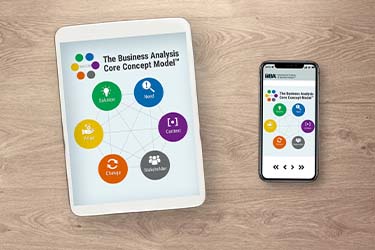
The Business Analysis Core Concept Model™ (BACCM™)
The Business Analysis Core Concept Model™ (BACCM™) is composed of six core concepts that provide a common language and guidance for effective business analysis.
Strategic Business Analysis – Insight
Learn how to perform business analysis at strategic level.
Download
Strategic Business Analysis in Planning Processes – Insight
Learn what to consider in strategic planning.
Download
Strategic Business Analysis Method and Tools – Insight
Learn about helpful tools in strategic analysis.
Download