
10. Techniques
10.29 Mind Mapping
BABOK® Guide
10.29.1 Purpose
Mind mapping is used to articulate and capture thoughts, ideas, and information.
10.29.2 Description
Mind mapping is a form of note taking that captures thoughts, ideas, and information in a non-linear diagram. Mind maps use images, words, colour, and connected relationships to apply structure and logic to thoughts, ideas, and information. A mind map has a central main idea supported by secondary ideas (or topics), followed by as many layers of ideas (or sub-topics) as necessary to fully capture and articulate the concept. Connections are made between ideas by branches that typically have a single keyword associated with them that explain the connection.
Mind maps can be developed individually or as a collaboration exercise. They can be created on paper or with the use of specialized software.
Business analysts use mind maps to:
- think through and generate ideas on complex concepts or problems,
- explore relationships between the various facets of a problem in a way that inspires creative and critical thinking, and
- present a consolidated view of complex concepts or problems.
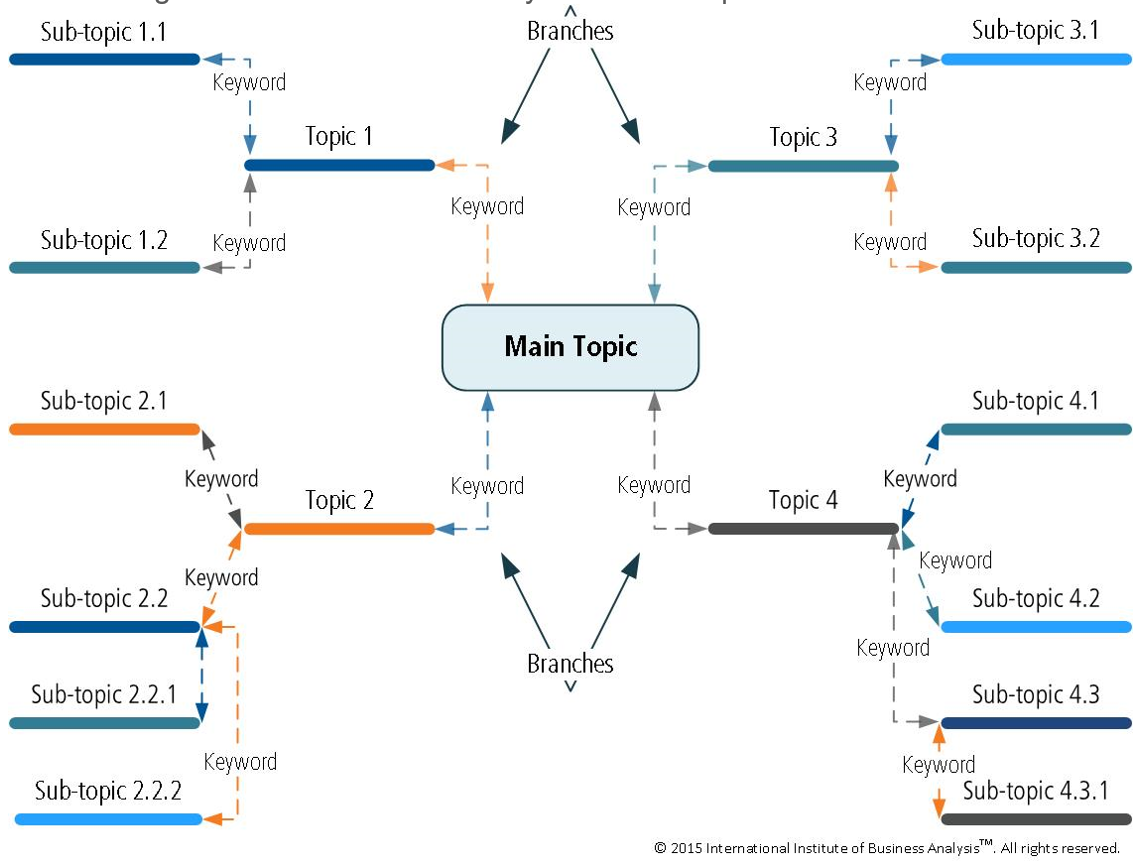
There is no standardized format for a mind map. The intent of a mind map is to capture information in a fashion closely resembling how our minds process information. The following image is intended to illustrate the general structure and usage of mind maps.
Figure 10.29.1: The Taxonomy of a Mind Map
10.29.3 Elements
.1 Main Topic
The main topic of a mind map is the thought or concept that is being articulated. The main topic is positioned in the centre of the images so that multiple topics and associations can branch off. Images are frequently used as the main topic because they contain a great deal of information and can be useful in stimulating associated topics.
.2 Topics
Topics are thoughts or concepts that expound upon or further articulate the main topic. Their association with the main topic is expressed through a branch (connected line) that has a keyword associated with it. There can be as many or as few topics as required to fully explore the thought or concept of the main topic.
.3 Sub-topics
Sub-topics are thoughts or concepts that expound upon or further articulate the topic and directly relate to the main topic. Their association with the topic is expressed through a branch (connected line) that has a keyword associated with it. There can be as many or as few sub-topics as required to fully explore the thought or concept of the main topic.
.4 Branches
Branches are the associations between the main topic, topics, and sub-topics. Branches include a keyword that clearly articulates the nature of the association.
.5 Keywords
Keywords are single words used to articulate the nature of the association of topics or sub-topics connected by a branch. The keywords are useful for both categorizing topics and for triggering additional associations.
.6 Colour
Colour may be used to categorize, prioritize, and analyze topics, sub-topics, and their associations. There is no defined colour coding standard for mind maps. Each mind map creator applies colour in a way that best suits their mode of thinking.
.7 Images
Images can be used in mind maps to express larger volumes of information that are unable to be expressed in short topic headings. Images are useful in stimulating creativity and innovation by generating additional thoughts, ideas, and associations.
10.29.4 Usage Considerations
.1 Strengths
- Can be used as an effective collaboration and communication tool.
- Summarizes complex thoughts, ideas, and information in a way that shows the overall structure.
- Associations and sub-topics facilitate understanding and decision making.
- Enable creative problem solving by articulating associations and generating new associations.
- Can be helpful in preparing and delivering presentations.
.2 Limitations
- Can be misused as a brainstorming tool, and the related documenting of ideas and creating associations may inhibit idea generation.
- A shared understanding of a mind map can be difficult to communicate.