4. Elicitation and Collaboration
BABOK® Guide
Introduction
The Elicitation and Collaboration knowledge area describes the tasks that business analysts perform to obtain information from stakeholders and confirm the results. It also describes the communication with stakeholders once the business analysis information is assembled.
Elicitation is the drawing forth or receiving of information from stakeholders or other sources. It is the main path to discovering requirements and design information, and might involve talking with stakeholders directly, researching topics, experimenting, or simply being handed information. Collaboration is the act of two or more people working together towards a common goal. The Elicitation and Collaboration knowledge area describes how business analysts identify and reach agreement on the mutual understanding of all types of business analysis information. Elicitation and collaboration work is never a 'phase' in business analysis; rather, it is ongoing as long as business analysis work is occurring.
Elicitation and collaboration can be planned, unplanned, or both. Planned activities such as workshops, experiments, and/or surveys can be structured and organized in advance. Unplanned activities happen in the moment without notice, such as last-minute or 'just in time' collaboration or conversations. Business analysis information derived from an unplanned activity may require deeper exploration through a planned activity.
Eliciting business analysis information is not an isolated activity. Information is elicited while performing any task that includes interaction with stakeholders and while the business analyst is performing independent analytical work. Elicitation may trigger additional elicitation for details to fill in gaps or increase understanding.
The Elicitation and Collaboration knowledge area is composed of the following tasks:
- Prepare for Elicitation: involves ensuring that the stakeholders have the information they need to provide and that they understand the nature of the activities they are going to perform. It also sets a shared set of expectations regarding the outcomes of the activity. Preparation may also involve identifying research sources or preparing to conduct an experiment to see if a process change actually results in an improvement.
- Conduct Elicitation: describes the work performed to understand stakeholder needs and identify potential solutions that may meet those needs. This may involve direct interaction with stakeholders, doing research, or running experiments.
- Confirm Elicitation Results: involves ensuring that stakeholders have a shared understanding of the outcomes of elicitation, that elicited information is recorded appropriately, and that the business analyst has the information sought from an elicitation activity. This task also involves comparing the information received with other information to look for inconsistencies or gaps.
- Communicate Business Analysis Information: provides stakeholders with the information they need, at the time they need it. The information is presented in a useful form, using the right terminology and concepts.
- Manage Stakeholder Collaboration: describes working with stakeholders to engage them in the overall business analysis process and to ensure that the business analyst can deliver the outcomes needed.
Figure 4.0.1: Elicitation and Collaboration Input/Output Diagram

The Core Concept Model in Elicitation and Collaboration
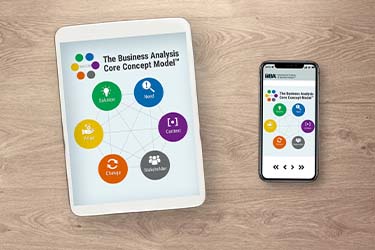
The Business Analysis Core Concept Model™ (BACCM™) describes the relationships among the six core concepts.
The following table describes the usage and application of each of the core concepts within the context of Elicitation and Collaboration.
Table 4.0.1: The Core Concept Model in Elicitation and Collaboration
|
Core Concept |
During Elicitation and Collaboration, business analysts... |
|
Change: the act of transformation in response to a need. |
use a variety of elicitation techniques to fully identify the characteristics of the change including concerns that stakeholders have about the change. The change itself may determine the appropriate types and extent of elicitation and collaboration. |
|
Need: a problem or opportunity to be addressed. |
elicit, confirm, and communicate needs and supporting business analysis information. As elicitation is iterative and incremental, the understanding of needs may evolve over time. |
|
Solution: a specific way of satisfying one or more needs in a context. |
elicit, confirm, and communicate necessary or desired characteristics of proposed solutions. |
|
Stakeholder: a group or individual with a relationship to the change, the need, or the solution. |
manage the collaboration with the stakeholders who participate in the business analysis work. All stakeholders may participate in different roles and at different times during a change. |
|
Value: the worth, importance, or usefulness of something to a stakeholder within a context. |
collaborate with stakeholders to assess the relative value of information provided through elicitation, and apply a variety of techniques to confirm and communicate that value. |
|
Context: the circumstances that influence, are influenced by, and provide understanding of the change. |
apply a variety of elicitation techniques to identify business analysis information about the context that may affect the change. |