7. Requirements Analysis and Design Definition
BABOK® Guide
Introduction
The Requirements Analysis and Design Definition knowledge area describes the tasks that business analysts perform to structure and organize requirements discovered during elicitation activities, specify and model requirements and designs, validate and verify information, identify solution options that meet business needs, and estimate the potential value that could be realized for each solution option. This knowledge area covers the incremental and iterative activities ranging from the initial concept and exploration of the need through the transformation of those needs into a particular recommended solution.
Both requirements and designs are important tools used by business analysts to define and guide change. The main difference between requirements and designs is in how they are used and by whom. One person's designs may be another person's requirements. Requirements and designs may be either high-level or very detailed based upon what is appropriate to those consuming the information.
The business analyst's role in modelling needs, requirements, designs, and solutions is instrumental in conducting thorough analysis and communicating with other stakeholders. The form, level of detail, and what is being modelled are all dependent on the context, audience, and purpose.
Business analysts analyze the potential value of both requirements and designs. In collaboration with implementation subject matter experts, business analysts define solution options that can be evaluated in order to recommend the best solution option that meets the need and brings the most value.
The following image illustrates the spectrum of value as business analysis activities progress from delivering potential value to actual value.
Figure 7.0.1: Business Analysis Value Spectrum
The Requirements Analysis and Design Definition knowledge area includes the following tasks:
- Specify and Model Requirements : describes a set of requirements or designs in detail using analytical techniques.
- Verify Requirements : ensures that a set of requirements or designs has been developed in enough detail to be usable by a particular stakeholder, is internally consistent, and is of high quality.
- Validate Requirements : ensures that a set of requirements or designs delivers business value and supports the organization's goals and objectives.
- Define Requirements Architecture : structures all requirements and designs so that they support the overall business purpose for a change and that they work effectively as a cohesive whole.
- Define Solution Options : identifies, explores and describes different possible ways of meeting the need.
- Analyze Potential Value and Recommend Solution : assesses the business value associated with a potential solution and compares different options, including trade-offs, to identify and recommend the solution option that delivers the greatest overall value.
The Core Concept Model in Requirements Analysis and Design Definition
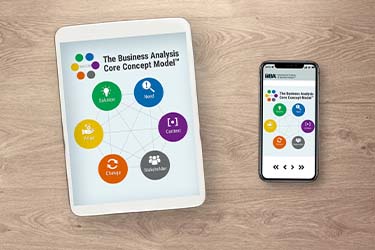
The Business Analysis Core Concept Model™ ( BACCM™ ) describes the relationships among the six core concepts. The following table describes the usage and application of each of the core concepts within the context of Requirements Analysis and Design Definition.
Table 7.0.1: The Core Concept Model in Requirements Analysis and Design Definition
|
Core Concept |
During Requirements Analysis and Design Definition, business analysts... |
|
Change: the act of transformation in response to a need. |
transform elicitation results into requirements and designs in order to define the change. |
|
Need: a problem or opportunity to be addressed. |
analyze the needs in order to recommend a solution that meets the needs. |
|
Solution: a specific way of satisfying one or more needs within a context. |
define solution options and recommend the one that is most likely to address the need and has the most value. |
|
Stakeholder: a group or individual with a relationship to the change, the need, or the solution. |
tailor the requirements and designs so that they are understandable and usable by each stakeholder group. |
|
Value: the worth, importance, or usefulness of something to a stakeholder within a context. |
analyze and quantify the potential value of the solution options. |
|
Context: the circumstances that influence, are influenced by, and provide understanding of the change. |
model and describe the context in formats that are understandable and usable by all stakeholders. |
Figure 7.0.2: Requirements Analysis and Design Definition Input/Output Diagram