
1. Introduction to Business Data Analytics
1.2 The Business Data Analytics Cycle
Guide to Business Data Analytics
The business data analytics cycle represents the research aspects of business analytics. It is an iterative cycle initiated through the development of a well-formed research question and then explored through targeted but thorough data analysis.
The cycle is based on the scientific method. The scientific method is a process for research that is used to explore observations and answer questions. The process starts by asking a question that scopes the research and is phrased as who, what, when, where, which, why, or how. Based on these questions, background information is collected and smaller scoped questions are formed. A question may take the following format:
If_______happens then will_______happen, or
Is_______different to_______, or
Does_______affect_______, etc.
The question is then tested using a method or procedure, and the results are analyzed to draw conclusions based on the smaller scoped question.
Business data analytics focuses on the data collection and data analysis part of the scientific method, while the processes before and after this are informed by business analysis. Business data analytics requires business analysis to ensure the data analysis is focused on identifying questions that are of importance to answer and that the data produces valuable insights for resolving important business situations (problem or opportunity).
The scientific method paired with the business data analytics cycle:
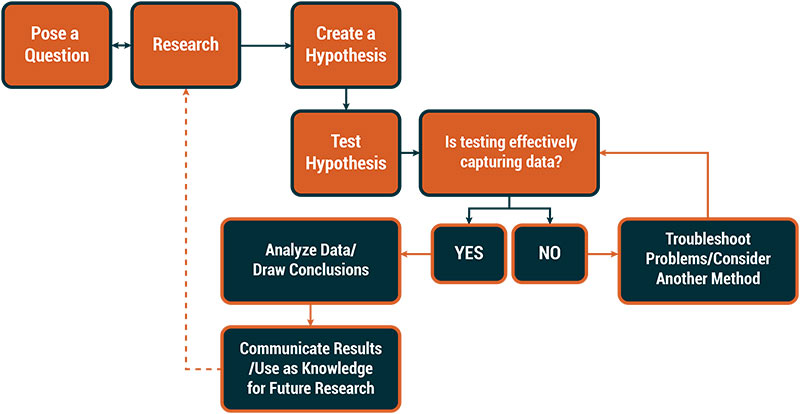
Taking an example where the organization is looking for a solution to address its employee turnover problem, the analytics cycle begins by posing a question such as “How can we improve our staff retention rates?”
After conducting initial research, it may be discovered that turnover is affected by several factors, resulting in the need to create several hypotheses, one of which might be “Does work overload affect turnover in our organization?” The organization may develop a survey to measure work overload and turnover and administer it to current and past employees. The results of the survey may be analyzed to understand any cause and effect relationships. It might be determined that work overload is high in parts of the organization that have or are experiencing a large amount of turnover. These results may lead the organization to put measures in place to re-balance work or decrease the workload of individual employees or roles.
Despite its similarities to the scientific method, the business data analytics process has some slight differences. For one, the business data analytics process may differ depending on the type of analysis taking place. Testing may not always include an experiment to collect data, as the data might simply be accessed from a server using existing data sources. In business data analytics, it is necessary to perform data validation and verification on the data collected. In the scientific method, data validation may not be required because the data collected as part of a scientific experiment is obtained in a controlled environment.
When the objective of the analytics effort is continuous improvement or some other metric of improvement over time, the business analytics cycle is on- going and iterative.
In the context of projects, with defined end points, the conclusions drawn from a project may be used to form new research questions, in turn, perpetuating another execution of the entire business data analytics cycle.
The cycle is based on the scientific method. The scientific method is a process for research that is used to explore observations and answer questions. The process starts by asking a question that scopes the research and is phrased as who, what, when, where, which, why, or how. Based on these questions, background information is collected and smaller scoped questions are formed. A question may take the following format:
If_______happens then will_______happen, or
Is_______different to_______, or
Does_______affect_______, etc.
The question is then tested using a method or procedure, and the results are analyzed to draw conclusions based on the smaller scoped question.
Business data analytics focuses on the data collection and data analysis part of the scientific method, while the processes before and after this are informed by business analysis. Business data analytics requires business analysis to ensure the data analysis is focused on identifying questions that are of importance to answer and that the data produces valuable insights for resolving important business situations (problem or opportunity).
The scientific method paired with the business data analytics cycle:
Taking an example where the organization is looking for a solution to address its employee turnover problem, the analytics cycle begins by posing a question such as “How can we improve our staff retention rates?”
After conducting initial research, it may be discovered that turnover is affected by several factors, resulting in the need to create several hypotheses, one of which might be “Does work overload affect turnover in our organization?” The organization may develop a survey to measure work overload and turnover and administer it to current and past employees. The results of the survey may be analyzed to understand any cause and effect relationships. It might be determined that work overload is high in parts of the organization that have or are experiencing a large amount of turnover. These results may lead the organization to put measures in place to re-balance work or decrease the workload of individual employees or roles.
Despite its similarities to the scientific method, the business data analytics process has some slight differences. For one, the business data analytics process may differ depending on the type of analysis taking place. Testing may not always include an experiment to collect data, as the data might simply be accessed from a server using existing data sources. In business data analytics, it is necessary to perform data validation and verification on the data collected. In the scientific method, data validation may not be required because the data collected as part of a scientific experiment is obtained in a controlled environment.
When the objective of the analytics effort is continuous improvement or some other metric of improvement over time, the business analytics cycle is on- going and iterative.
In the context of projects, with defined end points, the conclusions drawn from a project may be used to form new research questions, in turn, perpetuating another execution of the entire business data analytics cycle.