
2. Business Data Analytics Domains and Tasks
2.6 Guide Organizational-Level Strategy for Business Data Analytics
Guide to Business Data Analytics

The Guide Organizational-Level Strategy for Business Data Analytics domain builds on the first five domains that describe a business data analytics practitioner's work by elaborating on organizational elements that support their success.
Organizations obtain valuable insights from data and these insights support informed business decision-making. Organizations invest in analytics to deliver on their strategic imperatives to innovate and obtain competitive advantages in the marketplace. These investments drive the demand for more skilled professionals with business data analytics knowledge and experience.
The success of analytics engagements depends on the organizations disposition to analytics. Business data analytics provides the transformational capabilities for guiding organizations to be analytics-driven.
The Guide Organizational-Level Strategy for Business Data Analytics domain explores how organizations can embed analytics initiatives into the organizational architecture and overall decision-making framework. This domain describes about how organizations can be transformed and made more conducive to being data- and insights-powered.
Tasks in the Guide Organizational-Level Strategy for Business Data Analytics domain include:
- Organizational Strategy,
- Talent Strategy, and
- Data Strategy.
2.6.1 Organizational Strategy
Organizations aiming to integrate analytics to drive business decisions consider unique organizational models for the analytics team and how these organizational models can be situated within the organization in relation to other teams and business units. Many organizations start with analytics initiatives as proof of concepts or pilots for projects that have a limited impact on the strategic posture of the organization.
The following organizational models can help with a transformation from an analytics-aware organization to an analytics-driven organization.


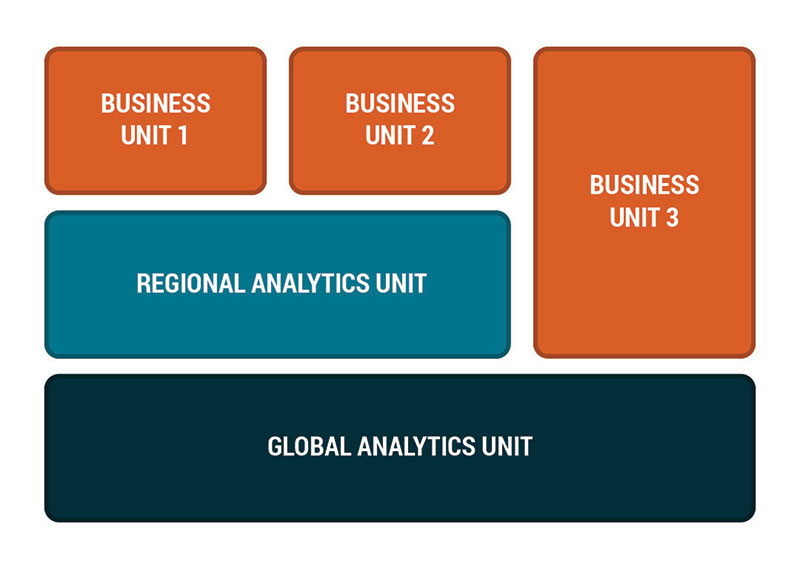
Another choice of determining an organizational model for analytics teams is to organize by different functions within the organization such as business intelligence units, IT, CIO's office, and so forth.
How the analytics teams is organized depends upon, but is not limited to:
When determining the right organizational model for analytics teams, multiple strategic business analysis skills are used to connect enterprise components with analytics. Systems thinking, conceptual thinking, and expertise in collaborating with cross-functional stakeholders, including executive leadership, all help define organizational models. Techniques such as business model canvas, balanced scorecard, benchmarking and market analysis, value chain analysis, SWOT, and CATWOE are relevant in connecting enterprise components for analytics transformation.
Organizations aiming to integrate analytics to drive business decisions consider unique organizational models for the analytics team and how these organizational models can be situated within the organization in relation to other teams and business units. Many organizations start with analytics initiatives as proof of concepts or pilots for projects that have a limited impact on the strategic posture of the organization.
The following organizational models can help with a transformation from an analytics-aware organization to an analytics-driven organization.
- Centralized model refers to the analytics team operating as a single unit supporting other business units in decision- making. An analytics Centre of Excellence is a good example of a centralized model where upskilling talent may be an advantage as it forms a cohesive team within the organizational structure.
- Decentralized model refers to the model where analytics teams are embedded in different business units. In a decentralized model, analytics teams may be more aligned to the business practices and processes of a business unit which may positively influence specialized analytics solutions within that business unit.
- Hybrid model refers to a mix of centralized and decentralized analytics teams operating within an organization. For example, a hub and spoke model can be considered with geographic separation for hubs and centralized structure within a specific geography to structure the analytics teams.
Another choice of determining an organizational model for analytics teams is to organize by different functions within the organization such as business intelligence units, IT, CIO's office, and so forth.
How the analytics teams is organized depends upon, but is not limited to:
- enterprise data ownership,
- governance within the organization,
- requirements around outsourcing the analytics,
- competition,
- overall industry outlook,
- supplier and vendor relationships, and
- involvement of senior leadership in analytics efforts.
When determining the right organizational model for analytics teams, multiple strategic business analysis skills are used to connect enterprise components with analytics. Systems thinking, conceptual thinking, and expertise in collaborating with cross-functional stakeholders, including executive leadership, all help define organizational models. Techniques such as business model canvas, balanced scorecard, benchmarking and market analysis, value chain analysis, SWOT, and CATWOE are relevant in connecting enterprise components for analytics transformation.
| A Sample Organization of Analytics Teams within a Large Organization Building an effective model for the analytics team depends on various organizational components such as business functions, leadership oversight, existing data architecture and sources, and types of business data. Many organizations start with a decentralized approach for analytics engagements with analytics embedded into different business units. With maturity in data governance, data best practices within an organization start to leverage analytics for strategic benefits. The organizational model may reflect maturity over time. For large scale enterprises, the analytics team takes either a hybrid or a centralized shape with multiple business units requesting parallel engagements from the analytics organization with standardized practice. An example of a Centre of Excellence for analytics may resemble a model such as this: 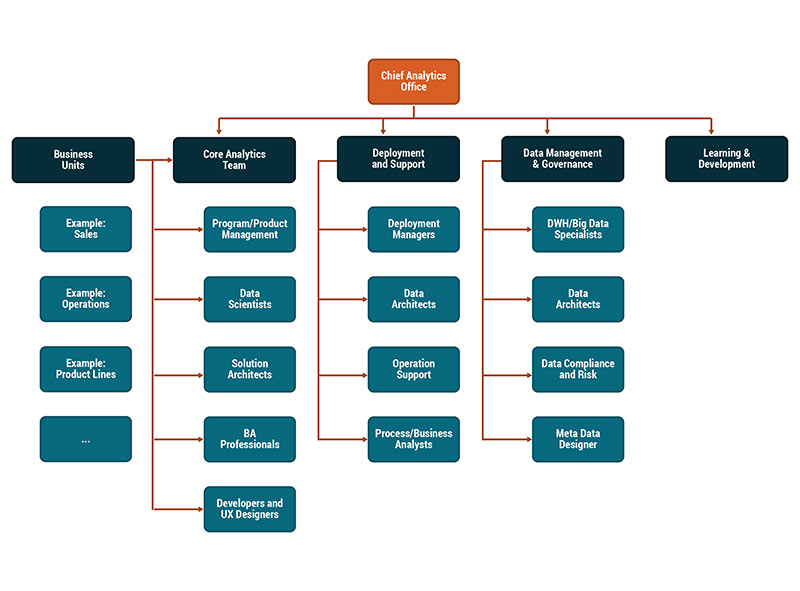 |
2.6.2 Talent Strategy
With the growing demand for analytics professionals, organizations create a strategy to attract and retain analytics professionals and related roles. Competitive compensation is one of the main driving factors in the industry. Several other factors also contribute to recruiting and retaining analytics professionals:
A productive partnership between those providing the business experience (business stakeholders, SMEs, business analysis professionals) and those with the technical skills (data engineers, data analysts, scientists) contribute to the success of any data-driven engagement. These roles work collaboratively to ensure the business context is properly translated to guide the analytics activities appropriately and to find the best ways to obtain value from available data.
For a large organization, the analytics team structure may consist of any or all of the following roles:
Each of these roles has overlapping and complementary skills. Based on the organization’s needs, and criteria such as the size of the initiative, the industry, budget, project plan, and organizational capabilities, multiple roles can be merged to create the right team structure. For example, a business analysis professional with sufficient analytics and business knowledge can play the roles of SME, data analyst, and data journalist, and support data architecture, data engineering, and experience design. The focus area for an organization-level strategy is primarily to determine the guidelines that govern the right team structure for the right initiative.
.2 Learning and Development for Talent Strategy
The complexity of analytics capabilities is changing at an extremely rapid pace, from data management technologies that are capable of handling large volume with high velocity and variety to analytics platforms and toolsets that include complex machine learning and deep learning architectures. Analytics objectives have evolved to be able to include predictive and prescriptive objectives with data science, machine learning, and artificial intelligence playing a increasing role.
To address this rapid transformation, organizations formulate strategies to continuously upgrade their talent in emerging analytics platforms and workbench, big data, and cloud technologies. Many such platforms and technologies are offered as open-source solutions or self-service models. For example, Microsoft’s Azure Machine Learning offers visual modelling for machine learning, which can be used by business professionals directly with a minimal amount of coding. Google's TensorFlow packages help build complex neural networks with a great deal of accuracy. Other utilities can be used to manage unstructured data and create data lakes that hold large amounts of raw data.
In addition to the technical competencies and analytics platforms knowledge, key attributes that ensure analytics success are strong business knowledge and the ability to understand the underlying statistical and mathematical concepts. Many of the analytics solutions in predictive and prescriptive spaces are dependent on the business problem that requires custom analytical models. Strong business and mathematical foundations are essential competencies for analytics solutions.
Communicating the findings in the right way, by developing data stories and visuals, is equally critical to ensure the business outcome. Even if the analytics initiative is producing quality results, if the results are not understood by the stakeholders the entire engagement could be at risk.
When formulating a learning and development strategy, organizations focus on business knowledge, technology and analytics platforms, and data communication and translation competency areas.
.3 Establishing Best Practices
Best practices in analytics engagements are established through the accumulation of experience, lessons learned, and current knowledge and advancements in industry trends. Knowledge about other industries also helps in establishing the best practices.
Establishing best practices in analytics involves identifying a standard set of tools and techniques that work well for the organization, for the types of problems being solved, and for the skill sets and capabilities available. Best practices that provide a set of standard procedures can be recommended to be adopted by organization-wide analytics teams. For example, in establishing best practices, an organization may develop policies to ensure sampling methods between different analytics projects are shared across teams.
Another best practice is maintaining subsets of analytics requirements for re- use or establishing a procedure for securing approval for data access. Whatever the practice is, the motivation for identifying, stating, and developing policies around best practices is to shape analytics in a way that fosters improved performance and moves the organization forward to obtain more value from the investments being made in these initiatives.
With the growing demand for analytics professionals, organizations create a strategy to attract and retain analytics professionals and related roles. Competitive compensation is one of the main driving factors in the industry. Several other factors also contribute to recruiting and retaining analytics professionals:
- opportunity to work on engaging and exciting initiatives,
- ability to work directly with key decision-makers,
- opportunity to learn the business,
- ability to solve complex business problems,
- access to relevant tools and technologies, and
- a culture that promotes trust and appreciation.
- establishing the right team structure for analytics initiatives,
- having an ability to create an eco-system for learning and development, and
- establishing best practices for analytics initiatives.
A productive partnership between those providing the business experience (business stakeholders, SMEs, business analysis professionals) and those with the technical skills (data engineers, data analysts, scientists) contribute to the success of any data-driven engagement. These roles work collaboratively to ensure the business context is properly translated to guide the analytics activities appropriately and to find the best ways to obtain value from available data.
For a large organization, the analytics team structure may consist of any or all of the following roles:
- Subject matter experts (SMEs): provide specific knowledge of the business sector or specified business domain (for example, finance and human resources).
- Data/solution architect: designs and develops data systems to capture and store data. Generally, does not program systems as that is the role of the data engineer.
- Data engineer: develops and maintains data systems.
- Data scientist: applies advanced technical skills to create and evaluate analytics models to obtain insights from data.
- Data analyst: interprets and analyzes data; may work under the direction of the data scientist.
- Experience designer: develops customized experience prototypes and visual enhancements for different levels of stakeholders that aids in communication and comprehension of analytics results.
- Data journalist: turns results into data stories that can be communicated to different levels of stakeholders within the organization.
- Business analysis professional: establishes the scope for the analytics work and utilizes results to support business decision-making and implementation of the resulting decisions.
Each of these roles has overlapping and complementary skills. Based on the organization’s needs, and criteria such as the size of the initiative, the industry, budget, project plan, and organizational capabilities, multiple roles can be merged to create the right team structure. For example, a business analysis professional with sufficient analytics and business knowledge can play the roles of SME, data analyst, and data journalist, and support data architecture, data engineering, and experience design. The focus area for an organization-level strategy is primarily to determine the guidelines that govern the right team structure for the right initiative.
.2 Learning and Development for Talent Strategy
The complexity of analytics capabilities is changing at an extremely rapid pace, from data management technologies that are capable of handling large volume with high velocity and variety to analytics platforms and toolsets that include complex machine learning and deep learning architectures. Analytics objectives have evolved to be able to include predictive and prescriptive objectives with data science, machine learning, and artificial intelligence playing a increasing role.
To address this rapid transformation, organizations formulate strategies to continuously upgrade their talent in emerging analytics platforms and workbench, big data, and cloud technologies. Many such platforms and technologies are offered as open-source solutions or self-service models. For example, Microsoft’s Azure Machine Learning offers visual modelling for machine learning, which can be used by business professionals directly with a minimal amount of coding. Google's TensorFlow packages help build complex neural networks with a great deal of accuracy. Other utilities can be used to manage unstructured data and create data lakes that hold large amounts of raw data.
In addition to the technical competencies and analytics platforms knowledge, key attributes that ensure analytics success are strong business knowledge and the ability to understand the underlying statistical and mathematical concepts. Many of the analytics solutions in predictive and prescriptive spaces are dependent on the business problem that requires custom analytical models. Strong business and mathematical foundations are essential competencies for analytics solutions.
Communicating the findings in the right way, by developing data stories and visuals, is equally critical to ensure the business outcome. Even if the analytics initiative is producing quality results, if the results are not understood by the stakeholders the entire engagement could be at risk.
When formulating a learning and development strategy, organizations focus on business knowledge, technology and analytics platforms, and data communication and translation competency areas.
.3 Establishing Best Practices
Best practices in analytics engagements are established through the accumulation of experience, lessons learned, and current knowledge and advancements in industry trends. Knowledge about other industries also helps in establishing the best practices.
Establishing best practices in analytics involves identifying a standard set of tools and techniques that work well for the organization, for the types of problems being solved, and for the skill sets and capabilities available. Best practices that provide a set of standard procedures can be recommended to be adopted by organization-wide analytics teams. For example, in establishing best practices, an organization may develop policies to ensure sampling methods between different analytics projects are shared across teams.
Another best practice is maintaining subsets of analytics requirements for re- use or establishing a procedure for securing approval for data access. Whatever the practice is, the motivation for identifying, stating, and developing policies around best practices is to shape analytics in a way that fosters improved performance and moves the organization forward to obtain more value from the investments being made in these initiatives.
2.6.3 Data Strategy
Organization-level strategy guides comprehensive analytics engagements managing data residing within and outside the organization. Simply consolidating organizational data for a single analytics initiative may be sufficient for organizations that are interested in achieving ad hoc results. Unplanned analytics initiatives with a weak data strategy can only provide limited business value.
Organizations with large scale analytics engagements consider how data is acquired, stored, and used in a planned way. Multiple components influence the data strategy, including end-to-end enterprise data architecture, storage capabilities, data privacy, and data governance policies driving data life cycle within the organization. As more and more data sources start residing outside the control of the analytics team within the organization, policies directing the data integrity, consistency, relevancy, and other quality parameters are established.
Similarly, data gateways from devices such as the internet of things (IoT), sensors, business applications, and business processes are established for data storage in cloud environments. When the volume and velocity of data acquisitions increase, as in the case of streaming data, or the number of analytics initiatives increase within the organization, keeping track of an organization’s data and data requests becomes a complex activity. In the absence of a single source of truth, a just in time approach, or a self-service strategy can be employed to cater to data needs within the organization.
An organization-level data strategy may include the following planning considerations:
Organization-level strategy guides comprehensive analytics engagements managing data residing within and outside the organization. Simply consolidating organizational data for a single analytics initiative may be sufficient for organizations that are interested in achieving ad hoc results. Unplanned analytics initiatives with a weak data strategy can only provide limited business value.
Organizations with large scale analytics engagements consider how data is acquired, stored, and used in a planned way. Multiple components influence the data strategy, including end-to-end enterprise data architecture, storage capabilities, data privacy, and data governance policies driving data life cycle within the organization. As more and more data sources start residing outside the control of the analytics team within the organization, policies directing the data integrity, consistency, relevancy, and other quality parameters are established.
Similarly, data gateways from devices such as the internet of things (IoT), sensors, business applications, and business processes are established for data storage in cloud environments. When the volume and velocity of data acquisitions increase, as in the case of streaming data, or the number of analytics initiatives increase within the organization, keeping track of an organization’s data and data requests becomes a complex activity. In the absence of a single source of truth, a just in time approach, or a self-service strategy can be employed to cater to data needs within the organization.
An organization-level data strategy may include the following planning considerations:
- Data governance: the rules and policies that manage the data assets of an organization to ensure high-quality data.
- Data architecture: the models and standards that govern how data is collected, stored, and integrated across an organization.
- Data security: the activities performed to protect data from a privacy and confidentiality perspective.
- Metadata management: the administration of information that is maintained about the data assets an organization collects and manages.
2.6.4 Select Techniques for Guide Organizational-Level Strategy for Business Data Analytics
The following is a selection of some commonly used analysis and analytics techniques applicable to the Organizational-Level Strategy for Business Data Analytics domain. The following list of techniques does not represent a comprehensive set of techniques used by an analyst in the Organizational-Level Strategy for Business Data Analytics domain but presents a small, but useful, set of techniques that can be used.
The following is a selection of some commonly used analysis and analytics techniques applicable to the Organizational-Level Strategy for Business Data Analytics domain. The following list of techniques does not represent a comprehensive set of techniques used by an analyst in the Organizational-Level Strategy for Business Data Analytics domain but presents a small, but useful, set of techniques that can be used.
| Techniques | Usage Context for Business Data Analytics | BABOK® Guide v3.0 Reference |
| Balanced Scorecard | Used to describe a balanced view of the organization from different perspectives. It is useful for aligning the data strategy to business objectives and outcomes. | Chapter 10.3 |
| Benchmarking and Market Analysis | Used to identify problems and opportunities in the current state and plan for the future state to align the organizational- level strategy. Often used with with different frameworks such as Five Forces, STEEP, and CATWOE. | Chapter 10.4 |
| Five Forces | Used to analyze the market forces that determine the effectiveness of analytics strategies. For example, it can be useful to evaluate new entrants that are heavily utilizing analytics in a particular industry. | Chapter 10.4 (Benchmarking and Market Analysis) |
| Business Capability Analysis | Used to create a hierarchical catalogue of capabilities the organizaion possesses and determine the role of analytics where it can enhance or restrict any business capabilities. For example, adding analytics for sales and marketing can enhance the ability of the teams to effectively target and communicate enterprise value propositions to the customers. | Chapter 10.6 |
| Business Model Canvas | Used to understand how the organization creates value propositions and how analytics is currently leveraged. It is useful in identifying areas where analytics can be a competitive advantage in delivering business outcomes. | Chapter 10.8 |
| Collaborative Games | Use to encourage stakeholders in an analytics strategy formulation activity to collaborate in building a joint understanding of the strategy. | Chapter 10.10 |
| Metrics and Key Performance Indicators (KPIs) | Used to understand how analytics can influence the metrics and KPIs of an enterprise as well as the KPIs for analytics strategy once implemented. | Chapter 10.28 |
| Organizational Modeling | Used to understand and identify gaps in the current organizational models to design the organization strategy for analytics. | Chapter 10.32 |
| Risk Analysis and Management | Used to identify and mitigate uncertainties in the analytics startegy for the enterprise. For example, it can be used to determine an alternate course of action when analytics engagements fail. | Chapter 10.38 |
| SWOT Analysis | Used to understand the enterprise's strengths, weaknesses, opportunities, and threats. It is useful for explaining the internal and external context of an organization. For example, it can be used to assess how analytics can be used to mitigate the challenges or generate opportunities for the organization. | Chapter 10.46 |
| Value Chain Analysis | Used to discover how value is added through key activities within the organization to deliver products and services to the customers. It is useful to outline the key business units where analytics can enhance the value of the offerings. | Chapter 10.6 |
2.6.5 Underlying Competencies for Guide Organizational-Level Strategy for Business Data Analytics
It is important to build a supportive organizational environment to drive the full value of business data analytics initiatives. This includes building relevant capabilities and leveraging best practices for data management at an organizational level. Business data analytics practitioners can help ensure appropriate discussions take place and effective practices are adopted. To achieve this, they will rely heavily on the following key underlying competencies.
It is important to build a supportive organizational environment to drive the full value of business data analytics initiatives. This includes building relevant capabilities and leveraging best practices for data management at an organizational level. Business data analytics practitioners can help ensure appropriate discussions take place and effective practices are adopted. To achieve this, they will rely heavily on the following key underlying competencies.
| Underlying Competencies | Usage Context for Organizational Strategy for Analytics | BABOK® Guide v3.0 Reference |
Analytical Thinking and Problem Solving:
|
While creating and implementing an organizational level strategy for analytics, a business analysis professional can use these underlying competencies to:
|
|
Business Knowledge:
|
While creating and implementing an organizational-level strategy for analytics, a business analysis professional can use these underlying competencies to:
|
|
| Communication Skills | While creating and implementing an organizational-level strategy for analytics, a business analysis professional can use these underlying competencies to:
|
|
| Interaction Skills | While creating and implementing an organizational-level strategy for analytics, a business analysis professional can use these underlying competencies to:
|
2.6.6 A Case Study for Guide Organization-Level Strategy for Business Data Analytics
Singapore has one of the oldest and most well-developed retirement programs in Asia, consisting of defined contribution plans in individual accounts. Mai Tan works as one of several product owners at Retire Inc., a young company that recently launched a new product, RetireSafe for the citizens of Singapore. RetireSafe allows qualified individuals to determine how prepared they are for retirement. RetireSafe verifies citizenship based on tax identification data and demographic details, allowing it to interact with government databases for publicly available data. It also allows individuals to enter employment details, current net worth, financial assets, health status, post retirement plans, and desired future income streams.
With this information identified, the product generates assessments and scenarios depicting what kind of retirement the individual can expect through an interactive, intuitive dashboard. Sensitivity analysis features are incorporated to allow individuals to modify parameters and see the impact of those changes. In this way, the product provides information to help citizens better understand and maximize the expected results for their individual accounts.
.1 An Overwhelming Success
RetireSafe was developed by Mai's team and has been available for approximately twelve months. It is both the company's largest investment in product development and is on track to becomes its highest generating product. RetireSafe has been warmly embraced by Singaporean citizens who have flooded the company with requests for new features and additional functionality. The product team adds each request to a product backlog where it is prioritized for upcoming releases. Mai uses several metrics to track performance and adoption of various product features. She also uses this information to decide which features to remove to reduce ongoing maintenance costs. Afterall, as a young organization, it's a constant challenge to ensure positive returns that can be used to fund building additional features.
To add greater depth in understanding adoption and customer satisfaction, Mai decided to track product usage and satisfaction indicators through a net promoter score (NPS) as a single high-level metric. She used several drill-down metrics, detailed information tracking feature usage, and time individuals spent constructing various types of scenarios to provide more clarity. This type of data helped the team assess and prioritize requested new features.
The product team has built and rolled out a steady stream of new features but is overwhelmed by requests. What was originally envisioned as an annual product release cycle has become a quarterly release from a team that has doubled in size since the initial launch of this product. Their work has become increasingly more difficult in the last few weeks as other Retire Inc. departments have requested access to the information being collected through this product. Other teams want to use this data to build a repository of prospects, cross sell existing financial products, and design new or enhanced products. As busy as the product team is, Mai realizes her work is no longer just about rolling out new enhancements to a popular product.
.2 The Challenge
To continue its growth and success, Retire Inc. needs to holistically view how data is managed and governed on behalf of all interested stakeholders. Requests for data tracked by Mai's product team has identified issues that need to be resolved at an organization level. These include:
Mai relied on several business analysis techniques to build her understanding of what needs to be done, including: benchmarking, business capability analysis, organizational modelling, and SWOT analysis. Through her benchmarking analysis and discussions with other organizations that have greater data maturity, she learned about the importance of data architecture and data governance. It also helped her develop a clear picture of what future practices could look like. Using organizational modelling techniques, Mai developed a good understanding of where changes could be made in Retire Inc.'s current data practices and she recognized the shortfall in skills that are currently missing - those that are needed to effectively evolve data analytic practices. She also started to have appreciation for what the desired changes would cost and wondered how she could possibly secure the required budget to propose a centralized data analytics function. Mai's business capability analysis helped her identify areas of opportunities and components that could be leveraged as Retire Inc. continues this journey. She discovered that all the existing data expertise within Retire Inc. lies within her product team. Her SWOT analysis helped strengthen her analysis and provided vital information to include in her assessment.
This assessment also solidified the important responsibility that Retire Inc. had to protect customer data. Mai realized that RetireSafe data included personally identifiable and sensitive information such as age, income and net worth which needed to be securely managed within internal departments. Formulating internal guidelines for use of this information, anonymizing it while still providing value, meeting General Data Protection Regulation (GDPR) regulations, and meeting other government or financial regulations would require time and expertise.
Throughout this analysis, Mai used her knowledge of key stakeholders to share her findings, determine what Retire Inc. leaders really wanted, and identified potential sources of funding to support the future implementation of data analytics expertise. Although not an exhaustive list, Mai was able to summarize the pros and cons for her two basic options as follows:
.4 Recommendation
Based on her analysis, Mai realized it wasn't a binary option. She recommended establishing data standards within the RetireSafe team, specifically around data sharing and light-weight data governance practices. As the organization gained better understanding of their data needs, Mai recommended they transition to a centralized analytics function sourcing some members from the RetireSafe team and augmenting them with key personal to account for deficiencies in key skillsets. In the meantime, she recommended carefully adding data experts to the RetireSafe team through short term contracts to help mature data architecture practices.
.5 Rationale
Both centralizing and decentralizing in themselves would be helpful but the advantages or disadvantages are finely balanced. There were not enough benefits for either option to merit one over the other. Other criteria proved to be instrumental in Mai's recommendation. Particularly the need to mature data management practices, align with budget considerations and the ability to move fast.
Retire Inc. is a new company with an "in demand" product that is demanding additional organizational funding to keep up with the backlog of customer requested enhancements. Based on conversations with Retire Inc. leaders, Mai realized it would be difficult to secure the funding required to build an effective centralized function at this time. Additionally, the time to hire new staff, effectively onboard them, and then start to standardize data management practices would take too long before the centralized analytics function would be able to provide data to other departments.
Mai felt decentralizing the analytics function with the current lack of data maturity was risky and could result in poor use of data, corrupted data, data silos being created throughout Retire Inc, or proliferation of unsecured sensitive data. This could lead to poor decisions, stalled progress, or worse yet, irresponsible use of customer data. She assessed the risk to be high and it would set back the organization for many years - she could not recommend a fully decentralized structure.
The final deciding point for the recommendation was the fact that although the RetireSafe backlog was long, it would reduce significantly over time. She estimated that the current team was sufficient to manage this workload and reasoned that over time, there would be less and less requests for additional enhancements.
.6 Key Takeaways
Singapore has one of the oldest and most well-developed retirement programs in Asia, consisting of defined contribution plans in individual accounts. Mai Tan works as one of several product owners at Retire Inc., a young company that recently launched a new product, RetireSafe for the citizens of Singapore. RetireSafe allows qualified individuals to determine how prepared they are for retirement. RetireSafe verifies citizenship based on tax identification data and demographic details, allowing it to interact with government databases for publicly available data. It also allows individuals to enter employment details, current net worth, financial assets, health status, post retirement plans, and desired future income streams.
With this information identified, the product generates assessments and scenarios depicting what kind of retirement the individual can expect through an interactive, intuitive dashboard. Sensitivity analysis features are incorporated to allow individuals to modify parameters and see the impact of those changes. In this way, the product provides information to help citizens better understand and maximize the expected results for their individual accounts.
.1 An Overwhelming Success
RetireSafe was developed by Mai's team and has been available for approximately twelve months. It is both the company's largest investment in product development and is on track to becomes its highest generating product. RetireSafe has been warmly embraced by Singaporean citizens who have flooded the company with requests for new features and additional functionality. The product team adds each request to a product backlog where it is prioritized for upcoming releases. Mai uses several metrics to track performance and adoption of various product features. She also uses this information to decide which features to remove to reduce ongoing maintenance costs. Afterall, as a young organization, it's a constant challenge to ensure positive returns that can be used to fund building additional features.
To add greater depth in understanding adoption and customer satisfaction, Mai decided to track product usage and satisfaction indicators through a net promoter score (NPS) as a single high-level metric. She used several drill-down metrics, detailed information tracking feature usage, and time individuals spent constructing various types of scenarios to provide more clarity. This type of data helped the team assess and prioritize requested new features.
The product team has built and rolled out a steady stream of new features but is overwhelmed by requests. What was originally envisioned as an annual product release cycle has become a quarterly release from a team that has doubled in size since the initial launch of this product. Their work has become increasingly more difficult in the last few weeks as other Retire Inc. departments have requested access to the information being collected through this product. Other teams want to use this data to build a repository of prospects, cross sell existing financial products, and design new or enhanced products. As busy as the product team is, Mai realizes her work is no longer just about rolling out new enhancements to a popular product.
.2 The Challenge
To continue its growth and success, Retire Inc. needs to holistically view how data is managed and governed on behalf of all interested stakeholders. Requests for data tracked by Mai's product team has identified issues that need to be resolved at an organization level. These include:
- Who decides which departments can have access to the data?
- How much data can be shared?
- What data should be restricted?
- How will data be secured as its shared?
- What other standards or policies need to be in place for data usage?
- Who in the organization enforces these data management procedures?
- How will Retire Inc. avoid inconsistent data silos cropping up?
- advocate for a single focused analytics team (centralized function), or
- recommend analytics expertise be developed throughout Retire Inc. (decentralized function).
Mai relied on several business analysis techniques to build her understanding of what needs to be done, including: benchmarking, business capability analysis, organizational modelling, and SWOT analysis. Through her benchmarking analysis and discussions with other organizations that have greater data maturity, she learned about the importance of data architecture and data governance. It also helped her develop a clear picture of what future practices could look like. Using organizational modelling techniques, Mai developed a good understanding of where changes could be made in Retire Inc.'s current data practices and she recognized the shortfall in skills that are currently missing - those that are needed to effectively evolve data analytic practices. She also started to have appreciation for what the desired changes would cost and wondered how she could possibly secure the required budget to propose a centralized data analytics function. Mai's business capability analysis helped her identify areas of opportunities and components that could be leveraged as Retire Inc. continues this journey. She discovered that all the existing data expertise within Retire Inc. lies within her product team. Her SWOT analysis helped strengthen her analysis and provided vital information to include in her assessment.
This assessment also solidified the important responsibility that Retire Inc. had to protect customer data. Mai realized that RetireSafe data included personally identifiable and sensitive information such as age, income and net worth which needed to be securely managed within internal departments. Formulating internal guidelines for use of this information, anonymizing it while still providing value, meeting General Data Protection Regulation (GDPR) regulations, and meeting other government or financial regulations would require time and expertise.
Throughout this analysis, Mai used her knowledge of key stakeholders to share her findings, determine what Retire Inc. leaders really wanted, and identified potential sources of funding to support the future implementation of data analytics expertise. Although not an exhaustive list, Mai was able to summarize the pros and cons for her two basic options as follows:
| Solution Options | Pros | Cons |
| Single focused analytics team (centralized) |
|
|
| Analytics expertise throughout Retire Inc. (decentralized) |
|
|
.4 Recommendation
Based on her analysis, Mai realized it wasn't a binary option. She recommended establishing data standards within the RetireSafe team, specifically around data sharing and light-weight data governance practices. As the organization gained better understanding of their data needs, Mai recommended they transition to a centralized analytics function sourcing some members from the RetireSafe team and augmenting them with key personal to account for deficiencies in key skillsets. In the meantime, she recommended carefully adding data experts to the RetireSafe team through short term contracts to help mature data architecture practices.
.5 Rationale
Both centralizing and decentralizing in themselves would be helpful but the advantages or disadvantages are finely balanced. There were not enough benefits for either option to merit one over the other. Other criteria proved to be instrumental in Mai's recommendation. Particularly the need to mature data management practices, align with budget considerations and the ability to move fast.
Retire Inc. is a new company with an "in demand" product that is demanding additional organizational funding to keep up with the backlog of customer requested enhancements. Based on conversations with Retire Inc. leaders, Mai realized it would be difficult to secure the funding required to build an effective centralized function at this time. Additionally, the time to hire new staff, effectively onboard them, and then start to standardize data management practices would take too long before the centralized analytics function would be able to provide data to other departments.
Mai felt decentralizing the analytics function with the current lack of data maturity was risky and could result in poor use of data, corrupted data, data silos being created throughout Retire Inc, or proliferation of unsecured sensitive data. This could lead to poor decisions, stalled progress, or worse yet, irresponsible use of customer data. She assessed the risk to be high and it would set back the organization for many years - she could not recommend a fully decentralized structure.
The final deciding point for the recommendation was the fact that although the RetireSafe backlog was long, it would reduce significantly over time. She estimated that the current team was sufficient to manage this workload and reasoned that over time, there would be less and less requests for additional enhancements.
.6 Key Takeaways
- It often takes one successful analytics driven project to open the floodgates for data requests. Organizations often transition between centralized, decentralized, and hybrid models as needs dictate and data maturity evolves.
- Recommendations do not have to be an "either-or" decision. In this case, a hybrid recommendation of initially allowing the RetireSafe product team to make foundational data management decisions could prove to be the most cost-effective way to build organizational-level data management strategies. Transitioning to a centralized data management function in the future would then allow much broader use of data in a disciplined, organized, and secure way throughout Retire Inc.
- Decisions often go far beyond the "pros and cons" analysis as many other factors come into play.
- How best to structure the business data analytics function at an organizational level can be a complex challenge and context is everything.
- Important considerations including analytics maturity, existing workload, available budget, and political considerations help drive decisions to centralize, decentralize or a hybrid approach to building organizational level data capability.