
3. Techniques
3.19 The Big Idea
Guide to Business Data Analytics
3.19.1 Purpose
The “big idea” is a concept that helps analysts communicate an important foundational or central insight to stakeholders. By removing extraneous information, the stakeholders better understand the essence of the key insight.
Effectively communicating the big idea increases the chance of influencing key stakeholders to take a recommended course of action.
The “big idea” is a concept that helps analysts communicate an important foundational or central insight to stakeholders. By removing extraneous information, the stakeholders better understand the essence of the key insight.
Effectively communicating the big idea increases the chance of influencing key stakeholders to take a recommended course of action.
3.19.2 Description
The big idea is used to convey an insight, story, or concept in a way that gains attention from stakeholders. The big idea distills an interpretation of an insight or answer to a question into one single, powerful statement of fact that compels key stakeholders to make a decision.
There are three integral parts to a big idea:
Using a structured approach helps refine the big idea. The following template is one example:
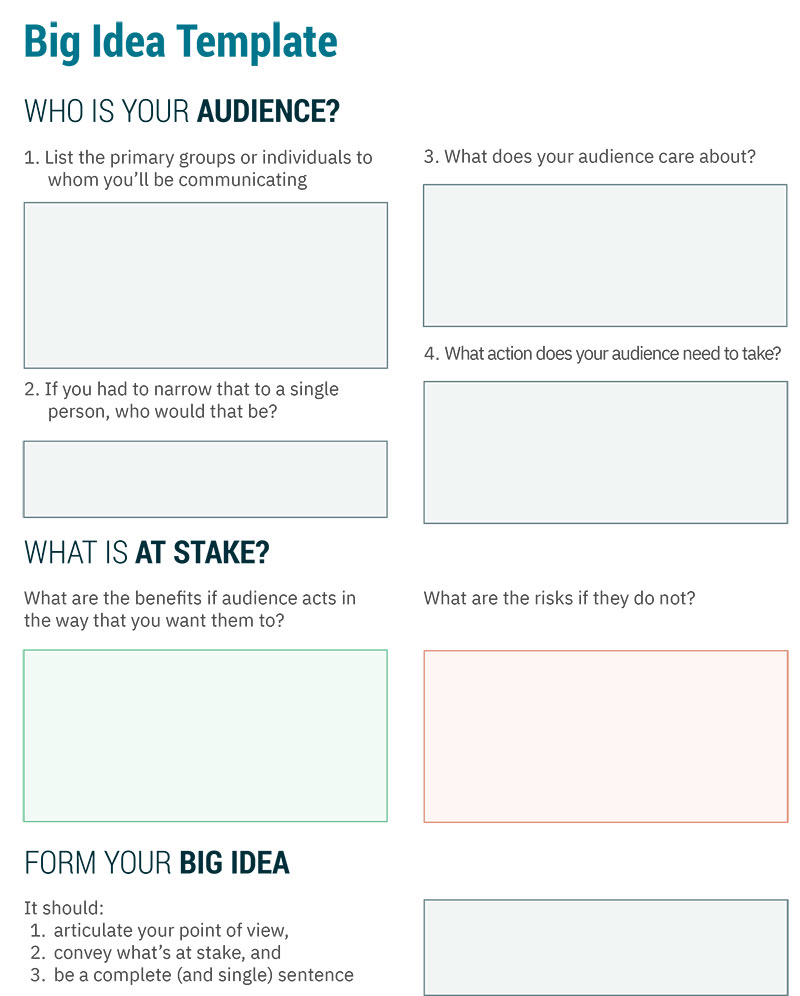
The big idea is used to convey an insight, story, or concept in a way that gains attention from stakeholders. The big idea distills an interpretation of an insight or answer to a question into one single, powerful statement of fact that compels key stakeholders to make a decision.
There are three integral parts to a big idea:
- Understanding the audience: Who are the key stakeholders? Who are the decision-makers? Who are the influencers? What are their biases? What is the action been recommended?
- Understanding the impact on key stakeholders: Why should certain stakeholders agree to a specific business decision? What would happen if the recommended action is not followed?
- Communicating the big idea: Communicate a data-driven recommendation that satisfies the business need. Simply stated as a concise statement about what needs to be done and what maybe lost if the recommended is not followed.
Using a structured approach helps refine the big idea. The following template is one example:
3.19.3 Elements
.1 Audience Details (Who is your audience?)
The details of the audience include who is impacted by the analytics outcome or the insight that analysts want to communicate to a specific audience.
Analysts carefully assess if there are stakeholder biases that could impact the recommended action or if there could be conflicts created by the recommendation. Analysts consider what level of influence or impact key stakeholders could have on the recommendation or insight being communicated. Reviewing the stakeholder analysis that was completed during the analytics initiative is a critical component to helping formulate the big idea.
.2 Impact of Change (What is at stake?)
The impact of rejecting the recommended course of action is addressed through the big idea. Negative impact can be widespread and may include impacts to existing processes, future finances, brand value, and even the business model. The impact is explained in a way to that the audience can relate. For example, executive decision-makers may not want to get into system level changes or impact, but will be very interested in the business outcome. The potential impact also includes a discussion of opportunity costs and risks.
.3 The Big Idea Outline
The big idea articulates the primary insight discovered from the analytics effort. The business decision, course of action, or the insight explained through the big idea may be accompanied by an explanation of success. For example, “Tracking success of our marketing campaign” is not the big idea, but “10% increased investment in digital marketing would result in a 40% increase in revenue by end of the next quarter” is. The big idea is fully formed and described in a way that compels action from decision-makers.
.1 Audience Details (Who is your audience?)
The details of the audience include who is impacted by the analytics outcome or the insight that analysts want to communicate to a specific audience.
Analysts carefully assess if there are stakeholder biases that could impact the recommended action or if there could be conflicts created by the recommendation. Analysts consider what level of influence or impact key stakeholders could have on the recommendation or insight being communicated. Reviewing the stakeholder analysis that was completed during the analytics initiative is a critical component to helping formulate the big idea.
.2 Impact of Change (What is at stake?)
The impact of rejecting the recommended course of action is addressed through the big idea. Negative impact can be widespread and may include impacts to existing processes, future finances, brand value, and even the business model. The impact is explained in a way to that the audience can relate. For example, executive decision-makers may not want to get into system level changes or impact, but will be very interested in the business outcome. The potential impact also includes a discussion of opportunity costs and risks.
.3 The Big Idea Outline
The big idea articulates the primary insight discovered from the analytics effort. The business decision, course of action, or the insight explained through the big idea may be accompanied by an explanation of success. For example, “Tracking success of our marketing campaign” is not the big idea, but “10% increased investment in digital marketing would result in a 40% increase in revenue by end of the next quarter” is. The big idea is fully formed and described in a way that compels action from decision-makers.
3.19.4 Usage Considerations
.1 Strengths
.1 Strengths
- Provides a direct and declarative statement involving a business decision.
- Reduces ambiguity in interpretation of insights among stakeholders.
- Can be used as a concluding summary for a 3-minute story, a data journey, a business visualization, or an analytics solution demonstration to underline the expected outcome.
- The big idea may not be useful if there is a lack of evidence or presence of bias from stakeholders.
- Without proper stakeholder analysis the big idea may lead to conflict.
- Multi-level insights are difficult to communicate through the big idea.