
Skip to content
Browse
BABOK Guide
BABOK Guide
10. Techniques
Introduction 10.1 Acceptance and Evaluation Criteria 10.2 Backlog Management 10.3 Balanced Scorecard 10.4 Benchmarking and Market Analysis 10.5 Brainstorming 10.6 Business Capability Analysis 10.7 Business Cases 10.8 Business Model Canvas 10.9 Business Rules Analysis 10.10 Collaborative Games 10.11 Concept Modelling 10.12 Data Dictionary 10.13 Data Flow Diagrams 10.14 Data Mining 10.15 Data Modelling 10.16 Decision Analysis 10.17 Decision Modelling 10.18 Document Analysis 10.19 Estimation 10.20 Financial Analysis 10.21 Focus Groups 10.22 Functional Decomposition 10.23 Glossary 10.24 Interface Analysis 10.25 Interviews 10.26 Item Tracking 10.27 Lessons Learned 10.28 Metrics and Key Performance Indicators (KPIs) 10.29 Mind Mapping 10.30 Non-Functional Requirements Analysis 10.31 Observation 10.32 Organizational Modelling 10.33 Prioritization 10.34 Process Analysis 10.35 Process Modelling 10.36 Prototyping 10.37 Reviews 10.38 Risk Analysis and Management 10.39 Roles and Permissions Matrix 10.40 Root Cause Analysis 10.41 Scope Modelling 10.42 Sequence Diagrams 10.43 Stakeholder List, Map, or Personas 10.44 State Modelling 10.45 Survey or Questionnaire 10.46 SWOT Analysis 10.47 Use Cases and Scenarios 10.48 User Stories 10.49 Vendor Assessment 10.50 Workshops

4. Agile Product Management

4.2 Product Lifecycle

Guide to Product Ownership Analysis

POA is applied throughout the product lifecycle.
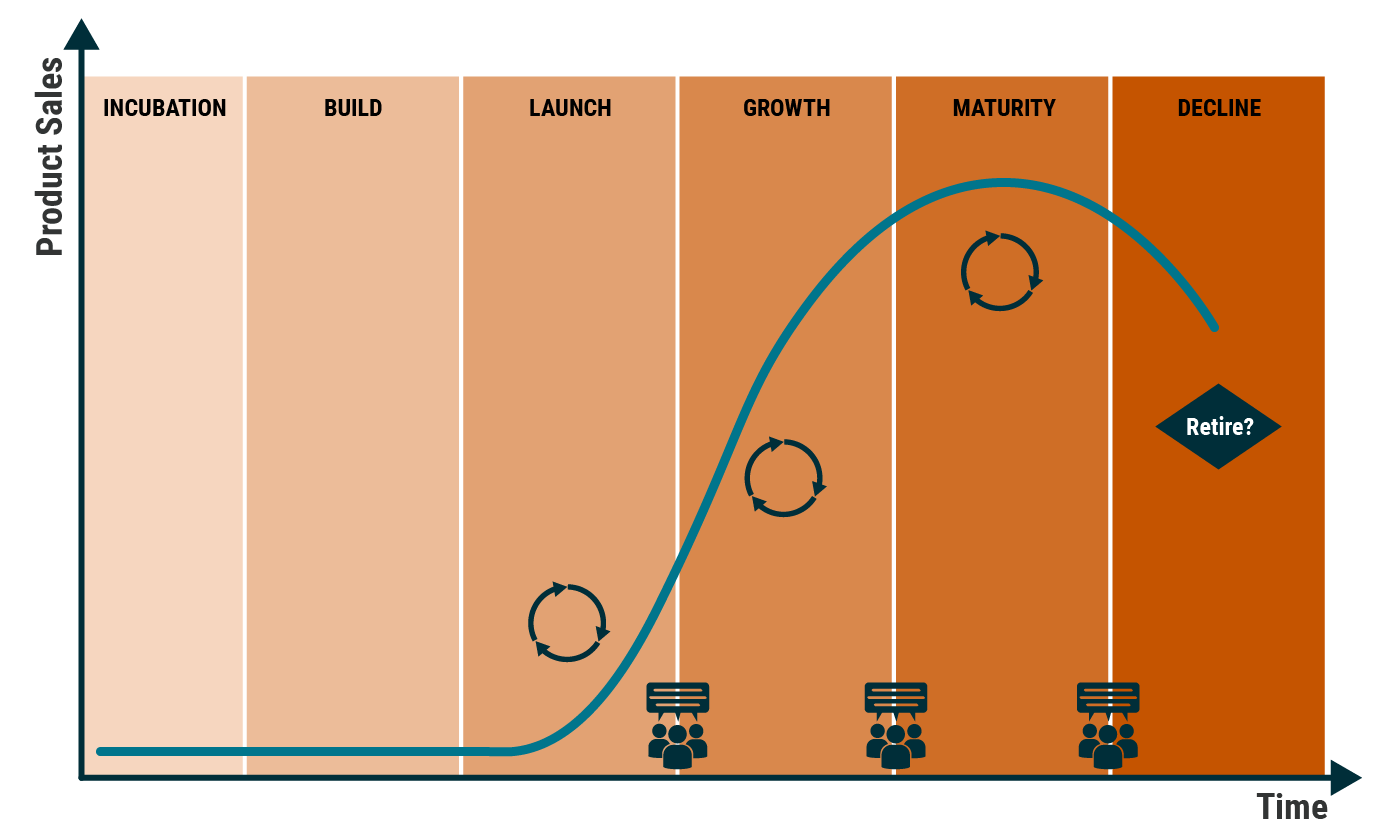
Lifecycle.png
Effective analysis throughout each product lifecycle stage allows the team to ensure:
  • Fast feedback is used to evolve the product
  • Ongoing customer value is delivered
POA practices applied at each product lifecycle stage:
Product Lifecycle Stage POA Practice
Incubation
  • Identify and understand customer needs, gaps, and opportunities, using cost-effective customer-centric design approaches.
  • Improve the quality of product ideas.
  • Evolve the understanding of customers and the marketplace to solidify a strong product vision.
Build Help
  • Develop a strong value proposition for customers.
  • Target market segments with a suitable value proposition.
  • Solidify implementation plans, using relevant strategies for market segments and product launch strategies.
Launch
  • Help fine-tune mechanisms to capture product metrics and customer feedback.
  • Provide opportunities to tweak product features based on initial launch success.
  • Manage organizational expectations based on the market introduction.
  • Plan and devise additional tactics for product growth and market penetration based on initial results.
Growth
  • Tweak the product to deliver additional customer value.
  • Search for additional tactics based on market feedback to increase product adoption and utility.
  • Identify ways to evolve the product organically.
  • Implement and test product growth strategies to identify the best ones.
  • Plan and execute implementation tactics to achieve desired product goals e.g., acceptance, adoption, or profitability goals.
Maturity
  • Sustain the product by continuously adapting to changing customer expectations.
  • Apply various strategies to improve, redesign, and optimize the overall customer experience to extend the life of the product.
  • Plan to revive the product for additional growth.
  • Plan to retire the product.
Decline
  • Codify learnings and successes so they can be reused in future products.
  • Implement plans to retire the product.
  • Migrate customers to other products.