
Skip to content
Browse
BABOK Guide
BABOK Guide
10. Techniques
Introduction 10.1 Acceptance and Evaluation Criteria 10.2 Backlog Management 10.3 Balanced Scorecard 10.4 Benchmarking and Market Analysis 10.5 Brainstorming 10.6 Business Capability Analysis 10.7 Business Cases 10.8 Business Model Canvas 10.9 Business Rules Analysis 10.10 Collaborative Games 10.11 Concept Modelling 10.12 Data Dictionary 10.13 Data Flow Diagrams 10.14 Data Mining 10.15 Data Modelling 10.16 Decision Analysis 10.17 Decision Modelling 10.18 Document Analysis 10.19 Estimation 10.20 Financial Analysis 10.21 Focus Groups 10.22 Functional Decomposition 10.23 Glossary 10.24 Interface Analysis 10.25 Interviews 10.26 Item Tracking 10.27 Lessons Learned 10.28 Metrics and Key Performance Indicators (KPIs) 10.29 Mind Mapping 10.30 Non-Functional Requirements Analysis 10.31 Observation 10.32 Organizational Modelling 10.33 Prioritization 10.34 Process Analysis 10.35 Process Modelling 10.36 Prototyping 10.37 Reviews 10.38 Risk Analysis and Management 10.39 Roles and Permissions Matrix 10.40 Root Cause Analysis 10.41 Scope Modelling 10.42 Sequence Diagrams 10.43 Stakeholder List, Map, or Personas 10.44 State Modelling 10.45 Survey or Questionnaire 10.46 SWOT Analysis 10.47 Use Cases and Scenarios 10.48 User Stories 10.49 Vendor Assessment 10.50 Workshops

5. The POA Framework

5.1 Apply Foundational Concepts

Guide to Product Ownership Analysis
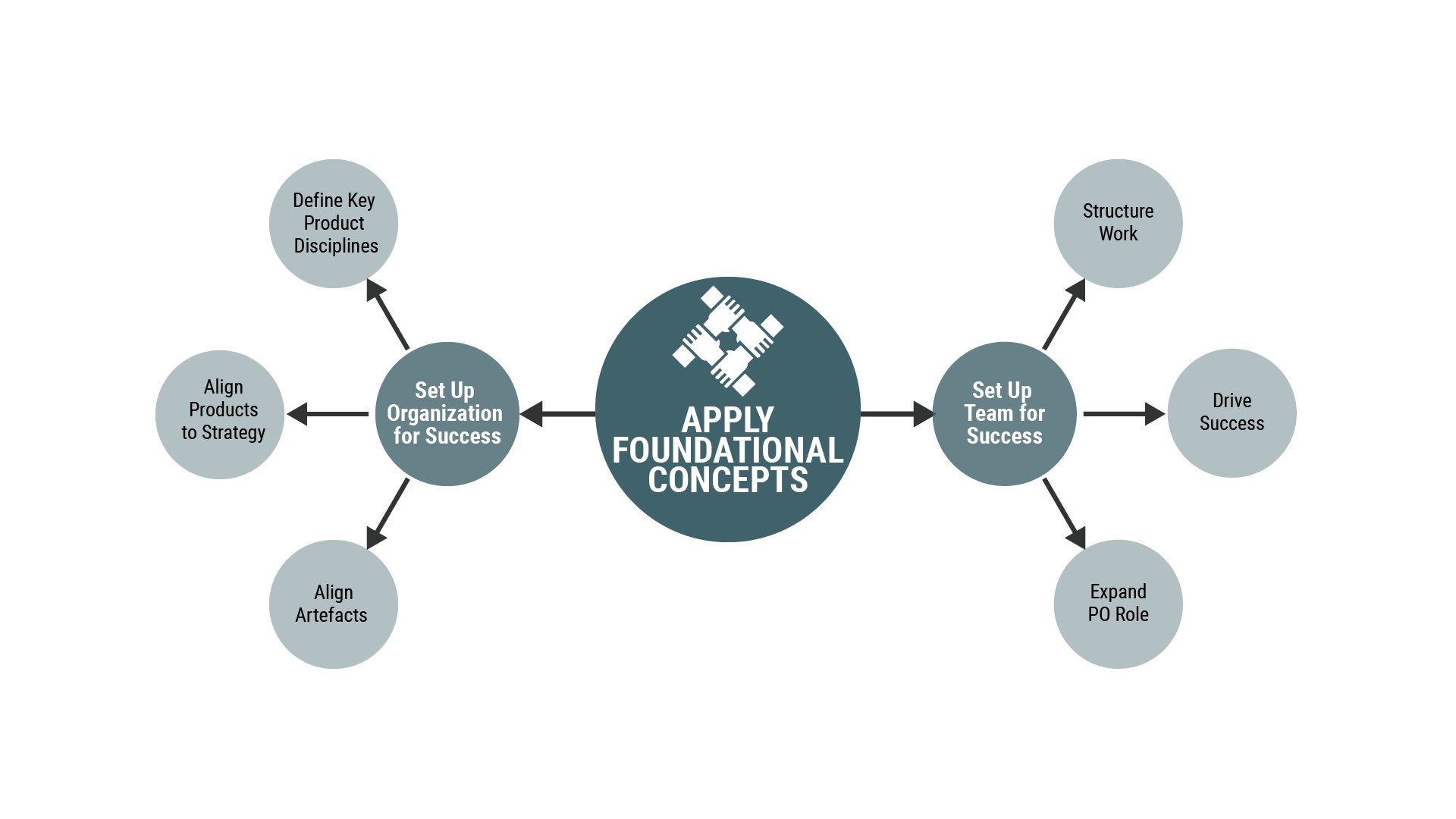
Framework - Foundational Concepts.png
Organizations must vie for customers' attention in a competitive landscape. Customer expectations have increased, making it harder to maintain customer loyalty. Organizations are challenged with how they create products and services and deliver them to the marketplace. Industry research estimates that more than 30,000 products are launched annually, and close to 95% of them fail.

Create and Launch High-Value Products

Organizations need to support Product Owners and teams in creating high- value products and launching them in the marketplace. The organizational context can support or hinder the delivery of successful products.

Organizations view products as the driving force in enterprise success (see 4. Agile Product Management) and focus on:
  • Enterprise product practices
  • Business functions
  • Evolving disciplines around products
  • The agility required to build upon a product-first enterprise
Organizational foundation needs to evolve so that each product in an enterprise portfolio can take advantage of these enablers. The Apply Foundational Concepts domain drives product success and provides guidance by asking the following questions:
  • Is the organization set up to support product success?
  • Does the organization do a good job of setting up teams for success?