
Skip to content
Browse
BABOK Guide
BABOK Guide
10. Techniques
Introduction 10.1 Acceptance and Evaluation Criteria 10.2 Backlog Management 10.3 Balanced Scorecard 10.4 Benchmarking and Market Analysis 10.5 Brainstorming 10.6 Business Capability Analysis 10.7 Business Cases 10.8 Business Model Canvas 10.9 Business Rules Analysis 10.10 Collaborative Games 10.11 Concept Modelling 10.12 Data Dictionary 10.13 Data Flow Diagrams 10.14 Data Mining 10.15 Data Modelling 10.16 Decision Analysis 10.17 Decision Modelling 10.18 Document Analysis 10.19 Estimation 10.20 Financial Analysis 10.21 Focus Groups 10.22 Functional Decomposition 10.23 Glossary 10.24 Interface Analysis 10.25 Interviews 10.26 Item Tracking 10.27 Lessons Learned 10.28 Metrics and Key Performance Indicators (KPIs) 10.29 Mind Mapping 10.30 Non-Functional Requirements Analysis 10.31 Observation 10.32 Organizational Modelling 10.33 Prioritization 10.34 Process Analysis 10.35 Process Modelling 10.36 Prototyping 10.37 Reviews 10.38 Risk Analysis and Management 10.39 Roles and Permissions Matrix 10.40 Root Cause Analysis 10.41 Scope Modelling 10.42 Sequence Diagrams 10.43 Stakeholder List, Map, or Personas 10.44 State Modelling 10.45 Survey or Questionnaire 10.46 SWOT Analysis 10.47 Use Cases and Scenarios 10.48 User Stories 10.49 Vendor Assessment 10.50 Workshops

4. Agile Product Management

4.3 POA and Agile Planning Horizons

Guide to Product Ownership Analysis

Organizations have adopted the key tenets of agile at all levels of planning and decision-making. In constant and rapidly changing environments, organizations need to respond to opportunities.

The Agile Extension defines three planning horizons:
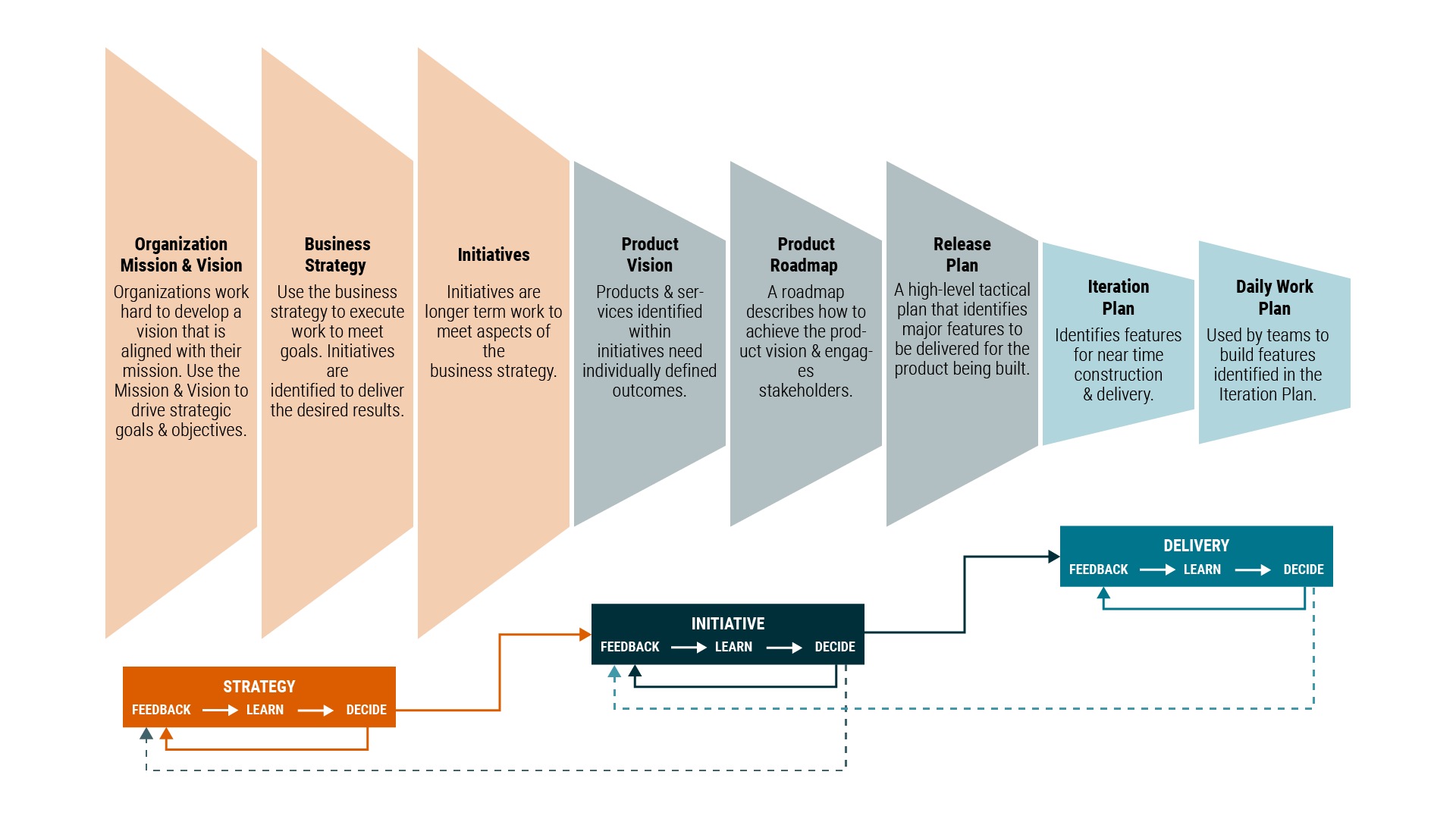
  • Strategy
  • Initiative
  • Delivery
The planning horizons are a framework to shift perspective between long- term strategic decision-making and the immediate needs of customers. Each planning horizon describes the longevity and impact of decisions, and feedback loops, to allow practitioners to synchronize activities and manage business imperatives. Customer expectations and needs feed into:
  • Strategy
  • Target markets
  • Product portfolio decisions
  • Product roadmaps
  • Product lifecycle investments
Agile Planning Horizons .png
Each planning horizon includes a feedback loop to help the team learn and make informed decisions.
  • The organization mission and vision
  • The business strategy
  • Initiatives and outcomes
The Individual Initiative Horizon includes:
  • Product vision
  • Product roadmap
  • Release plan
The Delivery Horizon includes:
  • The iterative plan
  • The daily work plan