
6. POA Techniques
6.19 Product Roadmap
Guide to Product Ownership Analysis
Purpose
Product Roadmap is a strategic, visual tool used to communicate direction and progress towards the vision for a solution or initiative. It measures progress against that vision by achieving the stakeholders' desired outcome.
Application of Product Roadmap as a technique is substantial in POA. See section 7.10 of the Agile Extension V2.
Description
A product roadmap is a visual representation of how a team plans to implement its product strategy over progressively longer time horizons. It describes how a product is likely to:
The product roadmap is not a succession of milestones, tasks, and deliverables that do not associate with product goals. The focus of the product roadmap is on goals, benefits, and demonstration of value the product will deliver.
Product roadmap enables iterative delivery by expressing features in terms of now, next, and later. It defines what the solution is and what it is not. It is the starting point for product delivery, so it is a crucial step in product planning:
Application of Product Roadmap as a technique is substantial in POA. See section 7.10 of the Agile Extension V2.
Description
A product roadmap is a visual representation of how a team plans to implement its product strategy over progressively longer time horizons. It describes how a product is likely to:
- Grow,
- Align to stakeholders' needs, and
- Acquire a budget for delivery.
The product roadmap is not a succession of milestones, tasks, and deliverables that do not associate with product goals. The focus of the product roadmap is on goals, benefits, and demonstration of value the product will deliver.
Product roadmap enables iterative delivery by expressing features in terms of now, next, and later. It defines what the solution is and what it is not. It is the starting point for product delivery, so it is a crucial step in product planning:
- It is the link between product vision and product delivery.
- It influences how the product will be built.
- It influences and aligns architectural and technical strategic decisions.
Three commonly used roadmaps:
- Goal-oriented product roadmap,
- Now-next-later roadmap, and
- Story map.
The goal-oriented product roadmap focuses on outcomes with success criteria.
Product Owners use visuals to clarify what success looks like across stakeholders and the delivery team. This type of roadmap can be used to help guide the outcome of the product, and the thinking about the most beneficial features.
Product Owners use visuals to clarify what success looks like across stakeholders and the delivery team. This type of roadmap can be used to help guide the outcome of the product, and the thinking about the most beneficial features.
| First Quarter | Second Quarter | Third Quarter | |
| Release | MVP | Release 2 | Release 3 |
| Goal - What is the goal: | |||
| Features - what product features and/or capabilities need to be included to achieve the goal: | |||
| Metrics: How to measure success? How to ensure the goal will be reached: |
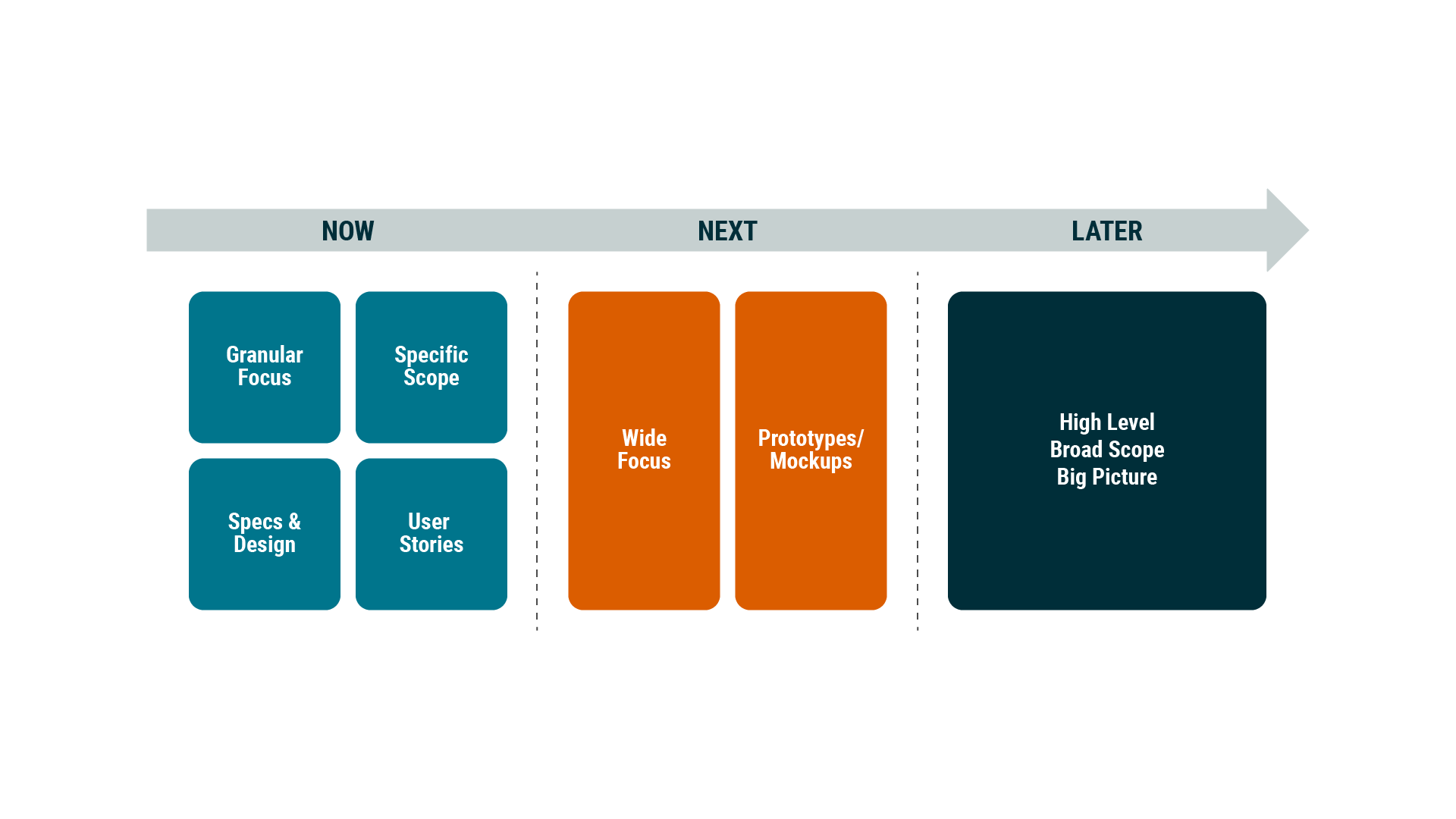
he now-next-later product roadmap visually communicates what is being worked on, what is planned, and what has not been scheduled. This type of roadmap is more focused on the features to be implemented but should look at the value and benefit each feature will provide.
The story map provides an overview of the features and activities the product could incorporate. While story maps are feature or story focused, they are beneficial at the beginning of new product planning
Two benefits from story mapping are:
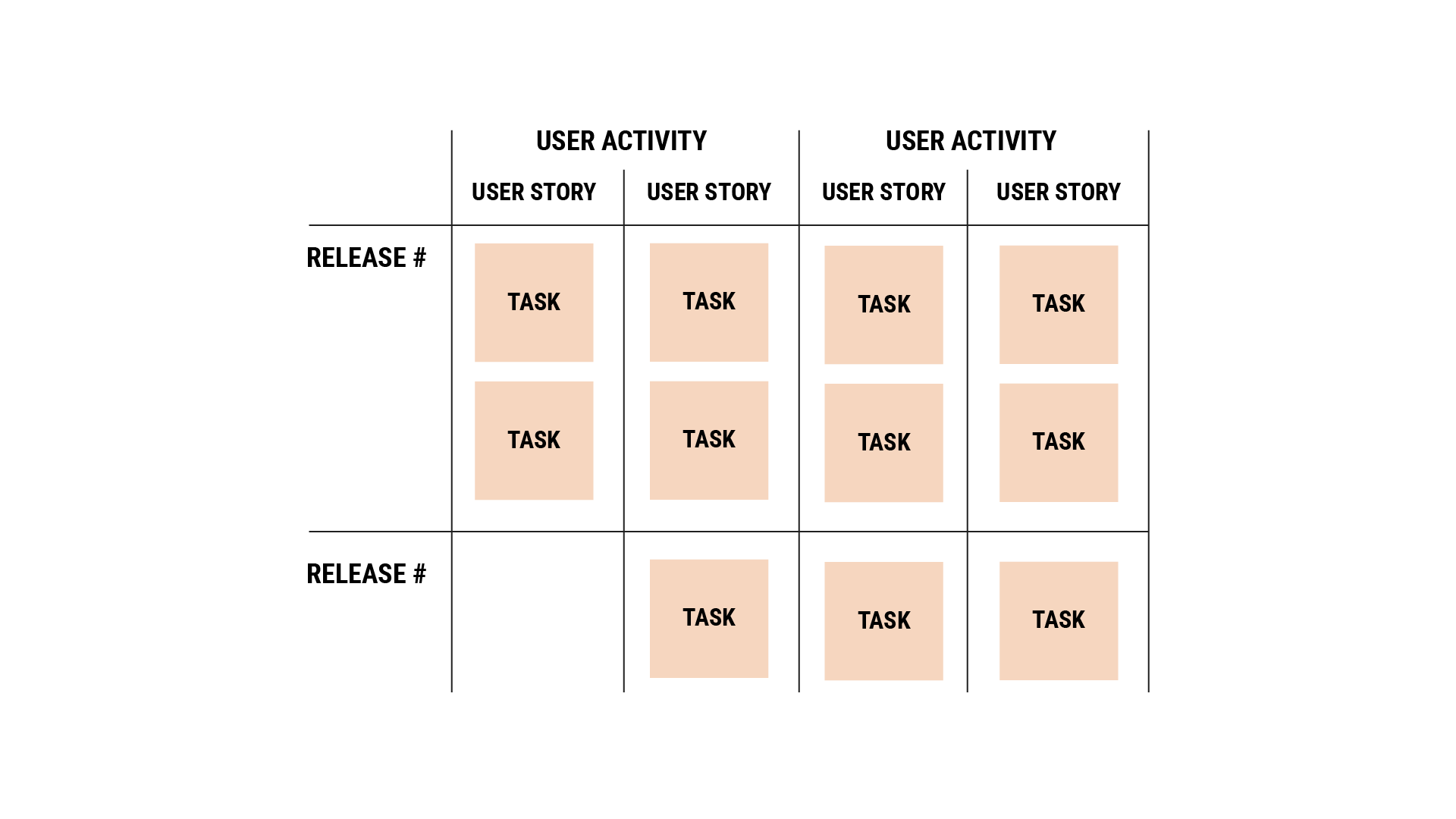
Both benefits invite opportunities for the team to focus on value. One of the major drawbacks of a Story Map is that it can give the impression that all listed features will be developed.
Components
Defined Vision and Strategy: The product roadmap elaborates the strategy through which the product Vision will be realized.
Defined Desired Outcomes: The P product roadmap articulates organization and stakeholder desired outcomes. Defining the desired outcomes helps the delivery team provide a working solution that adds value.
Product Management Team: The product management team is focused on maintaining the P product roadmap. The product management team ensures the roadmap:
Themes: Product roadmap includes themes that represent a collection of requirements, features, or stories.
High-level Requirements: The product roadmap is comprised of high-level requirements or features that are expected to deliver value to achieve the vision and goals for the solution. These high-level items represent a group of requirements or stories.
Two benefits from story mapping are:
- They start with customer or user activities, and
- The process fully engages stakeholders to share understanding and design solution feature ideas.
Both benefits invite opportunities for the team to focus on value. One of the major drawbacks of a Story Map is that it can give the impression that all listed features will be developed.
Components
Defined Vision and Strategy: The product roadmap elaborates the strategy through which the product Vision will be realized.
Defined Desired Outcomes: The P product roadmap articulates organization and stakeholder desired outcomes. Defining the desired outcomes helps the delivery team provide a working solution that adds value.
Product Management Team: The product management team is focused on maintaining the P product roadmap. The product management team ensures the roadmap:
- Reflects the most current priorities and goals,
- Is accessible to those who need it, and
- Tailors the view based on the audience.
Themes: Product roadmap includes themes that represent a collection of requirements, features, or stories.
High-level Requirements: The product roadmap is comprised of high-level requirements or features that are expected to deliver value to achieve the vision and goals for the solution. These high-level items represent a group of requirements or stories.
- Begin with the vision and its associated goals:
- Explore and understand the reason why the product is being developed and what customer needs will be fulfilled by the product.
- Evaluate market opportunities the product can:
- Take advantage of,
- Fulfill important demands, or
- Alleviate key market pressures.
- Identify the goals that will help achieve the product vision (if not already done), with customer and market considerations in mind.
- Determine product capabilities or features required to achieve the goals:
- Work with stakeholders to determine features the product could include to achieve the goals.
- Prioritize the possible features:
- Consider the
- Product budget,
- Available resources,
- Dependencies, and
- Other constraints.
- Prioritize the product features based on prioritization criteria and constraints, e.g.:
- High-impact and easy win features,
- Time,
- Budget,
- Dependencies, and
- Resource availability.
- Give each feature a timeframe for implementation.
- Consider the
- Develop the roadmap:
- Identify which type of roadmap or maps you are going to create.
- Determine the frequency of releases. Start-ups or new products may prefer more frequent deliverables, while mature products may go for longer releases.
- Begin placing features into time blocks, paying attention to:
- The availability of resources and their specialties,
- Environmental constraints and availability,
- Other dependent initiatives, and
- Any other constraints that may impact timeframes.
- Share the roadmap:
- With stakeholders and resources to obtain their buy-in, and
- To build the product backlog.
| Strengths | Limitations |
|
|
Tips for Success
- The timeframe for roadmaps varies. A long timeframe (2+ years) is not beneficial due to the high level of uncertainty.
- Items under each hierarchical level should have a unique colour to effectively show the thought process.
- Ensure that stakeholders understand that the roadmap includes features that could be implemented, but it does not guarantee implementation.
- Ensure that architectural and technical considerations are included.
- A roadmap is a living document and must be updated as needed.
- State the benefits the product is likely to create (or value delivered to the customer).
- Do not focus on details (this is not intended to be the backlog).
- Stay flexible—your roadmap will change.
- Roadmaps should only be developed after the product strategy is defined and agreed upon.