5. The POA Framework
5.7 Obsess About Value
Guide to Product Ownership Analysis
 Product development and innovation are usually hard and complex. When new products are built, with each iteration the team must consider:
- New features,
- Scale, and
- New challenges.
Value from the customer perspective is usually a comparison between the benefits of a product and the cost. The cost can be the actual price, or reduction in effort, by using the product. The industry has spent considerable time and energy in managing the price, and less time understanding the value. The value can be difficult to pin down, and it evolves as expectations change over time.
Value is: "The worth, importance, or usefulness of something to a stakeholder within a context. Value can be seen as potential or realized returns, gains, and improvements. It is also possible to have a decrease in value in the form of losses, risks, and costs. Value can be tangible or intangible." - BABOK® Guide.
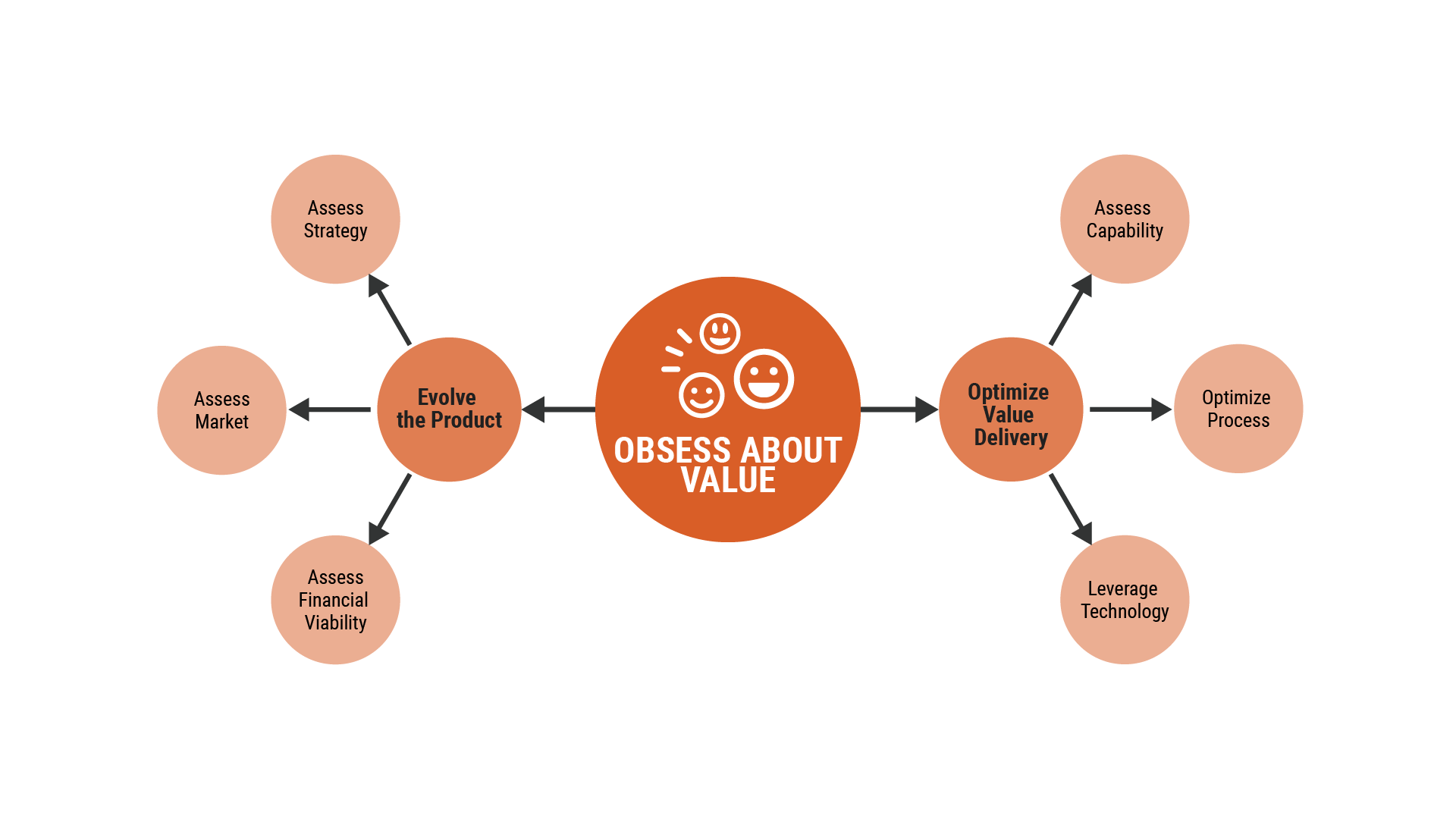
The definition of value is that it is context-driven and has an impact on stakeholders who can either be customers or organizations. Whether the value is tangible (cost-saving or revenue), or intangibles (reducing complexity or providing delight), it is difficult to define what is valuable. Customers and businesses are good at making choices rather than defining what they need upfront. Customers can choose an option that is compared to be more valuable. Product teams must be cognizant of two critical steps throughout the life of a product:
- Evolve the product: Provide valuable options to the customer by obtaining insights from the customers and other stakeholders quickly. Applying the learnings in the best way possible, so that the most valuable choices are integrated into the product.
- Optimize value delivery: Optimize the path taken for product development, that is quick to value, by optimizing processes involved in:
- Product development,
- Assessing the capabilities of the product team, and
- Use of technology.