Skip to content
Browse
BABOK Guide
BABOK Guide
10. Techniques
Introduction 10.1 Acceptance and Evaluation Criteria 10.2 Backlog Management 10.3 Balanced Scorecard 10.4 Benchmarking and Market Analysis 10.5 Brainstorming 10.6 Business Capability Analysis 10.7 Business Cases 10.8 Business Model Canvas 10.9 Business Rules Analysis 10.10 Collaborative Games 10.11 Concept Modelling 10.12 Data Dictionary 10.13 Data Flow Diagrams 10.14 Data Mining 10.15 Data Modelling 10.16 Decision Analysis 10.17 Decision Modelling 10.18 Document Analysis 10.19 Estimation 10.20 Financial Analysis 10.21 Focus Groups 10.22 Functional Decomposition 10.23 Glossary 10.24 Interface Analysis 10.25 Interviews 10.26 Item Tracking 10.27 Lessons Learned 10.28 Metrics and Key Performance Indicators (KPIs) 10.29 Mind Mapping 10.30 Non-Functional Requirements Analysis 10.31 Observation 10.32 Organizational Modelling 10.33 Prioritization 10.34 Process Analysis 10.35 Process Modelling 10.36 Prototyping 10.37 Reviews 10.38 Risk Analysis and Management 10.39 Roles and Permissions Matrix 10.40 Root Cause Analysis 10.41 Scope Modelling 10.42 Sequence Diagrams 10.43 Stakeholder List, Map, or Personas 10.44 State Modelling 10.45 Survey or Questionnaire 10.46 SWOT Analysis 10.47 Use Cases and Scenarios 10.48 User Stories 10.49 Vendor Assessment 10.50 Workshops

5. The POA Framework

5.4 Make an Impact

Guide to Product Ownership Analysis
Framework - Make An Impact.png
Every organization emphasizes its desire to make an impact. The organization's vision guides its values and culture. This is established at conception. However, the expression of it can change over time, based on the environment.

To clarify the impact of a product, POA Practitioners should ask:
  • "Who is impacted or influenced by the product?"
  • "How are customers and other key stakeholders impacted?"
  • "How is the team and the organization itself impacted?"
Culture is influenced by organizational vision, and the product is influenced by the team's vision to help the customer, the stakeholders, and the organization. Product ownership related activities drive the team to develop the customer-obsession mindset that great products require.

How do we define impact? Example:
  • Amazon's impact is not the drive to deliver the highest-quality products; it is the obsession to deliver the highest-quality customer experience from selection to purchase to product delivery. Amazon learned that sometimes customers buy on impulse. In many cases, customers prefer the speed of delivery to the actual quality of the product. This customer understanding guides Amazon to make an impact to delight customers by near-seamless delivery of frequent customer experience improvements. They advance the strategy through:
    • Focusing on cost-effective improvements to the speed of delivery over monitoring the quality of the products, and
    • Allowing the practice of customer ratings and reviews to speak for the quality of the products.
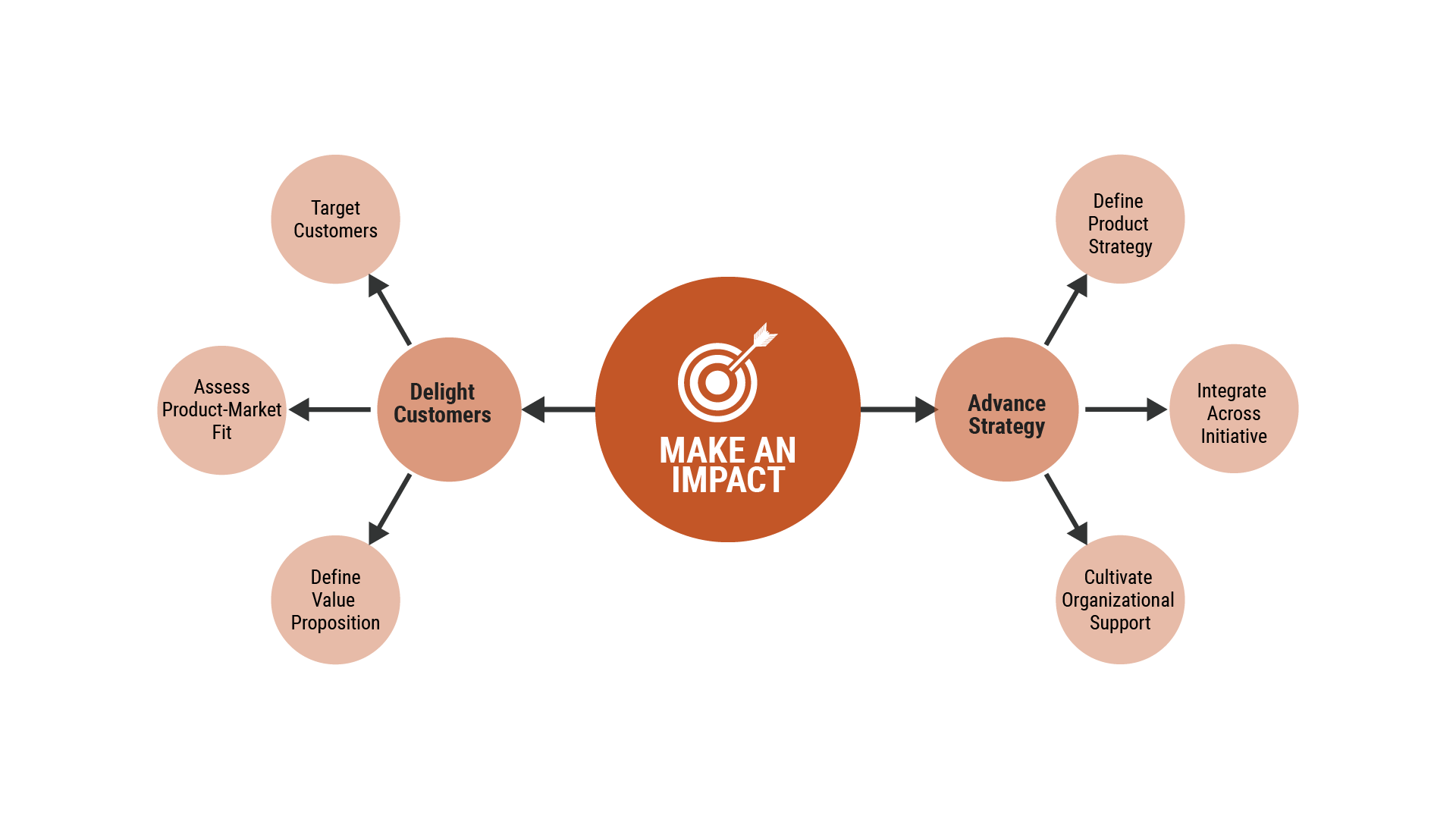
The impact of this can be viewed through two integrated lenses where equal attention needs to be paid to what type of product will resonate with customers, and what will deliver against the organization's strategy.

POA Practitioners use authenticity as a guide to influence the impact of the product. They use the determiners of product design, planning and delivery success while ensuring the product:
  • Delights customers, and
  • Advances strategy.