
5.4 Make an Impact
5.4.1 Delight Customers
Guide to Product Ownership Analysis

To make a lasting impact, the product must offer great value, newness, and be true to the brand of the organization. Usually, many products are providing similar value propositions and targeting a similar customer base. However, another similar type of product without distinguishing characteristics may not cut it. The problem can be further exacerbated due to many factors, including:
- Lack of key new technology,
- No internal process support, or
- A weak business model.
- Being unaware of new market entrants that may be replicating similar features.
- These product features may not prove popular with internal staff since they are often out-of-the-box ideas that challenge today's offerings.
- Emotionally connected and invested customers tend to have a higher lifetime value than just satisfied customers. Customer delight cannot be an afterthought for POA Practitioners. To achieve customer delight, they must focus on:
- Target Customers: Target only those who will get real value out of the product. Build deep understanding with user personas, that explore customers':
- Pain points,
- Feelings, and
- Desires.
- Product-Market Fit: That pivotal moment when a product is in the right market and can satisfy and create an emotional connection with the customer.
- Value Proposition: The promise of value to be delivered to a customer, which solves customer problem(s) through the product.
- Target Customers: Target only those who will get real value out of the product. Build deep understanding with user personas, that explore customers':
Goal: To define target customers for the purpose of accelerating the potential to delight customers while advancing strategy.
Effective POA highlights the importance of targeting customers through:
The Product Owner represents the customer in all things related to product decisions, design, and solutions. In some instances, particularly for internal products, the Product Owner may even be the customer.
By continually asking questions like, "How will this help this customer?", POA Practitioners influence:
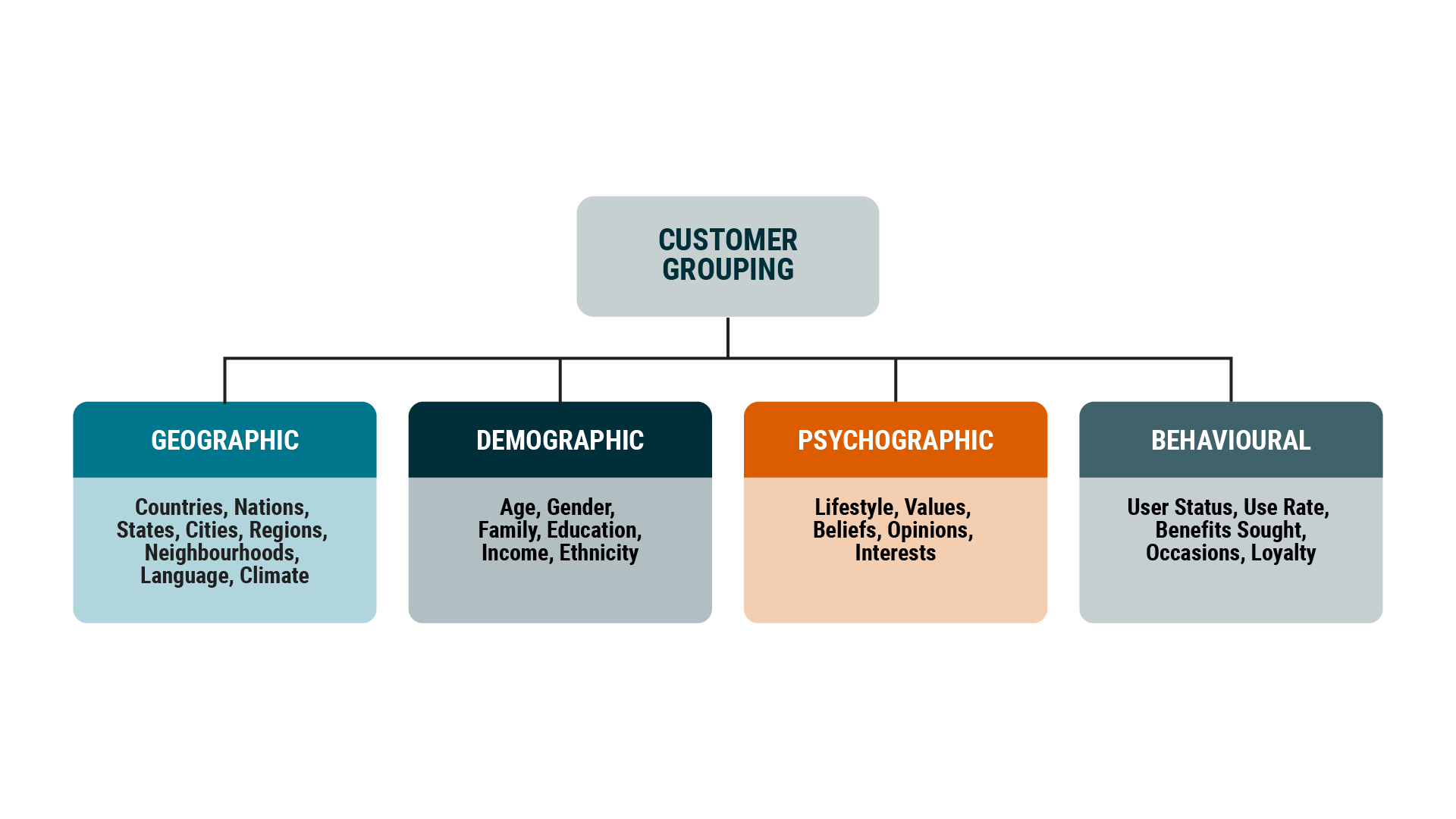
Customer Grouping helps to reveal the target customer. It facilitates an understanding of the source of their uniqueness and the importance of it. Using this information to identify patterns and similarities leads to additional considerations for grouping. Stakeholder maps may also reveal key grouping considerations.
Some standard groupings can help to guide and identify the techniques to deepen customer intimacy.
Purposeful customer grouping by considerations that are important to them, could include:
POA Techniques to Target Customers
Agile Extension Techniques
Case Study: Target Customers - Retailer
Effective POA highlights the importance of targeting customers through:
- Customer intimacy through relationship building and developing:
- Personas,
- Customer journey maps, and empathy maps, and
- Integrated with intelligent learning reveals groupings.
- Establishing customer groupings that:
- Organize customer information,
- Define commonalities and uniqueness of customers that guides segmentation, including
- Demographic,
- Geographic,
- Psychographic, and
- Behavioural trends.
- Design,
- Solution, and
- Marketing and promotional potential.
The Product Owner represents the customer in all things related to product decisions, design, and solutions. In some instances, particularly for internal products, the Product Owner may even be the customer.
By continually asking questions like, "How will this help this customer?", POA Practitioners influence:
- the team,
- prioritize work, and
- refine planning based on the answers.
- What matters,
- Prototyping,
- Observation, and
- Evaluation of feedback.
- Keep the customer at the centre of everything,
- Guide activities of the team to build a shared understanding,
- Make prompt decisions, and
- Organize to focus on the target.
Customer Grouping helps to reveal the target customer. It facilitates an understanding of the source of their uniqueness and the importance of it. Using this information to identify patterns and similarities leads to additional considerations for grouping. Stakeholder maps may also reveal key grouping considerations.
Some standard groupings can help to guide and identify the techniques to deepen customer intimacy.
Purposeful customer grouping by considerations that are important to them, could include:
| Direct Customer Group | Indirect Customer Group |
| Customer purchases, uses, or accesses services | Customer enables products or services for their organization, internally or externally |
| (i.e., utility/phone service, retail, or Insurance). | (i.e., sales department, HR tool, claims processing, online retail purchase fulfillment). |
| Customer-centric considerations: What is the product or service solving? |
| Product | Services | Product | Services |
| Design | Consider everything from Product plus | Consider everything from Direct Customer plus |
| Functionality | Control | Marketability |
| Convenience | Options | Speed to market |
| Experience | Empathy | Ease of insight |
| Efficiency | Fairness | Reports/Dashboards/Metrics/ROI |
| Direct Customer Group | Indirect Customer Group |
| Reliability | Information | ||
| Performance | Accessibility | ||
| Compatibility |
POA Techniques to Target Customers
Agile Extension Techniques
- Personas: Understand the customers better by empathizing with their key pain points and devising solutions to delight them.
- Interviews: Interacting with specific customers makes it more personal and focuses on the key issues with the customer experience.
- Observation: Passive and active observation helps in developing a deep understanding of customers to discover known and unknown problems a customer may be facing.
- Document Analysis: Analyzing subjective feedback from customers helps to identify unique aspects of customer problems.
- Empathy Maps: A visual tool to establish a shared understanding of the customer and their experience.
- Customer Journey Map: Understand the pain points and points of delight as the customer interacts with the product.
- Product-Market Fit: Ensure that the product value proposition is defined, delivered, and aligned with target audience needs.
- Value Proposition Canvas: Ensure the features of the products are aligned to what is valuable to customers and discover the target market.
Case Study: Target Customers - Retailer
| Background Super C, a leading brick-and-mortar retailer, was an early provider of online ordering, with pickup service at their stores. While their marketing team had significant studies showing that customers were demanding this type of service to avoid lines at the cashier, they were uncertain why this service was not being adopted by their customers at the pace they expected. They enlisted Gary, a Business Analysis Professional that currently supported the retail services division in product management, to determine if this service was indeed valuable to their customer base. Challenge Super C's goal was to increase in-store pickup of products ordered online to 45% over three years. After an initial performance of 25% in the first quarter of offering the service, the numbers dwindled to just below 10%. Marketing continued to highlight cost savings on shipping, convenience, and expanded product offerings to customers. Supply chain had found innovative ways of ensuring that products ordered online could be sourced through the stores, in many cases on the same day the online order was placed. Action To discover why the service was not adopted as anticipated, Gary started with learning how the process worked, to experience the process as a customer. What he found was interesting. Unlike the electronics store he had previously purchased from, at Super C, he was required to:
The process took more time than it would have taken for him to come in and shop for the item himself. Based on this experience, he decided to use Personas and Customer Journey Maps to analyze the real customer expectations and make recommendations for changes to the process to address the challenge. Based on his analysis, Gary determined that the primary customers interested in the service were in one of two Persona categories:
Gary visited several Super C stores and interviewed several people who seemed to fit into these Personas to map their Customer Journeys. Outcome He discovered that speed in-and-out of the store was essential to a successful journey. Having to park, enter the store, walk to the back of the store, and then walk back to their car was frustrating for customers, especially considering that product pickup was marketed as a convenient online service. Gary met with the marketing team, who explained that they had hoped the walk through the store would stimulate impulse purchases. They had failed to recognize that much of the convenience of shopping online was the delivery process. Gary recommended:
Lessons Learned In this scenario, although the initial solution did not require any systematic changes to entice more adoption of the online pickup service, it set the stage for enough adoption to lead to additional changes that could further enhance the customers' journeys. For example, without the persona analysis, Super C may not have learned that one of the characteristics of a young professional was to adopt technology early. This led to:
|
Product-market fit is when a product is in the right market and can satisfy that market. In other words, that product is in the right place at the right time.
The product-market fit provides a framework for the alignment of customer needs and organizational goals. It anticipates the expected value to the customer and the organization. The product-market fit is an essential tool for communication to:
The product-market fit is measured quantitatively and qualitatively (see Measure What Matters) and revised based on the outcomes of learning.
How POA Helps Product-Market Fit
The product-market fit provides structure to identify the right market for the product. Whether or not the Product Owner was engaged in the early activities of the strategy horizon, they have a strong voice in both the initiative and delivery horizon. When the Product Owner takes on the role, they inherit the product and the evolution of the product-market fit.
POA Practitioners lead collaborative conversations with the team and stakeholders in the development and ongoing revisions to the product- market fit artefact. Through this level of collaboration, the team strengthens their understanding and commitment to impact customers and the organization.
POA Techniques for Product-Market Fit
Agile Extension Techniques
The product-market fit provides a framework for the alignment of customer needs and organizational goals. It anticipates the expected value to the customer and the organization. The product-market fit is an essential tool for communication to:
- Ensure shared understanding across the stakeholders and the delivery team,
- Plan for the
- Minimal Viable Product (MVP),
- Minimal Marketable Feature (MMF),
- Minimal Marketable Release (MMR), or
- Minimal Marketable Product (MMP), and
- Integrate across the organization.
The product-market fit is measured quantitatively and qualitatively (see Measure What Matters) and revised based on the outcomes of learning.
How POA Helps Product-Market Fit
The product-market fit provides structure to identify the right market for the product. Whether or not the Product Owner was engaged in the early activities of the strategy horizon, they have a strong voice in both the initiative and delivery horizon. When the Product Owner takes on the role, they inherit the product and the evolution of the product-market fit.
POA Practitioners lead collaborative conversations with the team and stakeholders in the development and ongoing revisions to the product- market fit artefact. Through this level of collaboration, the team strengthens their understanding and commitment to impact customers and the organization.
POA Techniques for Product-Market Fit
Agile Extension Techniques
- Value Stream Mapping: Assess the pieces that are valuable for providing a better product-market fit by analyzing the flow of the
- Product features,
- Product workflows, or
- Transactions.
- Benchmarking and Market Analysis: Understand how customer satisfaction improves over time against the previous product or market benchmarks. Market analysis techniques such as PESTLE, CATWOE, and Porter's 5 Forces can be used to provide an overall context for product- market fit.
- Decision Analysis: Assess a product-market fit under different options to determine the value of alternate outcomes.
- Problem Definition and Analysis: Ensure the product is continuously aligned to the problem or opportunity by reshaping and framing.
- Product-Market Fit: Product-market fit is an artefact and concept used to summarize the analysis of customer expectation vs. product value propositions. It is observed to determine whether or not there is a disconnect.
(See Measure What Matters)
Case Study: Product-Market Fit - Home Security
Case Study: Product-Market Fit - Home Security
| Background Christina, an Enterprise Business Analysis Professional, worked with a mid-size home security provider, Homeview. Homeview was planning its strategic product offerings for the next fiscal year. The executive management team had to decide whether to enter one of two increasingly competitive market segments (based on budgetary constraints). The two options were smart home technology and home health technology. Homeview enlisted Christina to help identify which segment to select, based on the best fit for their market base. Challenge Since Homeview had over 100,000 home security customers with monitoring subscriptions and over 300,000 homes with their systems installed, it made sense to offer new technologies that could leverage the equipment and services already distributed. Homeview wanted to select a line of business to focus on that would:
Actions Christina started with benchmarking against competitors in the smart home technology and home health technology spaces. Some non-security service companies, specifically cell phone carriers and cable TV providers, were rapidly increasing their presence in smart home technology. A competing home security provider had even teamed up with a leading telecommunications company to provide smart home technology. There was a separate growing industry offering options for personal health alert technology. Some of the offerings were limited to wired technology that was rapidly being replaced by wireless options. The companies in that space did not appear to be keeping up with current trends. This seemed to be an opportunity that Homeview could exploit. Christina analyzed the demographics of Homeview's consumer base and conducted a broader demographic review of consumers in general. It appeared that early adopters of mobile technology were of an age where home health technology would be a desirable addition to their current services. In addition, she discovered that many of Homeview's subscribers were already utilizing their home security alert features to request medical services. Outcome There was a gap in the home health technology provider services market and the corresponding desire of home security subscribers to have access to medical services. Plus, there was a saturation in smart home services providers on the horizon. With this in mind, Christina recommended that Homeview pursue the home health technology line of business. Lessons Learned The emergence of smart home technology services, while appealing from a commercial standpoint, proved to not be a good choice for Homeview Security. It would have been a completely new type of product to offer and would have to compete against established, large companies already making inroads in the industry. It would have required a major investment in marketing, as well as the technology itself, and still may not have been successful against the giants already in play. A better plan was to focus on customers established in Homeview's portfolio, as well as similar ones in the broader consumer market. Customers with a growing need for medical services and an affinity for newer technology presented a better fit for Homeview's added services. Therefore, the company focused its efforts on developing and implementing home health technologies and medical alert service products for that consumer segment. |
The value proposition is a promise of value to be delivered to a customer that is developed from the culmination of:
Value proposition clarifies:
Through the value proposition, the customer sees part of the solution, and their interest is piqued.
The value proposition canvas tool helps to ensure that the product or service is positioned around what the customer values and needs. Originally developed by Dr. Alex Osterwalder, it aligns the fit between the product and the market. It feeds the customer segment and value proposition segments of the business model canvas. It provides a visualization that contributes to shared understanding and meaningful conversations.
How POA Helps with Value Proposition
Through alignment to the value proposition, effective POA inspires a value- focused mindset within the team. The team champions this value proposition.
The $100 Test Tool
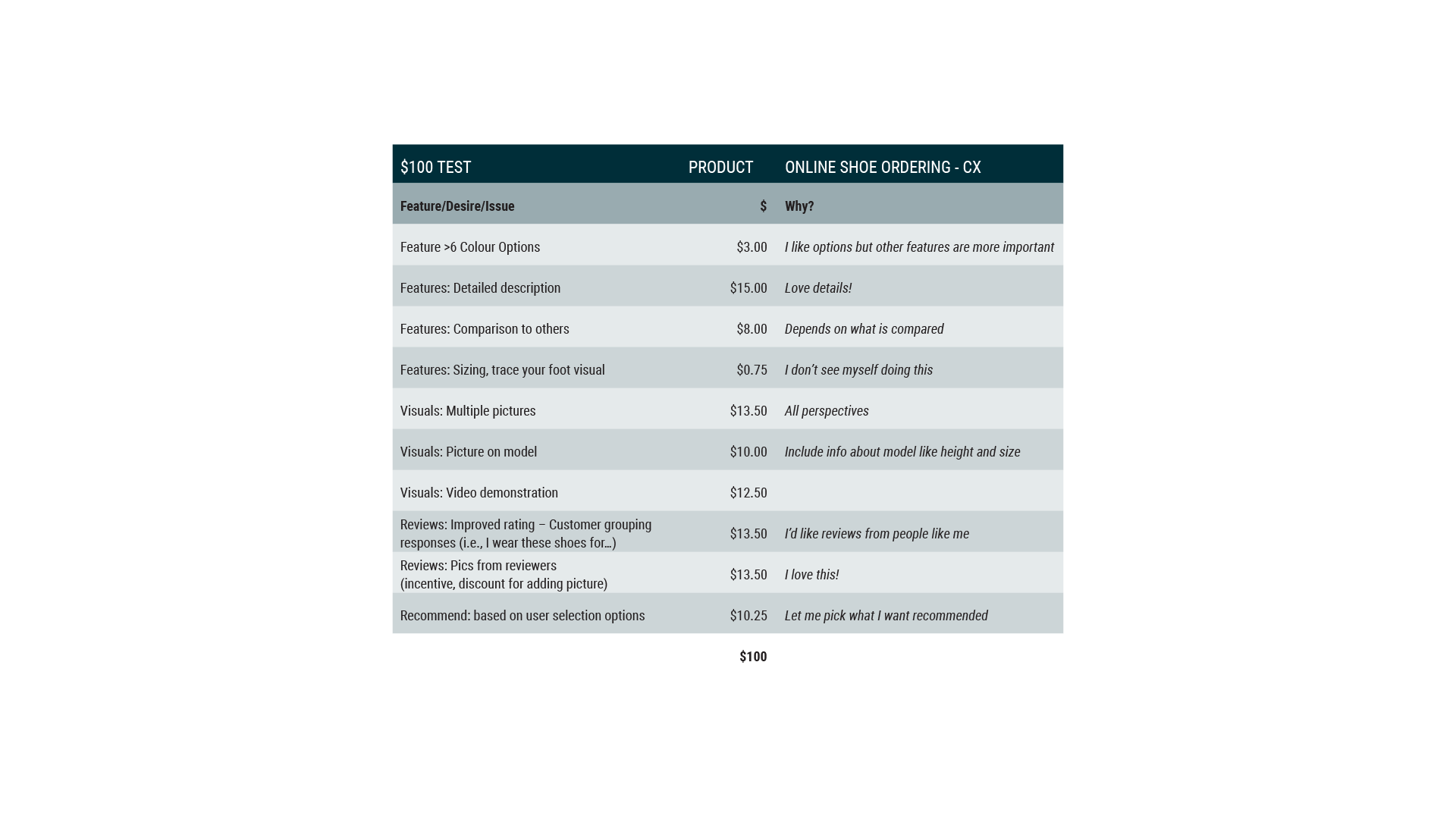
Using tools like the $100 Test, POA Practitioners create an interesting and fun way to engage with customers or users to validate understanding of value and priority. It can be done with a group, individually or as a fun survey. With this activity, customers get to spend an imaginary $100 on features or options that are presented in a list. Completing this activity with the team and then with customers validates the team's understanding.
POA helps practitioners with:
POA Techniques for Value Proposition
Agile Extension Techniques
Case Study: Value Proposition - Retailer
- Ideas,
- Customer intimacy,
- Market insights,
- Evidence, and
- Design.
| Understanding of: | Aligns with: |
|
|
Value proposition clarifies:
- How the product solves or improves the problem or pain.
- The benefits that the customer can expect.
- Why customers should choose this product over the competitor's product.
Through the value proposition, the customer sees part of the solution, and their interest is piqued.
The value proposition canvas tool helps to ensure that the product or service is positioned around what the customer values and needs. Originally developed by Dr. Alex Osterwalder, it aligns the fit between the product and the market. It feeds the customer segment and value proposition segments of the business model canvas. It provides a visualization that contributes to shared understanding and meaningful conversations.
How POA Helps with Value Proposition
Through alignment to the value proposition, effective POA inspires a value- focused mindset within the team. The team champions this value proposition.
The $100 Test Tool
Using tools like the $100 Test, POA Practitioners create an interesting and fun way to engage with customers or users to validate understanding of value and priority. It can be done with a group, individually or as a fun survey. With this activity, customers get to spend an imaginary $100 on features or options that are presented in a list. Completing this activity with the team and then with customers validates the team's understanding.
POA helps practitioners with:
- Crafting a strong value proposition,
- Making the value proposition canvas more effective, and
- Aligning validation points that contribute to the product-market fit.
POA Techniques for Value Proposition
Agile Extension Techniques
- Job Stories: Used to capture expected value from common activities, transactions, and workflows in a product.
- Value Stream Mapping: Assess the right value proposition by analyzing the:
- Flow of the product features,
- Product workflows, or
- Transactions.
- Collaborative Games - $100 Test: Participants are asked to spend an imaginary $100 to choose features that are valuable from a customer perspective.
- Human-Centred Design for Products: Continuously develop and align the product to customer expectations.
Case Study: Value Proposition - Retailer
| Background Super C retail stores had locations in the Midwest that also had gas stations and convenience stores on the same property. Super C catered to lower-income shoppers who were looking for bargains. They were introducing a store-branded credit card that could be used at Super C stores, as well as their related gas stations, and convenience stores. Challenge The average person in the United States has four credit cards. However, the average shopper at Super C does not have a traditional credit card because they do not have enough income or a sufficient credit score to secure one. However, they may qualify for a store credit card, which is typically easier to obtain. Super C wanted to:
Action Product Owner Alicia used a value proposition canvas and focus group feedback provided by the marketing team to make recommendations on how to position the Super C store brand card to customers. Super C customers were particularly interested in the low prices the store offered on all their products. The gas stations, however, had prices per gallon that were in line with other stations in the same areas as the stores. Alicia suggested that Super C stores:
When the credit card rolled out, Super C noticed:
Lessons Learned Super C's customers focused on shopping for low prices. Super C learned that paying attention to customer needs, and offering customers something unique, led to increased loyalty. |