
5. The POA Framework
5.3 Engage the Whole Team
Guide to Product Ownership Analysis
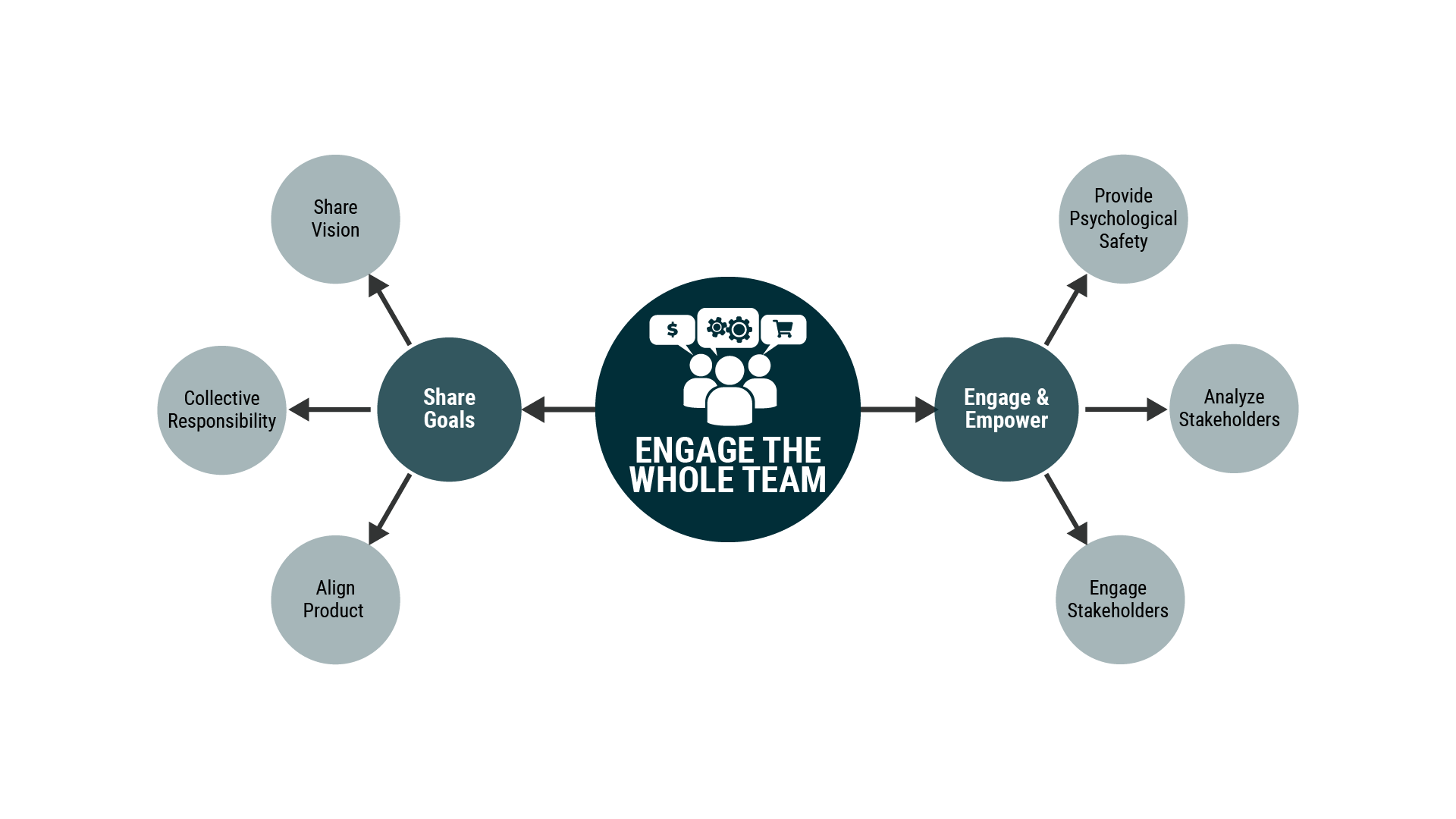
The common perception is that only the “delivery team” is responsible for building the product. However, effective POA acknowledges how critical the engagement and collaboration of customers and other key stakeholders are to product success. A more holistic view of what it takes to deliver a successful product involves thinking of the delivery team, customers, and key stakeholders as the whole team. Having the whole team collectively responsible for the product's success shifts the mindset of pre-defined roles and responsibilities to one centred on collaboration.
The Agile Mindset
The Scrum Master, Team Coach, or Agile Process Facilitator:
- Is responsible for ensuring that the delivery team works well together, amidst a positive work culture,
- Ensures that the team follows effective agile practices that are collectively defined, and
- Coaches the delivery team to use an agile mindset when working independently and collectively.
- Respect,
- Courage,
- Collaboration,
- Continuous learning,
- Customer focus, and
- Value maximization.
- Delivers value rapidly and consistently,
- Collaborates courageously,
- Iterates to learn,
- Simplifies to avoid waste,
- Considers context and adapts to realities,
- Reflects on feedback and adapts both product and process, and
- Produces the highest quality products.
The POA Practitioner adopts the agile mindset to guide the team with a product perspective and the flexibility required for the analysis work. They live and breathe the agile mindset in their approach, demonstrating the mindset and helping the team to do so, as well.
The Product Team
While the Scrum Master, Team Coach, or Agile Process Facilitator works primarily with the delivery team, the Product Owner works closely with the entire product team to ensure collaboration towards the shared goal. The Product Team consists of:
- Delivery team (BA Professional, Developer, Tester, UX, other specialists, etc.),
- Customers or customer representatives, and
- Other stakeholders:
- Those impacted by the product (internal and/or external), and
- Those providing support in product development (internal and external) - e.g., internal marketing or external support services.
POA Practitioners must plan for the unique communication and engagement of each group while operating as a unified team.
Unified Teamwork
The whole team is critical to product success. Without their contribution, the product will fail. To bring the product team together, POA Practitioners ensure the whole team:
- Has a sense of shared ownership towards the product's success.
- Is engaged and empowered to effectively contribute to the product work.