
5.3 Engage the Whole Team
5.3.1 Share Goals
Guide to Product Ownership Analysis

The Product Owner is accountable for maximizing the value of the product, but the product cannot be built without contributions from the whole team.
Shared goals are the catalyst for cooperative participation. In Social Psychology, shared goals are referred to as superordinate.
The goal to delight the customer supports a customer-centric culture that engages the product team. It gives them a voice to express their concerns and unique perspectives with common parameters.
To create a quality product, cross-functional perspectives are essential. Managing perspectives through shared goals keeps the focus on the customer and the product. The shared understanding of the customer needs and the product vision, integrated with varied perspectives, serves to enrich, and evolve the product.
POA Practitioners focus on three concepts to reap the benefits of shared goals:
Shared goals are the catalyst for cooperative participation. In Social Psychology, shared goals are referred to as superordinate.
"A superordinate goal is something that is big enough and compelling enough to aid individuals and groups to overlook personal differences in order to achieve something significantly beyond their current reach."
The goal to delight the customer supports a customer-centric culture that engages the product team. It gives them a voice to express their concerns and unique perspectives with common parameters.
To create a quality product, cross-functional perspectives are essential. Managing perspectives through shared goals keeps the focus on the customer and the product. The shared understanding of the customer needs and the product vision, integrated with varied perspectives, serves to enrich, and evolve the product.
POA Practitioners focus on three concepts to reap the benefits of shared goals:
- Shared Vision: Represents a common understanding of the product, with a compelling vision to delight the customers.
- Collective Responsibility: In product delivery, each team member is held responsible for the success of the product, and the associated strategic goals. It may extend to organizational responsibility, where all are held responsible.
- Product Alignment: This refers to continuous alignment of vision, strategy, and shared goals, plus alignment to customers, markets, and branding, with readiness to respond to changes.
The product vision is the impetus that guides the work to deliver the product. If the product team cultivates customer intimacy, they share in the vision of the product, and features to delight the customer.
A shared vision inspires and motivates the team. It is active. It is common and collective.
Vision Statement
For [target customer] who [statement of need or opportunity], the [product name] is a [product category] that [benefit or unique selling point and differentiator].
How POA Helps Shared Vision
A shared product vision is an outcome of great POA, with the whole team pitching in. POA Practitioners listen attentively, and guide the team, to share in the understanding of the customer.
The varied perspectives and interests of customers, the delivery team, and other stakeholders can make a project more challenging. The shared vision helps everyone, amidst their varied perspectives, understand why the product is being built.
The product vision is the guiding force for the team to focus on decisions and resolutions.
An effective tool in enabling a shared understanding, the product vision:
Agile Extension Techniques
A shared vision inspires and motivates the team. It is active. It is common and collective.
Vision Statement
For [target customer] who [statement of need or opportunity], the [product name] is a [product category] that [benefit or unique selling point and differentiator].
How POA Helps Shared Vision
Being forward-looking - envisioning exciting possibilities, and enlisting others in a shared view of the future,
is the attribute that most distinguishes leaders from non-leaders.
- HBR: To Lead, Create a Shared Vision
A shared product vision is an outcome of great POA, with the whole team pitching in. POA Practitioners listen attentively, and guide the team, to share in the understanding of the customer.
The varied perspectives and interests of customers, the delivery team, and other stakeholders can make a project more challenging. The shared vision helps everyone, amidst their varied perspectives, understand why the product is being built.
The product vision is the guiding force for the team to focus on decisions and resolutions.
An effective tool in enabling a shared understanding, the product vision:
- May evolve through collaboration,
- Should motivate and inspire, and
- Must be shared often.
Agile Extension Techniques
- Visioning: Determine the desired outcome for the product, worded concisely and approachably so that it cultivates a shared understanding by all stakeholders.
- Value Modelling: Segregate values derived by individual stakeholder groups that can be performed as a collaborative exercise to articulate a cohesive product vision.
- Business Capability Analysis: Understand enterprise capabilities to complement the product visioning exercise.
- Business Model Canvas: Connect business strategies to product strategies, resulting in a comprehensive vision for the product.
- Collaborative Games:
- 2 Brains: Tell it & Sell It: A tool in visioning exercise to understand/ build emotional and practical connections about the product vision within the product team.
- Elevator Pitch or Sound Bite: A slimmed-down version of the product vision focusing on the value proposition and outcome of the product. It is an excellent tool to communicate the product vision often, in any collaborative set up, to remind the user of the shared goal.
| Background WRU is a large European enterprise, with a diverse portfolio in construction and retail. The product management office (PMO), with several rounds of involved decisions with their strategic partners, customers, and vendors, recognized a need to simplify the different construction plans and models. Challenge The architects, engineers, drafters, and workers all work on their own drawings. The work is not centrally managed. A product team was set up to tackle the issue of information management in real estate constructions. The newly formed product team had a variety of stakeholders including:
Action Sem was a veteran Product Owner with experience in Product Ownership analysis. Sem understood that the product team never came together and discussed what the product was supposed to do. He knew it was going to be impossible to come up with a product roadmap without a cohesive vision of the product. To get to this stage, Sem wanted the team to collaboratively brainstorm the real value of the product. He called a meeting of all the relevant stakeholders for a visioning exercise. Several key points emerged about the product goals:
Sem was able to articulate the vision of the product to be: "An efficient and simplified cloud product that provides a single view of the property from customer contact, designing, project management, quality management, and cost and safety information, on a single digital space for any property construction". The group agreed on a working name for the product - "HomeQi" to represent the essence/core of construction projects.
Lessons Learned Typically, products take shape from a variety of ideas to a shared vision as a collective effort between several stakeholders. In this case, the responsibility to craft a vision for the product is not solely on the Product Owner, nor it is always possible for a PO to have the depth of knowledge of the entire stakeholder group to envision a product. It is equally critical to name a product, (even if it is a working name), so that it gives the essence of the vision, and describes what the product is all about. |
Product team members may have individual responsibilities, commonly described as:
Collective responsibility, with shared goals, and KPIs that measure actual outcomes, provides significant benefits. For example, collective responsibility:
There may be one or more stakeholders that are not as involved in the product delivery process and are contacted on an infrequent, as-needed basis. They are part of the extended product team and have no direct relation to the product. These stakeholders may not be considered as part of the team, and they may not have any accountability towards the product.
Nonetheless, their contributions are valuable and key to product success. POA Practitioners need to manage strong, ongoing working relationships with them.
See Stakeholder Analysis.
How POA Helps Collective Responsibility
Effective POA promotes and supports collective responsibility for product success. Considerations include:
POA Techniques for Collective Responsibility
Agile Extension Techniques
Case Study: Backlog Management for Information Management - Real Estate Construction
| Agile Team Role | Description |
| Deilvery Team |
| Product Owner | The Product Owner is accountable for the product and maximizing its value. |
| Delivery Team | The Development Team is responsible for the delivery of the product. They decide on how the priorities, set by the Product Owner, will be executed. |
| Scrum Master | The Scrum Master is responsible for supporting the Product Owner and the Development Team, through coaching and identifying effective ways of working. |
| Customers or Customer Representative(s) |
| Customers and/or Customer Representatives, help in understanding the personal and impersonal needs or desires that fuel the product idea. They validate the value of a product and identify areas for improvement. |
| Other Stakeholders |
| Those impacted by the product | There are numerous ways a product may impact a stakeholder, including those:
|
| Those providing support services | Support stakeholders include those who provide support in product build/support services, (e.g., product marketing or subject matter expertise). |
Collective responsibility, with shared goals, and KPIs that measure actual outcomes, provides significant benefits. For example, collective responsibility:
- Commits to, and builds, relationships within the team,
- Ties individual objectives to product and strategic objectives, and
- Keeps the focus on customer value and quality.
There may be one or more stakeholders that are not as involved in the product delivery process and are contacted on an infrequent, as-needed basis. They are part of the extended product team and have no direct relation to the product. These stakeholders may not be considered as part of the team, and they may not have any accountability towards the product.
Nonetheless, their contributions are valuable and key to product success. POA Practitioners need to manage strong, ongoing working relationships with them.
See Stakeholder Analysis.
How POA Helps Collective Responsibility
Effective POA promotes and supports collective responsibility for product success. Considerations include:
- Empowered commitment to the product vision,
- Awareness across the team, of the strategic objective, and the value proposition, and
- Understanding across the team of their contribution to success and the flexibility inherent with product development.
POA Techniques for Collective Responsibility
Agile Extension Techniques
- Impact Mapping: Trace the impact of delivery activities, through stakeholders, and to organizational goals.
- Roles and Permissions Matrix - RACI Matrix: Highlight responsibilities of stakeholders and product team member or groups. Promote shared responsibility rather than pointing to a specific team member.
- Definition Concepts (Ready, Delivery, Done): Help build shared understanding and shared responsibility as the team works together to create desired outcomes.
Case Study: Backlog Management for Information Management - Real Estate Construction
| Background The 'HomeQi" product from WRU was envisioned to provide a single intuitive source of truth for blueprints, models, and non-graphical information about a property under construction. Challenge During their bi-weekly customer pulse meeting, Sem, the Product Owner, along with the PMO team, realized that they were focusing on the expert users, such as Designers and Architects, and neglecting one group of end- customers - the actual homebuyers. They reviewed the product backlog to find it bloated with expert features such as:
Action The HomeQi team consisted of seasoned agile practitioners. During the post-mortem planning, they discussed why such an oversight happened and how to ensure they did not repeat it. An open discussion was advocated. The team had a collective sense of purpose to discover the root cause and find a practical solution. The over-representation of expert stakeholders led to a skewed priority of features. Many of the expert stakeholders were internal to the organization, and that influenced the prioritization decisions. Outcome One of the team members with Agile experience recommended using "swarming" to slim down the backlog. She explained that the product team could work in collaboration to pick up the slack and take care of the left-out features. This idea was readily accepted as the team committed to de- risking the product before the launch. Lessons Learned Product success depends on the team, rather than any one person. In this scenario, the entire team had a collective responsibility towards product success derived from a deep sense of psychological safety and open communication. The entire team worked as a unit to avert challenges. |
Product alignment is a continuous activity in product development. Adapting to change is innate in Agile Frameworks, increasing the potential for product success. Communication, collaboration, and planning across the product team, facilitate product alignment. Alignment may be influenced by factors including but not limited to:
Within an organization's product management function, product alignment happens at the Strategy, Initiative, and Delivery Horizons. Regardless of whether it is initiated through the product management or the product ownership function, the alignment influences product planning.
On a delivery level, product planning incorporates checkpoints for product alignment. Continuous alignment of work efforts and customer value, along with transparent communication synchronizes the alignment. Product planning cycles include focused attention on:
Agile Extension Techniques
Case Study: Product Alignment for Information Management - Real Estate Construction
- Customers,
- Stakeholders,
- Organizational strategy,
- Competition,
- Environment, and
- Politics.
Within an organization's product management function, product alignment happens at the Strategy, Initiative, and Delivery Horizons. Regardless of whether it is initiated through the product management or the product ownership function, the alignment influences product planning.
On a delivery level, product planning incorporates checkpoints for product alignment. Continuous alignment of work efforts and customer value, along with transparent communication synchronizes the alignment. Product planning cycles include focused attention on:
How POA Helps with Product Alignment The POA in the Five Product Planning cycles encompasses: |
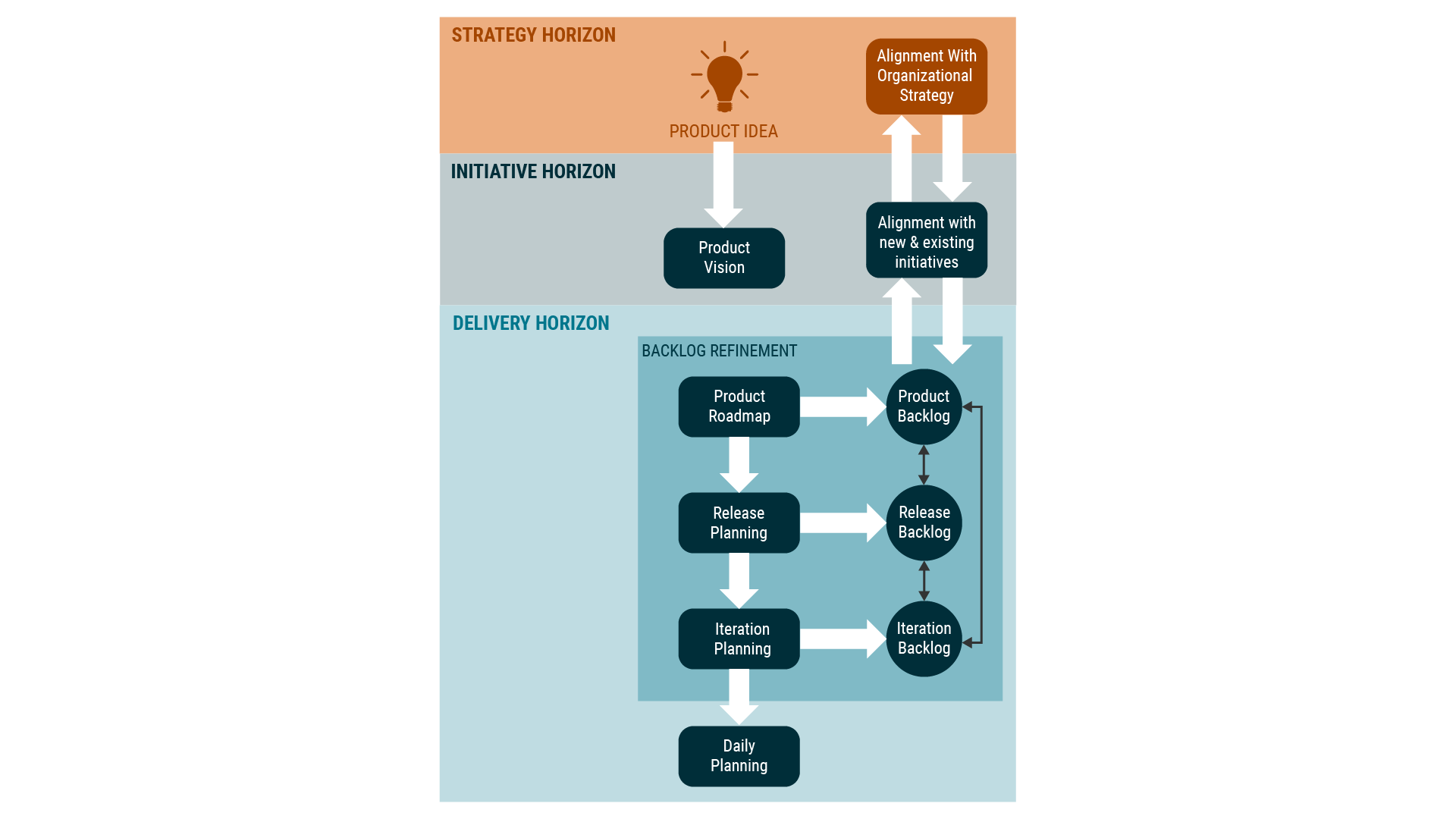 |
- Product Vision - The team uses the vision to inspire and motivate the work of the delivery team. It may evolve through the learn and adapt cycle.
- Product Roadmap - The team uses the product roadmap to visualize planning and track progress towards the goals associated with the vision. This transparency manages expectations and keeps the full product team informed. It also may evolve through the learn and adapt cycle.
- Release Planning - The team's focus shifts to the Initiative and Delivery Horizon using release planning to demonstrate features that will contribute to the vision and goals. It, too, may evolve through the learn- and-adapt cycle.
- Iteration Planning - The team focuses on the product vision by:
- Setting aligned iteration goals,
- Providing a ready product backlog, and
- Being available to answer questions.
- Daily Planning - Although it is optional for some team members to attend Daily Stand-ups, participation:
- Keeps them informed of progress,
- Raises awareness of obstacles and needed decisions, and
- Demonstrates partnership and commitment to the team.
Agile Extension Techniques
- Purpose Alignment Model: Assess product ideas in the context of customer and business value.
- Story Decomposition: Represent the requirements for a solution at the appropriate level of detail, aligned to desired outcomes from a stakeholder viewpoint.
Case Study: Product Alignment for Information Management - Real Estate Construction
| Background At a congratulatory team retreat for the successful launch of HomeQi, Les, a member of the senior leadership team of WRU, discussed the five-year plan of the organization. One of the key points was that WRU had to venture into foreign markets, mainly focusing on Nordic countries, in providing construction and project management services. That got Sem, the Product Owner, thinking. Challenge
The HomeQi product in its first avatar was meant for compiling all construction project data together with true-to-scale visualization. The primary purpose was the standardization of information across work teams. With the plan of geographical expansion, Sem anticipated that the product would require a realignment to the organization's goals. Action Sem and the product team decided to decompose this bigger problem into smaller, targetable pieces and thought of using the planning horizons. The team's approach was to:
Summary of the product team's product alignment to WRUs goals. Lessons Learned The product alignment process is continuous and iterative to assess and react to the needs. The planning horizons are an excellent construct to think of how the product can adapt in the future. It allows the POA Practitioners to think top-down and decompose changes to smaller, more manageable pieces. |