6. POA Techniques
6.16 Problem Definition Analysis
Guide to Product Ownership Analysis
Purpose
To effectively solve a problem, knowing and defining the problem that needs to be solved is essential. Problem discovery, problem framing, and problem scenarios and alternatives help to define the problem and prepare for solution design planning.
Description
Everyone collaborating on the product, from stakeholders to the delivery team, should have a common answer to these questions before the solution is designed.
Problem definition leads to a clear vision for the product. It pinpoints the target customer, it lays out the product roadmap, and prepares for planning the MVP. Articulating the problem leads to better ideas and better solutions. It is essential for the team to prioritize accurately, prototype, and plan a valuable MVP, MMF, MMR or MMP. These will help answer:
Problem discovery, problem framing, and problem scenarios and alternatives are problem-structuring exercises that help the team to:
The outcome of problem definition is a shared understanding and well- articulated problem statement.
Elements of Problem Definition and Analysis
Customer: Problem definition revolves around the customer and helps to identify the target customer. It leads to creating a shared vision and designing innovative solutions aimed at delivering value to that target customer.
Problem Discovery
Most customers have more than one problem that needs a solution. Product Owners probably cannot and do not want to solve all their problems, so decisions need to be made.
The Cynefin framework offers decision-makers a "sense of place" from which to view their perceptions. In agile product or service development, this framework can be used for a variety of decision-making efforts, including:
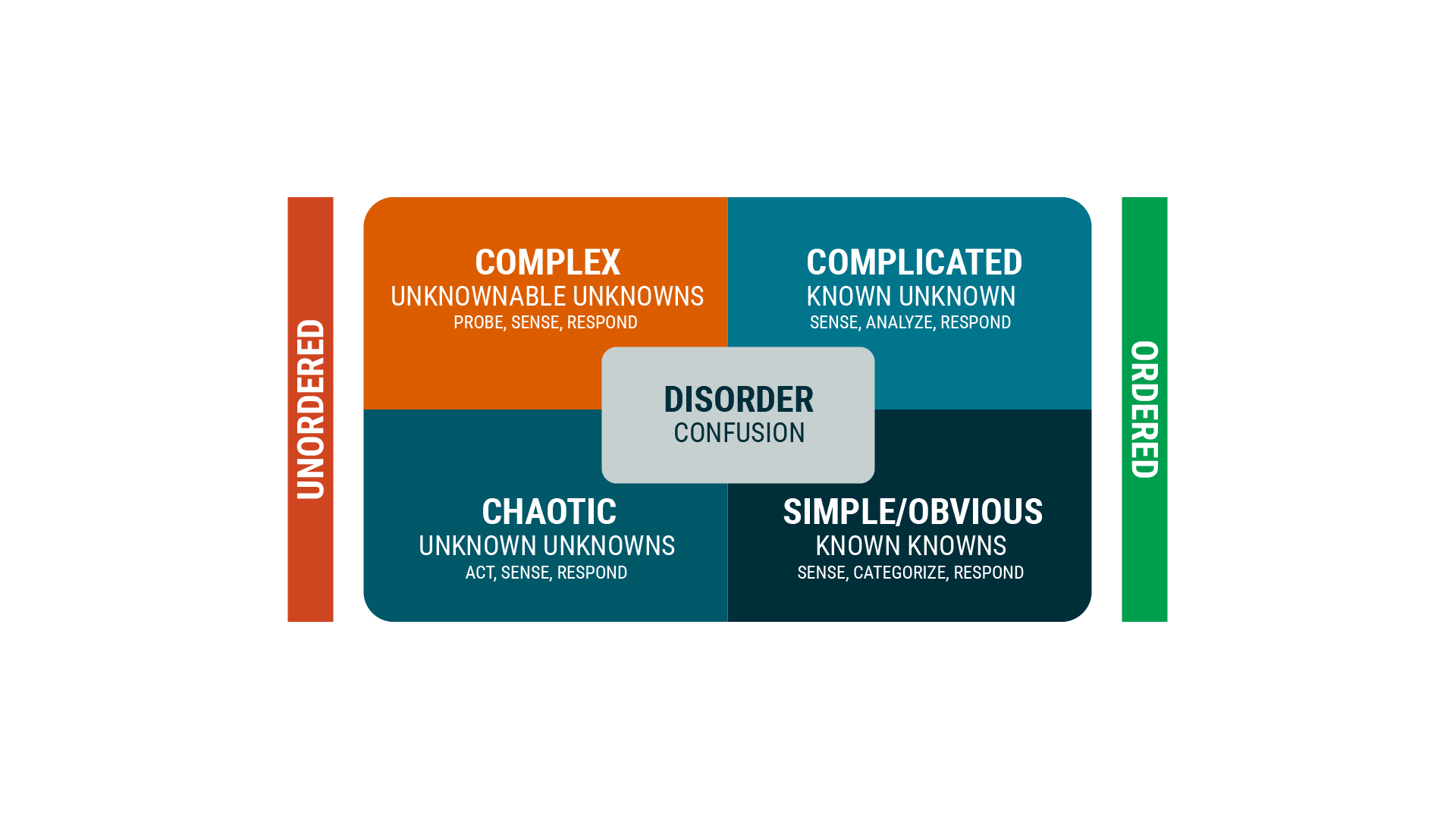
Using this framework creates an opportunity to:
Considerations for the product or service include:
Simple/Obvious
Problem-Framing
Framing the problem using the 4W's will help the team collaboratively reflect, synthesize, and articulate the problem. The problem framing canvas provides structured guidance for thoughtful conversations.
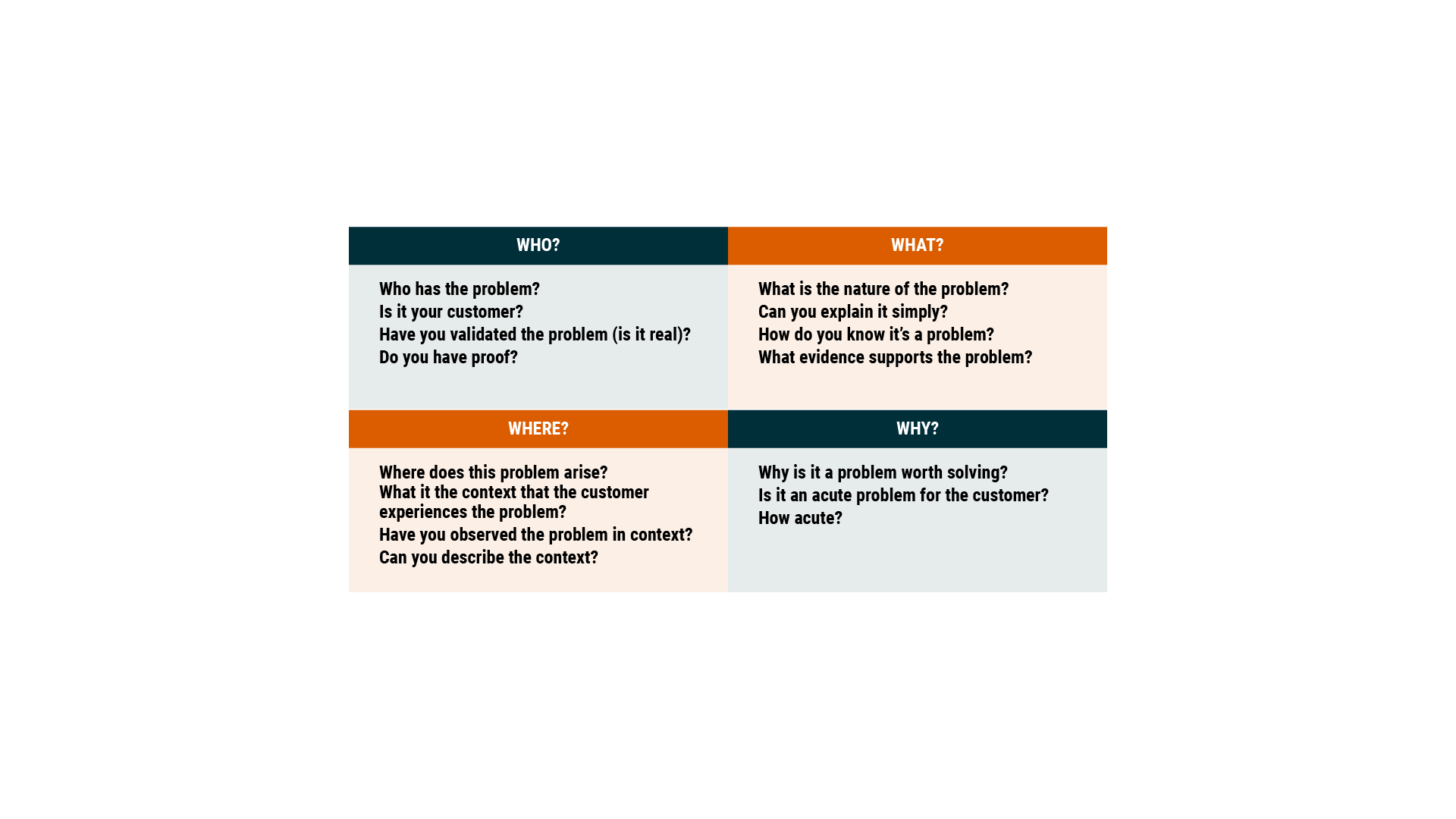
Example of a problem-framing team exercise:
Problem Scenarios and Alternatives
When Product Owners have a handle on customers' problem, needs, and desires, that is a good time for them to write some problem scenarios and expand their understanding of the alternatives that customers employ. Their current alternatives can provide another view of what is valuable to them.
This information can be gleaned from personas, empathy maps, journey maps, and the problem-framing canvas.
Extract scenarios where customer pain points arise and the path, they take to alleviate their pain. The current alternatives may be the competition for the product or service.
Begin to articulate the value propositions. They do not have to be formal. Generate ideas of potential customer value that the product or service may provide, focusing on any differentiators from competing alternatives.
Considerations for Problem Definition
Tips for Success
Description
Everyone collaborating on the product, from stakeholders to the delivery team, should have a common answer to these questions before the solution is designed.
- "What is the problem to be solved?"
- "Are we solving the right problem?"
Problem definition leads to a clear vision for the product. It pinpoints the target customer, it lays out the product roadmap, and prepares for planning the MVP. Articulating the problem leads to better ideas and better solutions. It is essential for the team to prioritize accurately, prototype, and plan a valuable MVP, MMF, MMR or MMP. These will help answer:
- "Is there a problem worth solving?"
- "Does everyone involved understand the problem?"
- "What alternatives are currently in place to accommodate the problem?"
- Personas,
- Customer journey mapping,
- Empathy mapping,
- Interviews,
- Observation, and
- Intelligent Learning through data analysis.
Problem discovery, problem framing, and problem scenarios and alternatives are problem-structuring exercises that help the team to:
- Define and answer critical questions,
- Validate a problem, and
- Define a problem that is worth pursuing.
The outcome of problem definition is a shared understanding and well- articulated problem statement.
Elements of Problem Definition and Analysis
Customer: Problem definition revolves around the customer and helps to identify the target customer. It leads to creating a shared vision and designing innovative solutions aimed at delivering value to that target customer.
Problem Discovery
Most customers have more than one problem that needs a solution. Product Owners probably cannot and do not want to solve all their problems, so decisions need to be made.
The Cynefin framework offers decision-makers a "sense of place" from which to view their perceptions. In agile product or service development, this framework can be used for a variety of decision-making efforts, including:
- MVP planning,
- Feature or user story prioritization,
- User story estimating, or
- Tool selection.
Using this framework creates an opportunity to:
- Ask more questions,
- Ask different questions,
- Capture assumptions and perceptions, and
- Reveal things that need further attention.
Considerations for the product or service include:
Simple/Obvious
- Simple problem,
- The solution is evident,
- Maybe a quick win, and
- May not be innovative enough to wow the customer.
- Need input from experts or analysis,
- Questions are known,
- Usually worth investigating further, and
- Potential to wow the customer.
- Start here!
- Need to identify and resolve unpredictability,
- Safe to fail experiments or prototypes may help move out of this zone,
- Risk of failure if “complicated and simple”are done first,
- Understand technical implications and requirements, and
- Potential to wow the customer at a high cost if not resolved.
- Extreme innovation zone.
- Not knowing where one is.
Problem-Framing
Framing the problem using the 4W's will help the team collaboratively reflect, synthesize, and articulate the problem. The problem framing canvas provides structured guidance for thoughtful conversations.
Example of a problem-framing team exercise:
| Action | Time Alloted | |
| Reflect |
|
10 min. |
| Synthesis |
|
20 min. |
| Reflect |
|
10 min. |
| Synthesis |
|
Problem Scenarios and Alternatives
When Product Owners have a handle on customers' problem, needs, and desires, that is a good time for them to write some problem scenarios and expand their understanding of the alternatives that customers employ. Their current alternatives can provide another view of what is valuable to them.
This information can be gleaned from personas, empathy maps, journey maps, and the problem-framing canvas.
Extract scenarios where customer pain points arise and the path, they take to alleviate their pain. The current alternatives may be the competition for the product or service.
| Product <name of product> |
| <describe the problem scenario> | <describe the current alternative> | <describe the value proposition of the current alternative> |
Begin to articulate the value propositions. They do not have to be formal. Generate ideas of potential customer value that the product or service may provide, focusing on any differentiators from competing alternatives.
Considerations for Problem Definition
| Strengths | Limitations |
|
|
Tips for Success
- Elicit information about customers in their own environment to aid in a deeper understanding of the customer problem.