
Skip to content
Browse
BABOK Guide
BABOK Guide
10. Techniques
Introduction 10.1 Acceptance and Evaluation Criteria 10.2 Backlog Management 10.3 Balanced Scorecard 10.4 Benchmarking and Market Analysis 10.5 Brainstorming 10.6 Business Capability Analysis 10.7 Business Cases 10.8 Business Model Canvas 10.9 Business Rules Analysis 10.10 Collaborative Games 10.11 Concept Modelling 10.12 Data Dictionary 10.13 Data Flow Diagrams 10.14 Data Mining 10.15 Data Modelling 10.16 Decision Analysis 10.17 Decision Modelling 10.18 Document Analysis 10.19 Estimation 10.20 Financial Analysis 10.21 Focus Groups 10.22 Functional Decomposition 10.23 Glossary 10.24 Interface Analysis 10.25 Interviews 10.26 Item Tracking 10.27 Lessons Learned 10.28 Metrics and Key Performance Indicators (KPIs) 10.29 Mind Mapping 10.30 Non-Functional Requirements Analysis 10.31 Observation 10.32 Organizational Modelling 10.33 Prioritization 10.34 Process Analysis 10.35 Process Modelling 10.36 Prototyping 10.37 Reviews 10.38 Risk Analysis and Management 10.39 Roles and Permissions Matrix 10.40 Root Cause Analysis 10.41 Scope Modelling 10.42 Sequence Diagrams 10.43 Stakeholder List, Map, or Personas 10.44 State Modelling 10.45 Survey or Questionnaire 10.46 SWOT Analysis 10.47 Use Cases and Scenarios 10.48 User Stories 10.49 Vendor Assessment 10.50 Workshops

6. POA Techniques

6.28 Value Stream Mapping

Guide to Product Ownership Analysis

Purpose

Value Stream Mapping is used to provide a complete, fact-based, time-series representation of activities required to deliver a product or service to the customer.

See section 7.23 of Agile Extension V2 for details.
Value stream mapping has its origin in manufacturing, for analyzing supply chain elements. This technique is adopted in the context of product ownership analysis. Historically, the definition of value in supply chain processes has been either cost or cycle time, but from a POA perspective, the extended product team often decides the definition of value. It may change depending on the product lifecycle.

For example, customer acquisition may be used as a measure of value during product launch and may change to customer lifetime value during the product maturity phase.

The definition of value may be fluid in agile product management and can be a subjective assessment, as opposed to a defined metric, if the product team has a shared understanding of the value delivered through the product.

Product value stream is often defined at the appropriate agile horizon to derive maximum value.
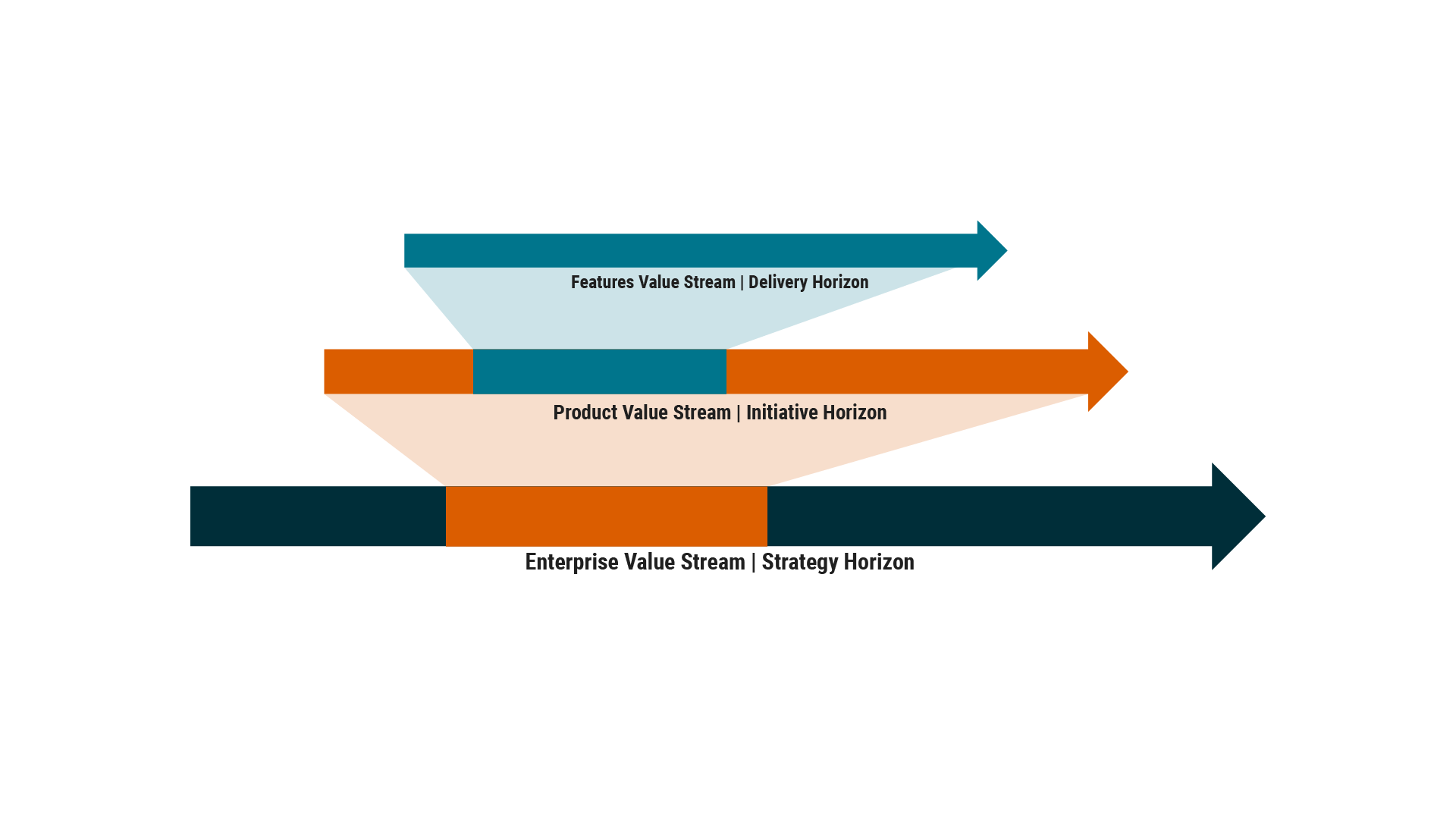
Value Stream Mapping.png
POA Domain Value Stream Mapping
Applying Foundational Concepts
  • A tool to gain a broader portfolio view for a group of products.
  • To evaluate the output from one product to determine if it is beneficial to another, which provides strategic alignment for the product to enterprise objectives.
Cultivate Customer Intimacy
  • The learnings and analysis from value stream mapping from other domains can be used to augment a deeper understanding of the customer, and for evaluating or evolving the product.
Engage the Whole Team
  • To conduct value stream mapping, the entire product team, as well as cross-functional representatives, must be involved for a variety of perspectives.
Make an Impact
  • Analyze the flow of product features, product workflows, or transactions to assess the pieces that are valuable for a better product-market fit and to craft a better value proposition.
  • Helps practitioners find the right time to ship product features for maximum impact.
Deliver Often
  • Plan the delivery of features by analyzing the flow of product features, product workflows, or transactions, to visually show how value is enhanced over time.
  • Helps in effectively planning iterations and releases by taking a cue from visual inputs from different value streams (i.e., where the team is tracking multiple descriptions or definitions of value).
Learn Fast
  • Contextualizes different KPIs across value streams to ensure that each element improves the metrics and allows planning of iteration and releases that help with strategic, market, and delivery assessments.
Obsess About Value
  • Applied at different agile horizons to capture the essence of value delivery.
  • Provides more detail than process flows, which takes the “time” element to enumerate the flow of activities.
  • Value stream can adapt to a different definition of value to continuously assess strategic, market and product alignment.