
6. POA Techniques
6.4 Customer Journey Map
Guide to Product Ownership Analysis
Purpose
A customer journey map is a visual representation of the end-to-end customer experience from the customer perspective. It reveals the customers' experiences and motivations when interacting with a specific brand and products at various touchpoints. This allows organizations to deliver personalized and highly relevant customer experiences.
Customer journey maps are beneficial in:
There are variations of customer journey maps. However, common components include
Description
Organizations undertaking digital transformation have created a heightened need to ensure a robust and seamless customer experience across all customer touchpoints. Due to their holistic nature, customer journey maps provide insight on:- Customer needs,
- Emotions, and
- Touchpoints.
- Satisfy pain points,
- Alleviate fragmentation, and
- Expose new opportunities to improve the customer experience.
- Understanding how a customer felt before they started the journey may provide:
- Insights or additional questions,
- Knowing why they like the way something works, or
- Hearing what they wish it did (each time they do the thing that they do not like).
Customer journey maps are beneficial in:
- Identifying touchpoints (i.e., where customers interact with the organization),
- Giving an external perspective to the sales process,
- Focusing the business on customer needs at different stages in the buying process,
- Showing gaps between desired customer experience and the one received, and
- Allowing to concentrate resources on what matters most to maximize effectiveness.
There are variations of customer journey maps. However, common components include
- Stages or Touchpoints: These include the occasions when the customer interacts with the organization in some capacity.
- Awareness - The potential customer is aware of a need or problem, and the product is one of the possible solutions.
- Consideration - The customer has researched the product and compared it to its competitors to help evaluate whether to purchase it or narrow down the options.
- Decision - The customer has evaluated the product against competitive products and, based on it being "fit for use" and "fit for purpose," decided to purchase one of them.
- Retention - Post-purchase, the organization needs to remain engaged with their customers, and gather their feedback to improve the product and the customer experience.
- Advocacy - The organization needs to convert customer loyalty to word-of-mouth advocacy.
- Activities or Actions: These occur within each of the stages that include communications and interactions between the customer and the organization.
- Channels: The channels through which the customer interactions and communications happen.
- Expectations: The organization's perception of what the outcome of each stage should be, including what the customer should feel or experience.
- Experiences: The outcome and experience of each stage, from the customer perspective.
- Feelings: How the customer was feeling at each stage, choosing from a range of emotions.
There is no one-size-fits-all for a customer journey map since it depends on the business, product or service that is being mapped. Some standard practices for a basic map include:
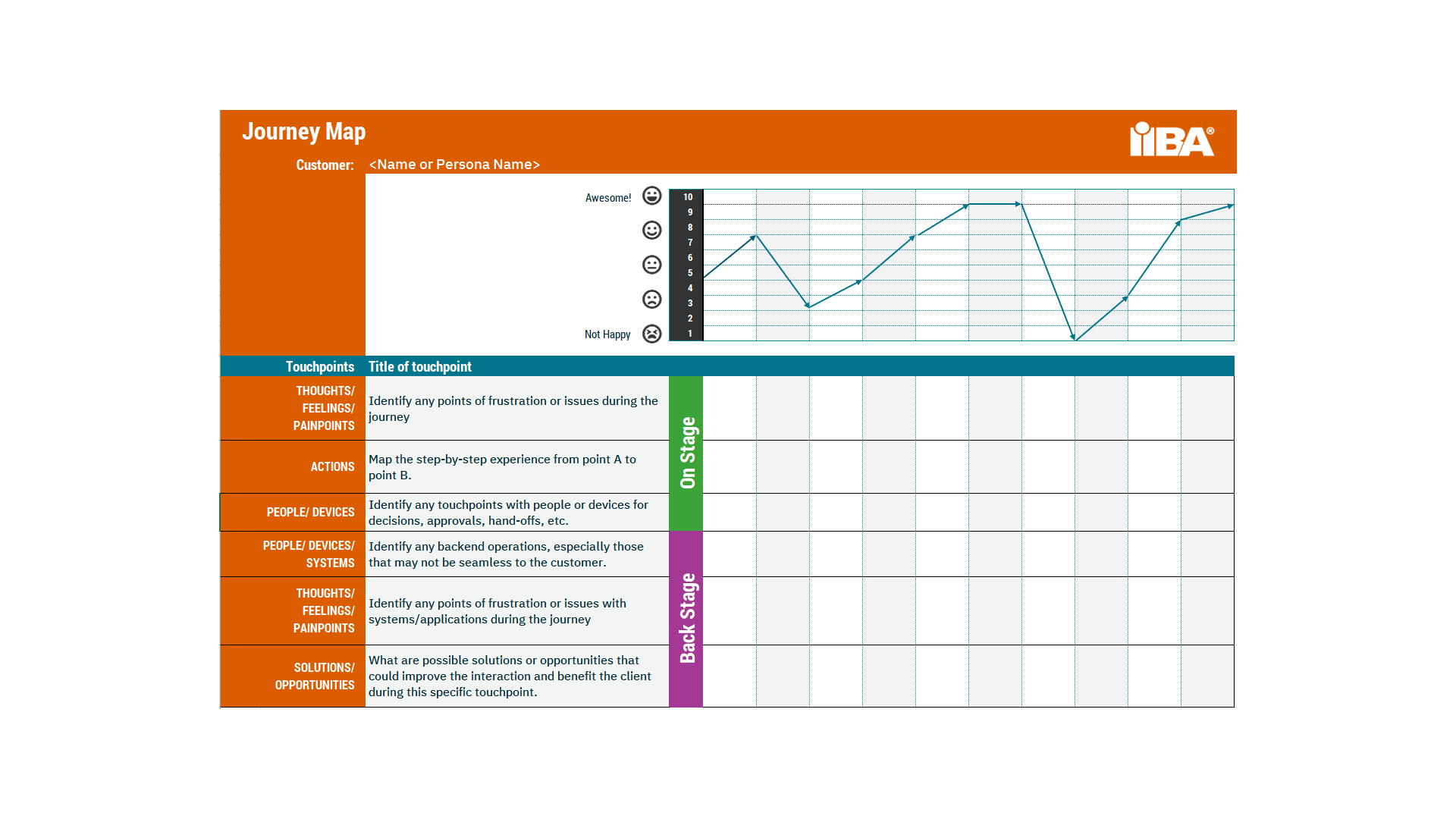
Customer Journey Map Considerations
Tips for Success
- Identify a clear goal for creating the journey map and for what you want to achieve from the exercise. It may include:
- Understanding the current state,
- Improving the current state,
- Designing the future state,
- Moving from known current to desired future,
- Developing a customer-centric roadmap, or
- Developing an innovative new offering.
- Identify target customers and define the customer (e.g., persona). Select one or more candidates from each persona to participate in creating the customer journey map.
- Determine the type of journey map is most appropriate for the project by asking, "What template is best suited? How many customer segments are there? What is the timeline of the journey?" Additional criteria to determine the right type of journey map include:
- Customer goals,
- Single-touchpoint experience,
- Single-channel experience,
- Front and backstage experience,
- Cross-touchpoint experience, and
- Cross-channel experience.
- Map out all the possible customer touchpoints or stages.
- Understand what the target customers want to achieve within each touchpoint or stage, and the expected value they want to be delivered.
- Identify customer pain points (both qualitative and quantitative).
- Assess, prioritize, address issues, improve experiences and add actions including those responsible for implementing them.
- Update the journey map to reflect changes in customer needs, or in the marketplace, and improve accordingly.
Customer Journey Map Considerations
| Strengths | Limitations |
|
|
Tips for Success
- Identify and map all customer touchpoints (direct or indirect, small, or big).
- Determine the critical touchpoints that make or break the customer's decision.
- Use the 80/20 rule to select the touchpoints that can heavily influence and impact the customer.
- Differentiate frontstage touchpoints from backstage touchpoints to provide a separation from customer-facing touchpoints to those with backend activities. Highlight dependencies and links between touchpoints.
- Complement the customer experience with insightful metrics and quotes from customers.
- Collaborate with other internal and external stakeholders involved in the customer journey map to add additional context and insight.
- Provide a comprehensive view that enables organizations to integrate enterprise architecture with customer experience when combined with business process modelling. It also shows multiple paths that can occur between touchpoints.
- Avoid making customer journey maps too detailed as it is easy to get lost in those details.