
Skip to content
Browse
BABOK Guide
BABOK Guide
10. Techniques
Introduction 10.1 Acceptance and Evaluation Criteria 10.2 Backlog Management 10.3 Balanced Scorecard 10.4 Benchmarking and Market Analysis 10.5 Brainstorming 10.6 Business Capability Analysis 10.7 Business Cases 10.8 Business Model Canvas 10.9 Business Rules Analysis 10.10 Collaborative Games 10.11 Concept Modelling 10.12 Data Dictionary 10.13 Data Flow Diagrams 10.14 Data Mining 10.15 Data Modelling 10.16 Decision Analysis 10.17 Decision Modelling 10.18 Document Analysis 10.19 Estimation 10.20 Financial Analysis 10.21 Focus Groups 10.22 Functional Decomposition 10.23 Glossary 10.24 Interface Analysis 10.25 Interviews 10.26 Item Tracking 10.27 Lessons Learned 10.28 Metrics and Key Performance Indicators (KPIs) 10.29 Mind Mapping 10.30 Non-Functional Requirements Analysis 10.31 Observation 10.32 Organizational Modelling 10.33 Prioritization 10.34 Process Analysis 10.35 Process Modelling 10.36 Prototyping 10.37 Reviews 10.38 Risk Analysis and Management 10.39 Roles and Permissions Matrix 10.40 Root Cause Analysis 10.41 Scope Modelling 10.42 Sequence Diagrams 10.43 Stakeholder List, Map, or Personas 10.44 State Modelling 10.45 Survey or Questionnaire 10.46 SWOT Analysis 10.47 Use Cases and Scenarios 10.48 User Stories 10.49 Vendor Assessment 10.50 Workshops

5. The POA Framework

5.5 Deliver Often

Guide to Product Ownership Analysis
Framework - Deliver Often .png
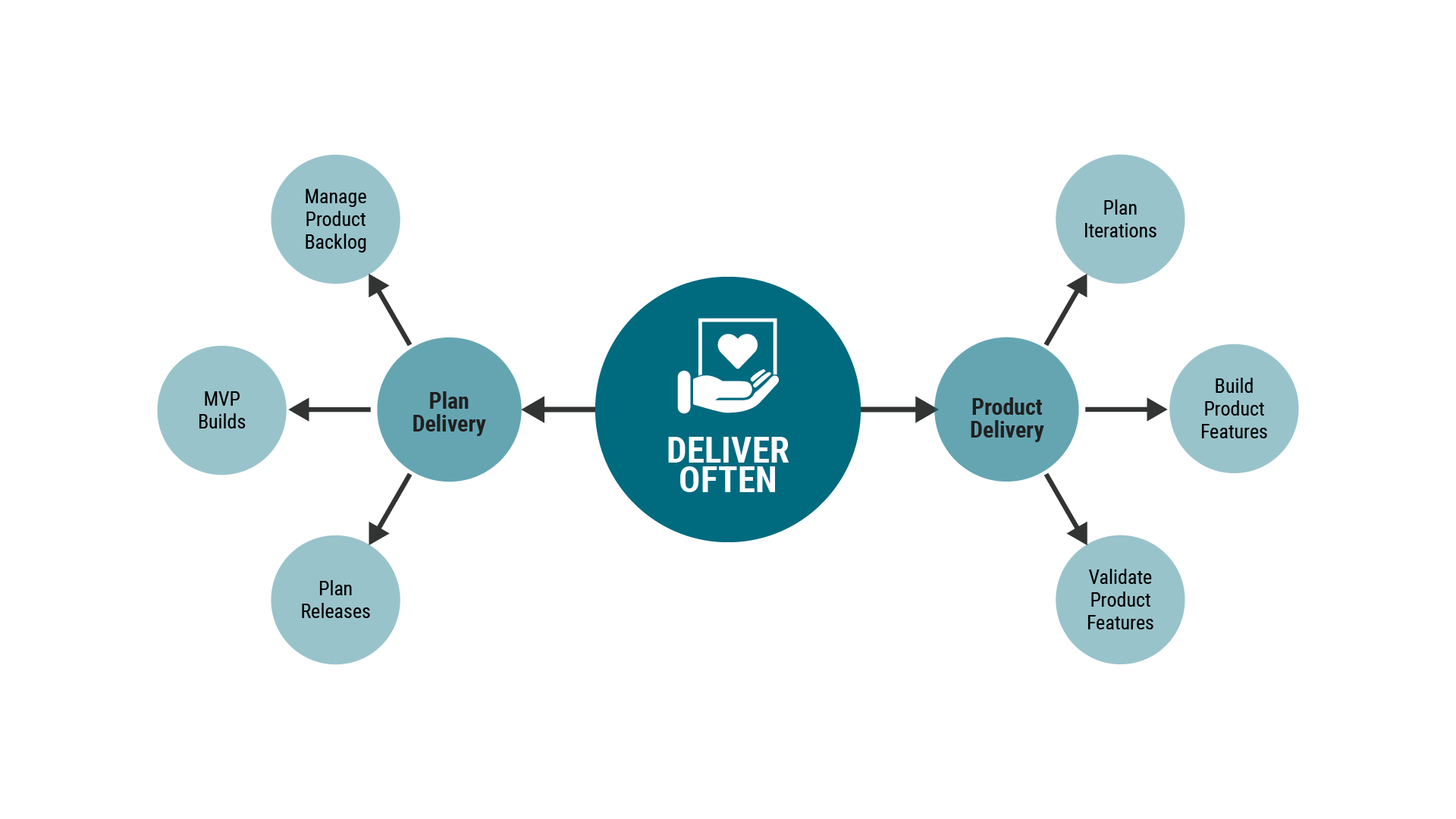
A customer-centric, agile mindset drives the POA Practitioner's thinking and behaviour towards value maximization. This mindset, combined with a set of practices and techniques, enables effective delivery of "just enough of the right product to the right people, early and often".

Deliver Often is motivated by the desire for continual assessment of value. It:
  • Breaks deliverables into smaller-sized, meaningful outcomes that can be shared for early and frequent feedback.
  • Focuses thoughts and actions to know the value of each task, and how that task contributes from the product backlog item (PBI) level through to the feature and/or component level.
  • Reduces risk and validates assumptions through frequent assessment and evaluation.
  • Manages costs and resource planning.
  • Guides decisions and is guided by demonstrations of value.
  • Requires dedication to ask questions and seek measurable answers.
  • Puts the customer at the centre of everything.
The agile mindset helps POA Practitioners rally the team to:
  • Plan,
  • Prepare,
  • Build, and
  • Deliver often.
The main aspects of an agile mindset include:
  • Deliver value rapidly and consistently,
  • Collaborate courageously,
  • Iterate to learn,
  • Simplify to avoid waste,
  • Consider the context and adapt to realities,
  • Reflect on feedback and adapt both product and process, and
  • Produce the highest quality products.
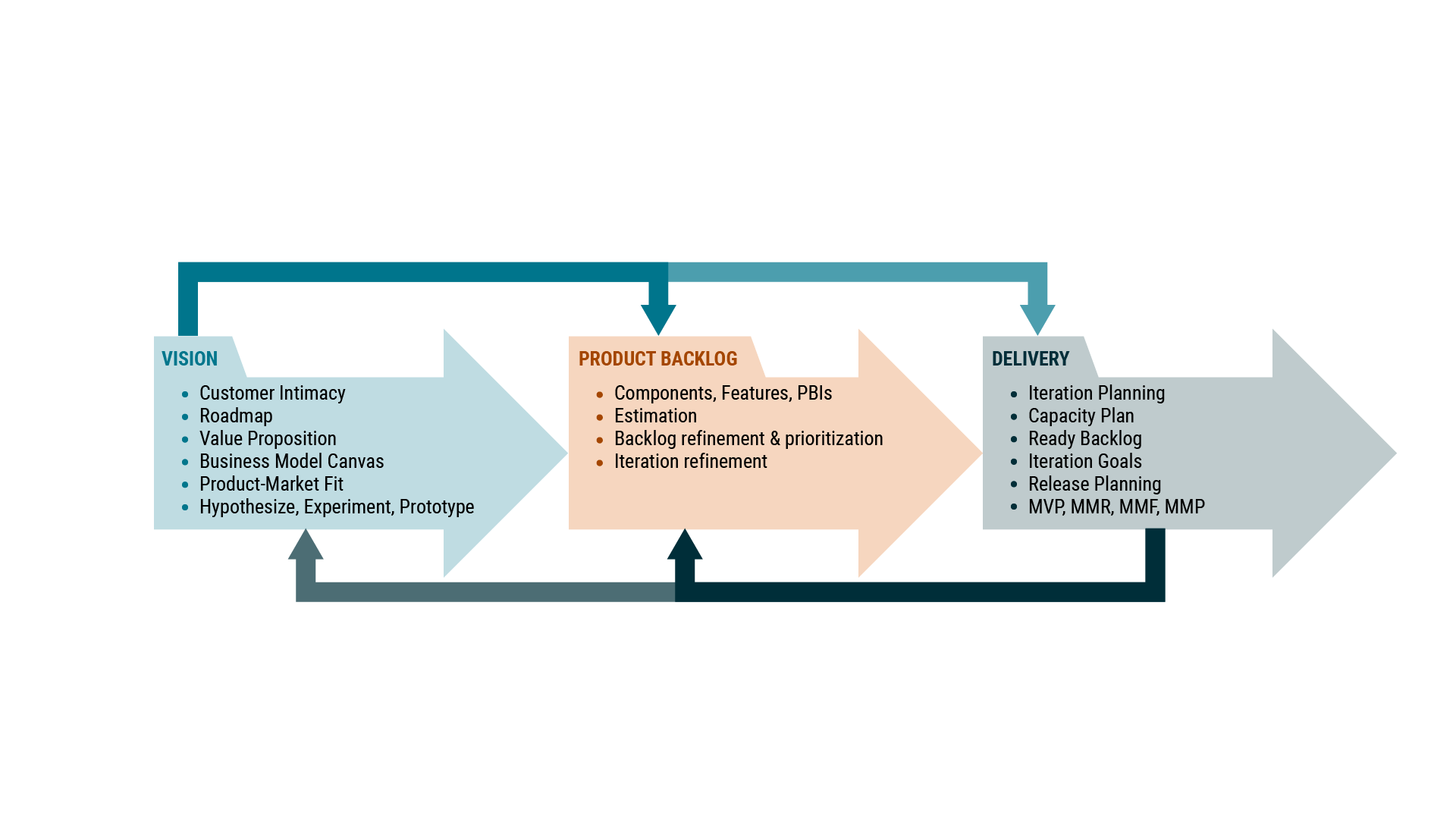
The main aspects of an agile mindset also guide the Product Owner and the delivery team to identify small, valuable increments that can be delivered to allow for insightful, meaningful feedback and evaluation.

Planned product components are delivered as increments. They:
  • Are shared sooner for customer validation, or
  • Unfold risk and cost, enabling early adjustments or strategic decisions, or
  • Hypothesize and experiment with a focus on the frequency of value assessment.
Vision to Delivery.png