
5.5 Deliver Often
5.5.1 Plan Delivery
Guide to Product Ownership Analysis

Agile delivery is a business strategy that creates value through fast feedback and short decision cycles. Planning is an activity that is a big part of the Product Owner's role and adopting effective POA can help. Agile planned delivery puts the focus on planning not on the plan.
Agile delivery planning can be iterative and adaptive.
The definition of Agile delivery is broad and leaves room for confusion and misunderstanding. Stakeholders may expect more than what is delivered. For example:
Planned delivery is healthy for the delivery team. It contributes to the value- focused attribute of an agile mindset by challenging the team to answer, "How will we know?" before starting work. It contributes to a culture of trust and transparency.
The Definition of Doneis used to clarify understanding of what completeness means for PBI work, iteration work and feature work. Applying this concept to articulate a Definition of Delivery enables collaborations and communication across the delivery team and the stakeholders. It sets expectations and helps mitigate any confusion among the delivery team and the stakeholders.
To facilitate planned delivery, the team:
Agile delivery planning can be iterative and adaptive.
- Iterative planning prioritizes and refines the work in short cycles designed to provide focus and increase the feedback and learning gained from stakeholders.
- Adaptive planning involves a continuous change to long-term plans. Evaluation is used to prioritize and refine the work to be done to deliver the highest value.
- Slicing the product into small pieces,
- Prioritizing them by business value,
- Addressing the riskiest items as early as possible, and
- Delivering new items of value frequently.
The definition of Agile delivery is broad and leaves room for confusion and misunderstanding. Stakeholders may expect more than what is delivered. For example:
- Stakeholders may not understand an experimental delivery to test technical features that are believed to add value by accelerating business capabilities. Delivering a prototype may be the option chosen to prove and demonstrate the functionality. It may only include basic features that build the foundation but does not demonstrate the full potential from a stakeholder's view.
Planned delivery is healthy for the delivery team. It contributes to the value- focused attribute of an agile mindset by challenging the team to answer, "How will we know?" before starting work. It contributes to a culture of trust and transparency.
The Definition of Doneis used to clarify understanding of what completeness means for PBI work, iteration work and feature work. Applying this concept to articulate a Definition of Delivery enables collaborations and communication across the delivery team and the stakeholders. It sets expectations and helps mitigate any confusion among the delivery team and the stakeholders.
To facilitate planned delivery, the team:
- Manages the product backlog,
- Defines the MVP, and
- Plans releases.
Effective POA guides the direction of the product and maximizes the value of the product through a product backlog. The product backlog is a list of items related to building a product, referred to as product backlog items (PBIs).
The source of PBIs may trace back to the customer, business, or technical items that are gathered throughout the strategy and initiative horizons. The Product Owner owns the product backlog and is accountable for managing it.
Iterative and adaptive planning both reference the need to "prioritize and refine the work." "The work" is captured as product backlog items in the product backlog. The PBIs roll up to a component, feature, or shippable product.
A product backlog is not a dumping ground for every request, an issue log for every submission, or a placeholder for every piece of work that may be considered for a product. In general, a healthy, well-managed product backlog:
As the owner of the backlog, the Product Owner understands the importance and value of consistent backlog management and can use POA practices to good effect. As a central touchpoint for everything related to the delivery of value, the product backlog is a continuous:
The health of the product backlog is reflective of the health of the team. Each domain within this Guide helps the team navigate the give and take required for better culture and teamwork, leading to better backlog health and, ultimately, better product delivery.
POA Techniques to Manage Product Backlog
Agile Extension Techniques
Case Study: Manage Product Backlog - Food Manufacturer
The source of PBIs may trace back to the customer, business, or technical items that are gathered throughout the strategy and initiative horizons. The Product Owner owns the product backlog and is accountable for managing it.
Iterative and adaptive planning both reference the need to "prioritize and refine the work." "The work" is captured as product backlog items in the product backlog. The PBIs roll up to a component, feature, or shippable product.
A product backlog is not a dumping ground for every request, an issue log for every submission, or a placeholder for every piece of work that may be considered for a product. In general, a healthy, well-managed product backlog:
- Demonstrates the product development strategy,
- Is the single source for product requirements,
- Includes 1 - 2 iterations of PBIs that meet the Definition of Ready,
- Includes 1 - 2 iterations of PBIs that are in refinement,
- Includes PBIs as a list of all work that needs to be completed to deliver a product,
- Is prioritized, estimated, and sorted, and
- Articulates the business and/or technical value of every PBI.
As the owner of the backlog, the Product Owner understands the importance and value of consistent backlog management and can use POA practices to good effect. As a central touchpoint for everything related to the delivery of value, the product backlog is a continuous:
- Receipt of work,
- Refinement of work, and
- Delivery of done work.
The health of the product backlog is reflective of the health of the team. Each domain within this Guide helps the team navigate the give and take required for better culture and teamwork, leading to better backlog health and, ultimately, better product delivery.
POA Techniques to Manage Product Backlog
Agile Extension Techniques
- Job Stories: Explain common activities, transactions, and workflows in a product as PBIs.
- Real Options: Determine when to make decisions. It is useful in determining the flow of the product backlog and the priority of PBIs.
- Relative Estimation: Make future predictions based on:
- Experience,
- Knowledge,
- Complexity,
- Size, and
- Uncertainty required to complete backlog items.
- Story Mapping: Assist with prioritizing product delivery and creating an understanding of:
- Product functionality,
- The flow of use, and
- Assist with prioritizing product delivery.
- Value Stream Mapping: Provide a complete, fact-based, time-series representation of the stream of activities required to deliver a product.
- Backlog Management: Record, track, and prioritize remaining work items.
- Balanced Scorecard: Manage performance in any business model, organizational structure, or business process. It helps with aligning backlog items to objectives.
- Brainstorming: Collaborative planning of PBIs.
- Collaborative Games: A tool to increase participation, collaboration and shared understanding of product backlog or elaboration of PBIs.
- Concept Modelling: Capture the main product and industry domain concepts to help build an understanding of concepts and their interrelationships. It aids in understanding PBIs and their dependence on prioritization, estimation, and elaboration.
- Data Modelling: Capture data elements tied to the product and their relationships which help detail the PBIs and their effect on the underlying data and data structures.
- Functional Decomposition: Successively decompose components, features and PBIs into implementable items and tasks.
- Interface Analysis: Identify where, what, why, when, how, and for whom information is exchanged between solution components, making the PBIs more comprehensive.
- Interviews: An elicitation tool to discover PBIs from stakeholders.
- Metrics and Key Performance Indicators (KPIs): Verify the success and failure of successful implementation of PBIs.
- Prioritization: A set of tools to manage the flow of the products and PBI.
- Process Modelling: Create a detailed understanding of different processes involved or affected by the product, which helps in discovering new PBIs or analyzing the effectiveness of deployed items.
- Prototyping: Demonstrate the delivered and deployed PBIs to stakeholders in order to gather feedback or elicit future PBIs.
Case Study: Manage Product Backlog - Food Manufacturer
| Background Tony, the Product Owner for the New Product Intake Process at Poultry Plus, established a Now-Next-Later Product Backlog at the outset of the initiative and had the high-level features laid out on a timeline for delivery. The next step was to get started organizing the "now" portion of the backlog and drive the product team toward their delivery goals. Challenge Although the features had been broken into smaller chunks of delivery for immediate versus longer-term needs, there was a lot of work to do. The team wanted to deliver testable functionality in every sprint to ensure the business users, as well as the end customers, were getting satisfying deliveries that built confidence toward the final release and future revisions. Tony and the team had established a User Story map and organized it to guide their development timeline. Action Tony led the team in activities to manage the backlog each sprint. For the initial sprint, they used concept modelling to determine which features had dependencies and which needed to be completed before the next one could be built. For example, it did not make sense to build customer product details without an understanding of the full project.
Outcome For example, when discussing the hierarchy of project, product, ingredients, and packaging, it was determined that one project may have one or many products. In this case, each product had many ingredients, and packaging may have been the same for some products, but not all. This was more easily determined using a visual diagram. After that, the backlog could be organized according to the agreed-upon hierarchy. 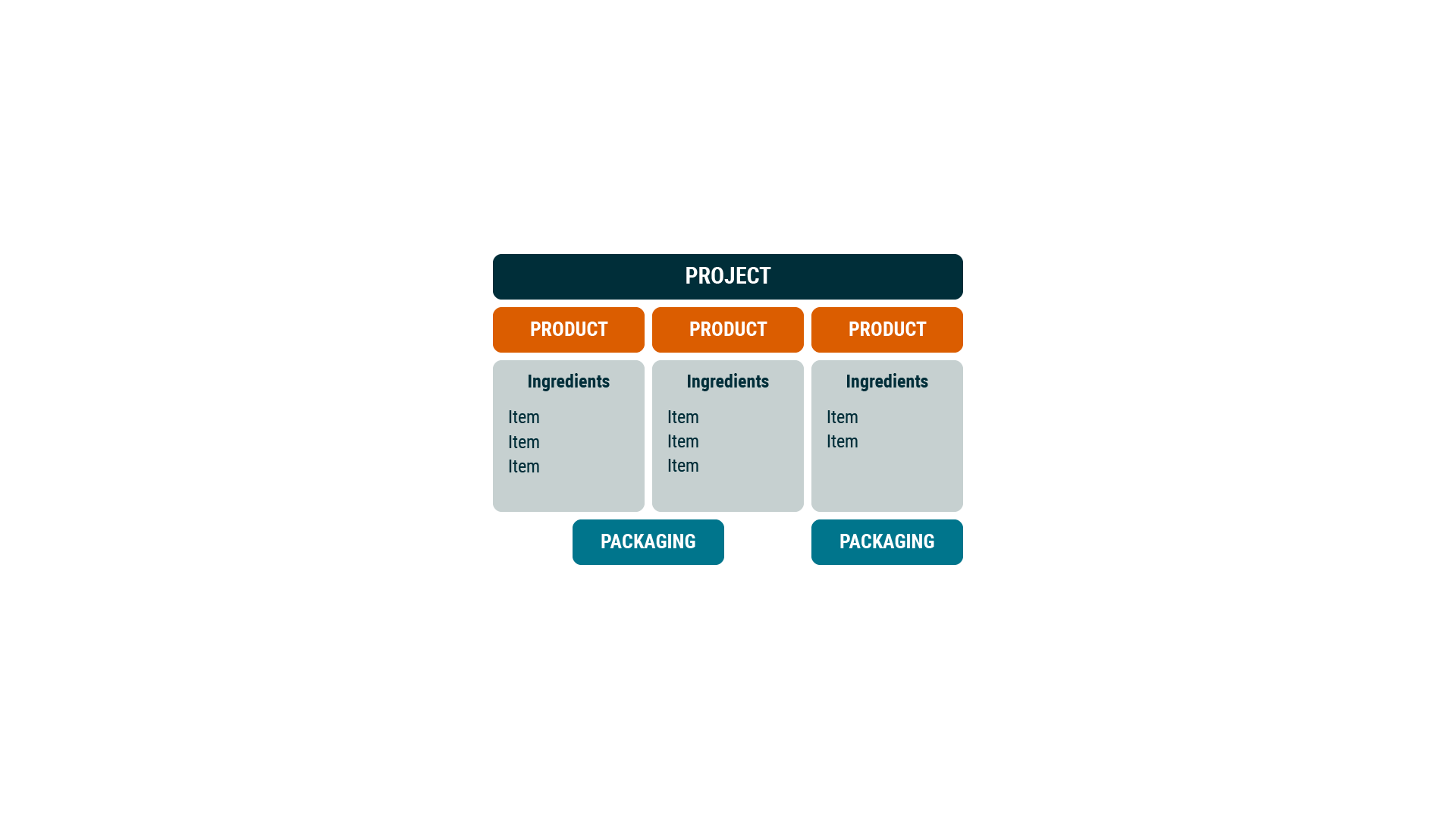 Lessons Learned The business team for the New Product Intake Process was distributed across three different locations, and they did most of their discussion via web conference. Tony found that the business team could talk easier about visual depictions since it was easy to re-arrange process tasks using sticky notes and a whiteboard. Since they were not co-located, Tony had to get a bit creative with collaborative tools to use. He found the use of simple hand- held dry-erase boards held up to his camera to be effective for these conversations. Once agreed-upon, it was just a matter of adjusting the backlog to match the diagrams to keep the development process flowing. |
Minimal Viable Product (MVP) is a concept used to reduce cost and risk associated with developing the wrong product, by:
MVP is "the fastest way to get through the Build-Measure-Learn feedback loop with the minimum amount of effort" - Agile Extension.
The MVP aims to:
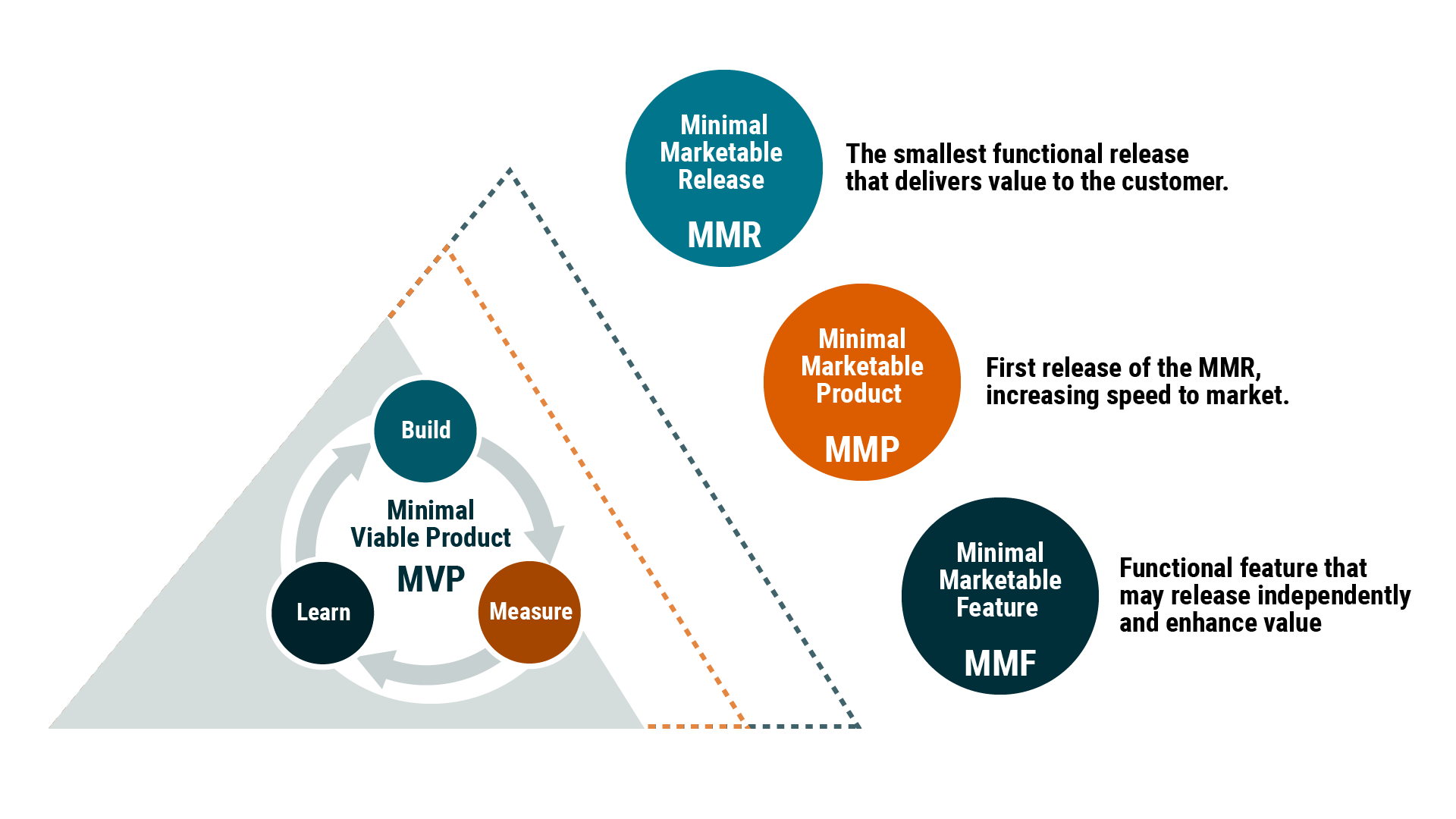
This led to the introduction of the:
One or several MVP's may roll up to an MMR, MMP or MMF, each adding components, features or improvements and providing opportunity for intelligent learning and value assessment.
The MVP demonstrated to business stakeholders may:
Feeling the constant passion to help customers, the drive to deliver often, and the urge to demonstrate value, the team wants to get the MVP right.
The MVP Build opens opportunities for carefully planned learning. While customer intimacy is forefront, the team benefits from some technical knowledge. Recognizing the importance of security and the right technical foundation to support the product, must be a priority. Knowledge gained through trusted relationships with Developers and Architects helps the team:
POA Practitioners will utilize people, processes, and technology to elicit and analyze information to find the right fit to deliver thoughtful calculated MVP builds. The first MVP is important. How it is delivered may be as important as what is delivered.
POA Techniques for MVP Builds
Agile Extension Techniques
Case Study: MVP Builds - Food Manufacturer
- Testing a hypothesis,
- Reducing waste, or
- Increasing speed to customers for feedback and learning.
MVP is "the fastest way to get through the Build-Measure-Learn feedback loop with the minimum amount of effort" - Agile Extension.
The MVP aims to:
- Represent the smallest, most cost-effective version of the product that maximizes validated learning opportunities from customer feedback.
- Validate a hypothesis through experimentation.
- Be inclusive of technical, market, regulatory or other supporting and enabling work.
- Organization,
- Strategy,
- Customer,
- Product, and
- Value proposition.
- What is enough to release,
- When to release it,
- Who to release to, and
- How to improve communication and shared understanding.
This led to the introduction of the:
- Minimal Marketable Release (MMR),
- Minimal Marketable Product (MMP), or
- Minimal Marketable Feature (MMF)
One or several MVP's may roll up to an MMR, MMP or MMF, each adding components, features or improvements and providing opportunity for intelligent learning and value assessment.
The MVP demonstrated to business stakeholders may:
- Be a prototype or a pilot,
- Be just enough to deliver measurable value, or
- Provide options.
- “How much is enough to add value?”
- “How will we know?”
- “Is there sufficient value to move forward?”
Feeling the constant passion to help customers, the drive to deliver often, and the urge to demonstrate value, the team wants to get the MVP right.
The MVP Build opens opportunities for carefully planned learning. While customer intimacy is forefront, the team benefits from some technical knowledge. Recognizing the importance of security and the right technical foundation to support the product, must be a priority. Knowledge gained through trusted relationships with Developers and Architects helps the team:
- Prioritize work,
- Balance decisions, and
- Communicate effectively with stakeholders.
| What it is |
| Building a viable product | Minimal effort with maximum learning | Evidence-based learning |
|
|
|
| What it might be |
| Functional prototype | Shippable product | Cheap and fast |
|
|
|
| What it is not |
| All must-have features | Proof of Concept (POC) | A single, fixed release |
|
|
|
POA Practitioners will utilize people, processes, and technology to elicit and analyze information to find the right fit to deliver thoughtful calculated MVP builds. The first MVP is important. How it is delivered may be as important as what is delivered.
POA Techniques for MVP Builds
Agile Extension Techniques
- Backlog Refinement: Ensure items selected for the MVP are defined in detail and with clarity.
- Minimal Viable Product: Determine the MVP build that needs to have rapid feedback.
- Product Roadmap: Communicate direction and progress towards the product vision. It can help the MVP scope to be determined.
- Kano Analysis: Understand which product characteristics or qualities will prove to be a differentiator in the marketplace and help drive customer satisfaction.
- Backlog Management: Record, track, and prioritize remaining work items including those for the MVP.
- Prioritization: Used with backlog management and backlog refinement, to prioritize items for the MVP.
Case Study: MVP Builds - Food Manufacturer
| Background Early in the development of Poultry Plus' New Project Intake Process, the Product Owner, Tony, recognized that there were other opportunities to connect the information gained from the process to other systems and processes across the company. When planning the product strategy, this was laid out in a Now-Next-Later Product Backlog. Challenge Tony and the development team needed to confirm MVP for the New Project Intake Process. Initially, it seemed that simply delivering an online tool for the customer to enter the details would suffice. After all, the main problem was that customer requests existed in disparate, and sometimes not even electronic, systems. In interviews with Sales Representatives, Tony discovered that:
Action Tony realized that to ensure the initial release addressed the main problem in a meaningful way, the functionality for MVP needed:
The team learned that while Minimal Viable Product should be a small, cost-effective version of the final product, the V was critical to assess. Viability leads to adoption, not just by the end-users of a system, but by others impacted by it. Simply providing an online form for customers to fill in would have been fast and cost-effective, and it would have been modern, but it would not have achieved a viable solution for Poultry Plus. It would have shifted ongoing work online. For MVP to be achieved, the team had to assess what was minimally viable for their internal users as well as the external customer. |
The team prioritized the product backlog and shaped it into an MVP, MMF,
MMP, or MMR aligned to the product vision and Roadmap identifying the "what" to deliver.
The tactical preparation that includes when and how to deliver is called release planning. Release planning translates customer value into an iterative progression to deliver prioritized features.
The outcome of a successful release plan is alignment on:
Participants in the release planning session include:
Release planning should be highly collaborative and interactive. It is important to include remote team members.
Tools include:
The Product Owner may share the release plan progress as part of each iteration review. This transparency will help if adjustments are required based on the outcome of an iteration. Revisions to the release plan after an iteration may be required:
The team is responsible for much of the release planning preparation:
Agile Extension Techniques
Case Study: Plan Releases - Food Manufacturer
MMP, or MMR aligned to the product vision and Roadmap identifying the "what" to deliver.
The tactical preparation that includes when and how to deliver is called release planning. Release planning translates customer value into an iterative progression to deliver prioritized features.
The outcome of a successful release plan is alignment on:
- The objectives for the next 3 to 6 months,
- The number and duration of the iterations,
- Deliverables or features the team aims to achieve iteratively,
- The iteration level goals,
- Management of identified dependencies and risks,
- The commitment and timing of resources doing the work, and
- The number of releases, value delivered in each release, and ship date for each release.
Participants in the release planning session include:
- POA Practitioners,
- Product Owner,
- Full delivery team,
- Stakeholders,
- Architects,
- Shared service teams, and
- Any essential contributors.
- High-level capacity plan:
- The delivery team, and
- Any supportive resources.
- High-level refinement with t-shirt sizing estimates:
- PBI elaboration,
- Development, and
- Testing efforts.
- High-level dependencies have been identified:
- Technical,
- Operational, and
- Business considerations.
Release planning should be highly collaborative and interactive. It is important to include remote team members.
Tools include:
- Sticky notes, flipcharts, and whiteboards.
- Video conference tools for collaboration.
- An Agile product management tool to manage and share results.
| Release Planning Session - Agenda example |
|
The Product Owner may share the release plan progress as part of each iteration review. This transparency will help if adjustments are required based on the outcome of an iteration. Revisions to the release plan after an iteration may be required:
- PBI's not completed,
- Unexpected complexity, and
- Spikes and unplanned capacity adjustments.
The team is responsible for much of the release planning preparation:
- Prioritized PBI's with high-level estimates,
- T-shirt sizing, and
- A defined MVP, MMF, MMP, or MMR.
- Capacity plans,
- People and technical resource needs,
- Dependencies, and
- Anything that influences the release.
Agile Extension Techniques
- Planning Workshops: Determine what value can be delivered in a product release.
- Reviews: Demonstrate and inspect an increment of the product with stakeholders for a release.
- Value Stream Mapping: Provide a complete, fact-based, time-series representation of the stream of activities required to deliver a product. It can be modified to assess whether the value is provided, and the strategy is sound.
- Visioning: Explain the release goals concisely. A release is compared to the entire product vision.
- Brainstorming: Foster creative thinking to support planning activities.
- Interviews: Interact with specific stakeholders to gain information or knowledge to support planning.
- Definition Concepts (Ready, Delivery, Done): Use to develop a shared understanding and significantly reduce the risk of building something incorrectly.
Case Study: Plan Releases - Food Manufacturer
| Background Poultry Plus' Product Owner, Tony, had the overall roadmap for the New Project Intake Process development, and had the MVP portion planned to a lower level of detail with user stories and story maps. Challenge Tony needed a delivery schedule that made sense for everyone, delivering maximum value functionality each time. He needed to work with:
Action Tony decided to have a planning workshop with the stakeholder group, except for the external customers, whose needs would be represented by the sales team. He used the product roadmap to show which features were planned for delivery in the Now, Next, and Later sections, and the detailed user story map for the MVP delivery. Tony explained to the team that the development was being done in two- week sprints and that the goal for each sprint was to have some functionality to demonstrate. The functionality demonstrated may or may not be ready to release, although it would be available to test. The team discussed the value of releasing small sets of functionalities directly to the customer. They decided that it would be better to have the Sales, R&D and QA teams receive the releases in the small increments first, then roll out to the external customers only when the team was satisfied that MVP was achieved. This way the customers would not be exposed to functionality that may not quite seem "finished" which may lower their confidence in the product. Using sticky notes on a whiteboard, different pieces of functionality were grouped according to themes, such as "ingredients," "packaging," "volume," "financial estimates," etc. Outcomes
Since the Next and Later iterations were not elaborated in detail, it was agreed to hold additional release planning meetings when they were closer to begin. Lessons Learned It was important to have the external customer represented when planning releases. The sales team:
|