
5.5 Deliver Often
5.5.2 Product Delivery
Guide to Product Ownership Analysis

Agile Product Delivery
Business stakeholders may not know what to expect from product delivery. Unexpected changes can occur frequently due to the nature of validated learning. Continuous communication by the Product Owner during planning helps manage delivery expectations.
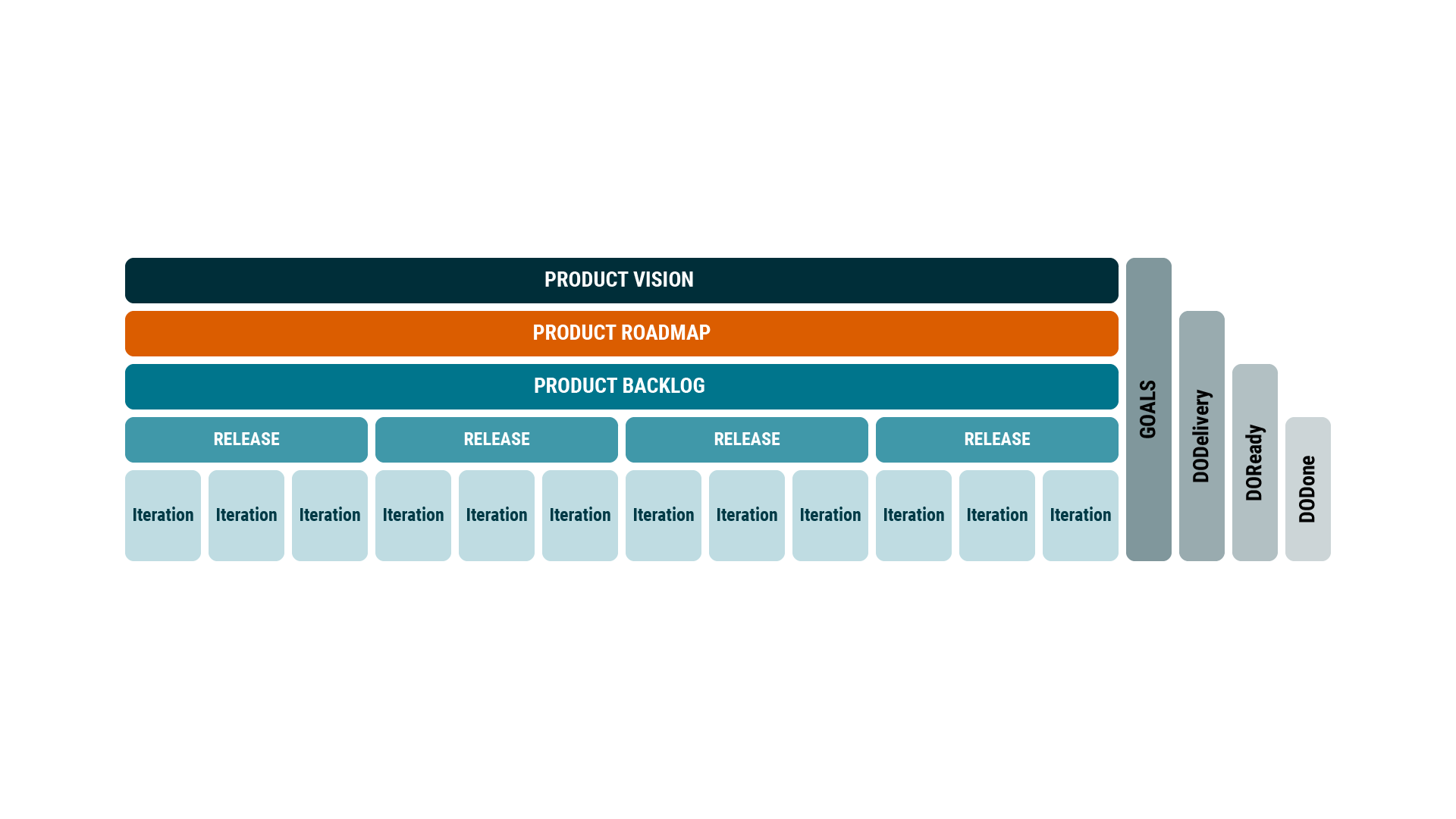
The Definition of Delivery is a concept for the team to collaboratively define what product delivery means for the unique product in progress.
The Definition of Delivery:
To facilitate product delivery, the team is fully engaged in:
- Puts all the planning pieces into play in a cadence of learning and improving.
- Puts the focus on value and relies on the quality of the planning.
- Delivers the value of the planning effort.
- Tests the plan and emphasizes planning over the plan.
- For Amazon, frequently enough may be hundreds of times each day.
- For a commercial off-the-shelf (COTS) insurance package used internally, every system change could impact processes or procedures requiring updates and communication and training, resulting in a different delivery model.
"Agile product delivery, whether for external or internal stakeholders, includes a degree of uncertainty. By delivering value in a minimum viable way as early as possible, organizations can learn what is valuable and what is not and help to minimize waste and understand what value meets stakeholders' needs."
Business stakeholders may not know what to expect from product delivery. Unexpected changes can occur frequently due to the nature of validated learning. Continuous communication by the Product Owner during planning helps manage delivery expectations.
The Definition of Delivery is a concept for the team to collaboratively define what product delivery means for the unique product in progress.
The Definition of Delivery:
- Becomes part of the product roadmap contributing to a shared understanding across the product team.
- Provides visibility and transparency of product delivery's progress.
- Provides a level of granularity to the product roadmap that adds meaning and clarifies interpretations.
- Reinforces the value of, and keeps focus on, setting goals and measuring progress.
- Is influenced by the Agile Framework employed by the team.
To facilitate product delivery, the team is fully engaged in:
- Plan iteration,
- Build product features, and
- Validate product features.
Iteration planning is an important time-boxed event designed to drive three outcomes:
Iteration planning is dependent on having enough product backlog items (PBIs) prioritized and that meet the Definition of Ready, for the team to commit to building, in the upcoming iteration. This preparation happens during backlog refinement.
Iteration Backlog Refinement = Ready PBI's
"Definition of Ready" is an agile concept that applies to ensuring enough information about a PBI is completed to be able to implement it, in an upcoming sprint. The team defines what needs to be included in a PBI to ensure that it is:
Iteration Planning = PBI Commitment
Iteration planning is a structured session that is held after iteration review and retrospective, and before starting the upcoming iteration.
Participants include:
At the end of the session the team:
Agile Extension Techniques
Case Study: Plan Iteration - Food Manufacturer
- The team determines what items or features they can build in the next iteration.
- The team develops detailed task level plans, describing how to get those items, to meet the Definition of Done.
- The team commits, individually and collectively, to the work that they will accomplish together during the iteration.
- It is realistic for the team to plan and commit to what they can get done in that timeframe.
- It increases the effectiveness of improvements based on feedback loops and validated learning.
Iteration planning is dependent on having enough product backlog items (PBIs) prioritized and that meet the Definition of Ready, for the team to commit to building, in the upcoming iteration. This preparation happens during backlog refinement.
Iteration Backlog Refinement = Ready PBI's
"Definition of Ready" is an agile concept that applies to ensuring enough information about a PBI is completed to be able to implement it, in an upcoming sprint. The team defines what needs to be included in a PBI to ensure that it is:
- Clearly articulated and understood,
- Achievable, and
- Testable.
- Architecture and design considerations,
- Risk, assumption, and dependency considerations,
- Quality, test preparation and test data considerations, and
- Requirement and elaboration considerations.
Iteration Planning = PBI Commitment
Iteration planning is a structured session that is held after iteration review and retrospective, and before starting the upcoming iteration.
Participants include:
- Delivery team,
- Product Owner,
- POA Practitioners, and
- Any contributors that were identified during iteration refinement to build a PBI for the iteration.
- Iteration goal(s),
- A brief description of the theme,
- Features, and
- The Ready PBI's targeted for the iteration work.
At the end of the session the team:
- Affirms a shared commitment to the iteration goal that is:
- clearly understood,
- compelling, and
- measurable.
- Commits to a set of:
- PBI's aligned to the iteration goal, and
- Estimated tasks associated with each PBI. (The team owns the commitment to the iteration backlog, and they decide what is doable.)
Agile Extension Techniques
- Backlog Refinement: Ensure there is enough detail and clarity for items in the backlog so that the delivery team can complete an iteration.
- Behaviour Driven Development (BDD): Focus on the intended customer behaviour to
- Increase value,
- Decrease waste, and
- Increase communication between stakeholders and delivery teams.
- Planning Workshops: Determine what value can be delivered in an iteration.
- Spikes: Accelerate understanding of PBIs by investigating or researching concepts, novel ideas, or user stories.
- Story Elaboration: Define the detailed design and acceptance criteria for a story to deliver a working solution.
- Story Mapping: Sequence the stories planned for an iteration and track progress over the iteration.
- Business Rules Analysis: Identify, validate, and express rules governing the functionalities included in the iteration.
- Data Dictionary: Assess the impact or added entities to the underlying data model for the product in an iteration.
- Non-Functional Requirements Analysis: Ascertain that the product quality parameters are as expected in the iteration.
- Prototyping: Quickly demonstrate value, or elicit information, about the stories slated to be developed in an iteration.
- Definition Concepts (Ready, Delivery, Done): Use to determine if an iteration meets all the defined and required criteria.
Case Study: Plan Iteration - Food Manufacturer
| Background Once release planning was completed, Poultry Plus' Product Owner, Tony, needed to work with the product development team to plan specific tasks at a more detailed level for the New Project Intake Process effort. He worked with the Scrum Master, Joanne, to set up agile ceremonies for their team to use to drive their work. Challenge The team had recently come together based on a reorganization at Poultry Plus. Some had not worked together in the past. They were building a brand-new application and did not have a solid sense of the work that would be required. They had to:
When the team reviewed the backlog in detail, they realized that:
There were questions on usability, which led to a discussion on non- functional requirements, including:
Fortunately, the sales team had quick answers for the product development team. They sat down the next day to plan the first sprint. Although many of the team members had not worked together before, several had the experience of developing a similar application and could apply their expert judgment to the estimates. They began by:
Lessons Learned There was a temptation to assign the tasks and have the individuals assigned provide an effort estimate. Joanne cautioned the team that while individual estimates may be quicker, agreeing as a team on estimates for each task would enable them to better estimate over time, especially as different Developers would take on various tasks over the course of the project. The team found that planning as a team helped:
The team decided that:
|
As an outcome of focused, collaborative, committed Iteration Planning, the team builds and delivers PBI's. The product features emerge and evolve by consistently building small, manageable value increments, and adapting increments through learning. This is accomplished with consistent and regular support from the Product Owner.
How POA Helps Build Product Features
The team should be confident in the quality of the product planning to self- organize and begin the work of building the product increment. The Product Owner should step back and let the team do their best work. During the iteration build, the primary role of the Product Owner is to be available.
Questions, clarifications, or decisions, which may not arise until the actual PBI work is started, need quick action from the Product Owner. Otherwise, the PBI may not get done.
The Product Owner should join daily stand-ups to stay in tune with the progress of the iteration and learn of any challenges, or questions, that need to be resolved.
In parallel to the team's iteration work, POA Practitioners:
Agile Extension Techniques
Case Study: Build Product Features - Food Manufacturer
How POA Helps Build Product Features
The team should be confident in the quality of the product planning to self- organize and begin the work of building the product increment. The Product Owner should step back and let the team do their best work. During the iteration build, the primary role of the Product Owner is to be available.
Questions, clarifications, or decisions, which may not arise until the actual PBI work is started, need quick action from the Product Owner. Otherwise, the PBI may not get done.
The Product Owner should join daily stand-ups to stay in tune with the progress of the iteration and learn of any challenges, or questions, that need to be resolved.
In parallel to the team's iteration work, POA Practitioners:
- Refine the product backlog to prepare for future iterations,
- Provide clarity to any questions from team members,
- Communicate with customers,
- Participate in PBI reviews, and
- Prepare for the upcoming iteration review.
Agile Extension Techniques
- Reviews: Collaboratively explain and discuss issues, stories, and work related to the iteration with the product team.
Case Study: Build Product Features - Food Manufacturer
| Background The releases and iteration were planned, and all the user stories elaborated and detailed to the satisfaction of the New Product Intake Process effort. The Developers were ready to complete their tasks. Product Owner Tony was excited to see what would be delivered in two weeks' time. Challenge Now was the time to make sure that the Developers had what they needed to execute their tasks effectively, with a minimum of roadblocks and with access to the tools and resources they needed. Action Scrum Master Joanne scheduled meetings for 15 minutes every morning to:
Outcome Tony and Joanne stood aside and let the Developers do their work. Lessons Learned One benefit of being able to step aside from the day-to-day task work for Tony was that his time was freed up to:
|
One of the benefits of agile product delivery is the frequency of validating product features throughout the product development lifecycle.
PBI Acceptance
POA Practitioners should review the PBI's when the team sets the status of the PBI to “done”. This review includes the:
The Product Owner has the option to accept or reject the PBI. By reviewing the PBIs as they are done, prior to iteration review, the team may be able to address any issues that would cause the Product Owner to reject the PBI before the end of the iteration. Through conversation with the team, they will determine if the work can be completed. If it cannot, the Product Owner will add the change to the Product Backlog for revision work in the next iteration.
Iteration Reviews
The Product Owner facilitates the iteration review ceremony at the end of the iteration. POA Practitioners can support this work. 30/70 or 20/80 are good guides to balance the time spent on the kick-off and the PBI demonstrations.
The Product Owner:
The Product Owner helps to facilitate frequent opportunities for users to participate in testing. Getting feedback from users or potential users gives meaningful insights that influence the released product. Showcase events are often used in place of a formal user acceptance testing, or as a prerequisite to improve the quality of what will be reviewed.
POA Techniques to Validate Product Features
Agile Extension Techniques
Case Study: Validate Product Features - Food Manufacturer
- In waterfall SDLC's, validation of product features occurs near the end of the lifecycle, just prior to production release, when it is typically too late to influence changes.
- Agile product delivery integrates validation iteratively, inviting feedback and promoting learning opportunities and changes. This helps increase the value of the product that will be delivered. Product features are validated through:
- PBI Acceptance, which is solely done by the Product Owner.
- Iteration Reviews, expanding the validation opportunity to include
- Stakeholders
- Users
- Customers
- User Acceptance Testing, which integrates actual users, customers, or representatives of the customer, to validate product functionality and features.
PBI Acceptance
POA Practitioners should review the PBI's when the team sets the status of the PBI to “done”. This review includes the:
- Product Owner
- Developer
- Tester
The Product Owner has the option to accept or reject the PBI. By reviewing the PBIs as they are done, prior to iteration review, the team may be able to address any issues that would cause the Product Owner to reject the PBI before the end of the iteration. Through conversation with the team, they will determine if the work can be completed. If it cannot, the Product Owner will add the change to the Product Backlog for revision work in the next iteration.
Iteration Reviews
The Product Owner facilitates the iteration review ceremony at the end of the iteration. POA Practitioners can support this work. 30/70 or 20/80 are good guides to balance the time spent on the kick-off and the PBI demonstrations.
The Product Owner:
- Ensures that the right participants are invited to gather meaningful feedback.
- Helps the team to prepare to showcase the work completed. Even things like technical PBI's can be creatively demonstrated to show how they contribute to customer value.
- Highlights how the work completed builds on previous work to show progression.
- Kicks-off by sharing:
- Information about the iteration that may include a story.
- An overview of PBI progress within the iteration, and relative to the release.
- The status of each committed PBI with an explanation of anything that did not get done.
- Orchestrates the demo of each PBI, which may be done by the Developer, Tester, Business Analyst, or the Product Owner, themself. Enabling the delivery team to demonstrate and showcase their work contributes to their sense of pride and puts them closer to the customer and stakeholders.
- Sets the stage for feedback, gathers feedback, asks clarifying questions to understand feedback, and requests further discussion if needed.
The Product Owner helps to facilitate frequent opportunities for users to participate in testing. Getting feedback from users or potential users gives meaningful insights that influence the released product. Showcase events are often used in place of a formal user acceptance testing, or as a prerequisite to improve the quality of what will be reviewed.
POA Techniques to Validate Product Features
Agile Extension Techniques
- Reviews (e.g., 3 Amigos, Iterations): Collaboratively explain and discuss issues, stories, and product-related work to iteration with the Developer and QA (for 3 amigos). Iteration review includes a broader team and a larger agenda with an evaluation of the entire iteration.
- Definition Concepts (Ready, Delivery, Done): Agree if PBI item is “done” according to agreed-upon criteria.
Case Study: Validate Product Features - Food Manufacturer
| Background Toward the end of their first sprint, the New Project Intake Process team was almost ready to demonstrate the customer and company contact features they had developed. The new application had the requested functionality but did not have the company look and feel. Still, the team was anxious to validate what they had produced. Challenge The team needed validation from the business stakeholders that the functionality developed over the sprint was correct. If it was not, then they needed to analyze what was and adjust. If adjustments were needed, they must be considered in the next sprint, when prioritizing work. Action The team agreed to use the Acceptance Criteria on the user stories as the basis for their Definition of Done. In this case, since the final look and feel of the application was not available, Product Owner Tony suggested that for this sprint, the Definition of Done could be limited to everything in the acceptance criteria except the look and feel. As long as the specified functionality worked as agreed, they could count the development successful. Tony asked the business stakeholders to bring their laptops to the sprint review meeting so they could take the new functionality on a test drive. The development team had the application set up in a test environment so they could provide a demonstration and then turn it over to the business team to try it. They demonstrated the way a customer would:
One of the business stakeholders, Laura, asked if there was a way for a customer to have more than one contact person. Customer projects were so large that customers needed to interact with a team of people, not just one point of contact, she reasoned. Outcome Product Owner Tony reviewed the related user stories and did not find a specification that more than one contact could be established per project, although more than one contact could be associated with a particular company. Tony agreed that they would:
New or missed requirements can arise from a demonstration and user acceptance testing. It is important to recognize that even though such requirements could be viewed as "missed" or that they render the functionality presented as incomplete, the delivery for the sprint can be considered "done." When this occurs, it is critical to communicate with the team that the new or missed requirements will be addressed in a future sprint. Care should be taken to point this out the next time the backlog is reviewed. |