6. POA Techniques
6.27 Value Proposition Canvas
Guide to Product Ownership Analysis
Purpose
The value proposition is the culmination of ideas, customer intimacy, market insights, evidence, and design articulated into a promise of value to be delivered to customers. It demonstrates a clear understanding of customer pains, gains, and jobs to be done, and introduces alignment of the pain relievers, gain creators, and product(s) benefits.
Description
The Value Proposition Canvas, originally developed by Dr. Alex Osterwalder, is used to understand the product's value from the customer's perspective. It clearly and simply states:
The value proposition canvas tool helps to:
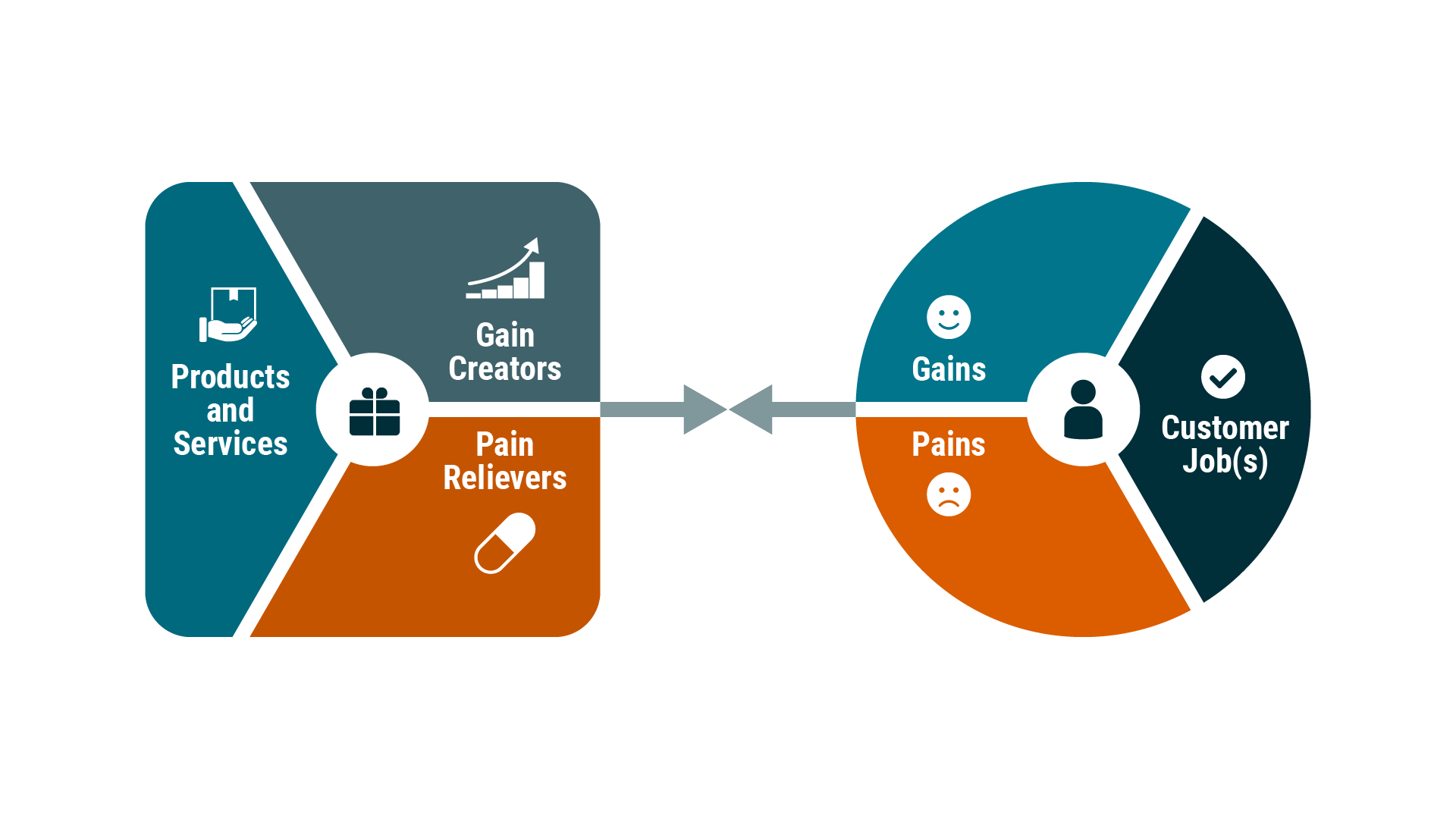
The Value Proposition Canvas diagram explained:
Description
The Value Proposition Canvas, originally developed by Dr. Alex Osterwalder, is used to understand the product's value from the customer's perspective. It clearly and simply states:
- How the product solves or addresses the problem or pain,
- The benefits that customers can expect, and
- Why customers should choose this product.
The value proposition canvas tool helps to:
- Ensure that the product or service is positioned around customer values and needs,
- Align between the product and the market,
- Feed into the customer and value proposition segments of the business model canvas (or vice versa), and
- Provide a visualization that contributes to shared understanding and meaningful conversations.
The Value Proposition Canvas diagram explained:
| Value Proposition Map (square on the left) | Customer Profile (circle on the right) |
| Describe the product and how the product addresses the customer's pains and achieves the customer's expected gains.
|
Understand the customer’s challenges, before deciding on a product. The circle is divided into three components, where the jobs the customer fulfils, as well as their associated experiences, are captured.
|
|
|
|
- Define the customer or customer segments:
- Start with understanding customer segments,
- Discuss within the team and agree on who the real customers are, and
- Create a canvas for each customer segment.
- Understand the customer and complete the customer profile:
- Detail the various jobs of customers. Try to uncover how these activities are done, how they feel about it, and what social qualities come into play.
- Discuss the challenges or pains that the customer faces for doing each of the activities when trying to complete the job.
- Understand the gains of customers which are generally the hidden ambitions, above and beyond the pain relievers.
- Identify a product aligned to the customer needs and document through the value Proposition map:
- List the solution options after the brainstorming session, and
- Select a solution that addresses the customers' jobs, pains, and gains.
- Determine canvas success
- Make sure there is a canvas for each customer segment,
- Identify jobs or activities to be done by the customer (3-5),
- Prioritize the pains and gains of the customer (3-5 for each),
- Every pain and gain could be mapped to a pain reliever or gain creator, and
- The product and services offered should cover the gain creators and pain relievers.
| Stengths | Limitations |
|
|
Tips for Success
- The sequence for completing the canvas should be customer map first, followed by the value proposition map. This way, it is clear what the customer really needs. Design the product based on those needs.