
5.1 Apply Foundational Concepts
5.1.1 Set Up the Organization for Success
Guide to Product Ownership Analysis

Either an organization supports product teams, or it hinders them. The challenge of creating, launching, and maintaining a successful product is complex and difficult. An organization needs to consider what it can do to ensure a supportive environment for Product Owners and the product development teams. Three areas need organizational attention:
Product failure can be attributed to poorly defined interactions, or gaps in responsibilities, at the integration points between:
With clearly defined accountabilities across product management, ownership and marketing, organizations can start to address gaps, and build robust work processes that focus on value delivery to their customers.
Misaligned Products and Services to Strategy
Misalignment causes product failure when the product:
To help maintain alignment through to product launch, organizations can adopt:
Products that were poorly defined from the onset, or suffered during product build activities, even though they may be good ideas, are another cause of product failure.
It is relatively straightforward to align key artifacts, thoughts, and perspectives with:
- Roles and responsibilities
- Products and services aligned to strategy
- Well defined products for teams to create
Product failure can be attributed to poorly defined interactions, or gaps in responsibilities, at the integration points between:
- Product management
- Product Ownership
- Product marketing
With clearly defined accountabilities across product management, ownership and marketing, organizations can start to address gaps, and build robust work processes that focus on value delivery to their customers.
Misaligned Products and Services to Strategy
Misalignment causes product failure when the product:
- Does not fit the organization's brand
- Is not an expected type of product from the organization
- Does not satisfy customers
- Was not launched because it did not match the organization's strategy
To help maintain alignment through to product launch, organizations can adopt:
- an alignment strategy, and
- build processes that allow greater visibility across the product development work including having regular touchpoints.
Products that were poorly defined from the onset, or suffered during product build activities, even though they may be good ideas, are another cause of product failure.
It is relatively straightforward to align key artifacts, thoughts, and perspectives with:
- Product vision
- Product roadmap
- Release plans
To create and deliver successful products, an organization needs carefully defined roles and responsibilities across:
Product Management
Product Owners have the greatest opportunity to create successful products because they work directly with the team to maximize the value being created. Product Ownership responsibilities can be shared by the team or other individuals. As strong representatives of customers, a Product Owner heavily influences what is being built and schedules regular touchpoints with customers to help determine which features are incorporated and when they get built by the team. POA Practitioners contribute to both the design of the product and the build activities.
How POA Helps with Role Clarity
Although POA Practitioners may not be directly involved in discussions about organizational structuring, they can:
POA Techniques for Role Clarity
These POA techniques discussed below reference the three key disciplines of product management, Product Ownership, and product marketing.
Agile Extension Techniques
- Product management - Manage a product through its lifecycle, from incubation to decline.
- Product Ownership - Maximize the value delivered by the product that is being built.
- Product marketing - Use market knowledge to ensure the product will resonate with customers.
Product Management
- Product lifecycle management
- Personas
- Business needs
- Product vision
- Product roadmap
- Release planning
- Feature definition
- Financial measures and adoption metrics
Product Ownership
|
Product Marketing
|
How POA Helps with Role Clarity
Although POA Practitioners may not be directly involved in discussions about organizational structuring, they can:
- Call attention to challenges in organizational structuring.
- Encourage organizational leaders to discuss and address the issues.
- Promote use of a product lifecycle approach from conception to retirement.
- Help identify organizational processes that support the full product lifecycle.
- Help steer organizational discussions to clarify the functional units or roles that support each component of the product lifecycle.
- Help integrate product management, Product Ownership, and product marketing practices to address gaps and resolve conflicts.
- Help communicate responsibilities to ensure shared understanding.
POA Techniques for Role Clarity
These POA techniques discussed below reference the three key disciplines of product management, Product Ownership, and product marketing.
Agile Extension Techniques
- Planning Workshop: Discuss how the organization will address functions and define responsibilities across the three disciplines.
- Value Stream Mapping: Understand the creation of value across the customer experience and make improvements from effectively organizing the three disciplines.
- Visioning: Understand decision options for integrating the three disciplines and clarify the organization's vision of how it creates and delivers products.
- Balanced Scorecard: Manage performance in any business model, organizational structure, or business process, and develop improvements through the integration of the three disciplines.
- Benchmarking and Market Analysis: Understand how effective organizations organize for product delivery success. This can help:
- Improve organizational operations
- Increase customer satisfaction
- Increase the value delivered to stakeholders
- Business Capability Analysis: Understand how things need to change and what an organization can do to implement those changes to build an integrated environment that can support:
- Product creation,
- Launch, and
- Ongoing management.
- Business Model Canvas: Assess how value is created, captured, and delivered to key stakeholders, and understand organizational or environmental changes.
- Decision Analysis: Assess options for integrating the three disciplines and determine the value of alternate outcomes for different ways of structuring the three disciplines.
- Interviews: Elicit information, share data, or build support for a proposed solution.
- Metrics and Key Performance Indicators (KPIs): Measure delivery across the organization as it is, and because of change.
- Organizational Modelling: Describe current roles, responsibilities, and reporting structures within an organization, and because of change.
- Process Analysis: Assess the processes describing how work is completed across the lifecycle, looking for efficiencies and effectiveness.
- Process Modelling: Provide a standardized graphic model to demonstrate how the product lifecycle is carried out and explain how to work through it.
- Roles and Permissions Matrix: Ensure coverage of activities across the product lifecycle by:
- Denoting responsibility
- Identifying roles
- Communicating planned changes
- Stakeholder List, Map, or Personas: Identify individuals who need to be involved in decision-making.
- SWOT Analysis: Evaluate an organization's strengths, weaknesses, opportunities, and threats, to internal and external conditions that impact product creation and delivery.
- Empathy Map: Develop a deeper understanding of organizational goals, attitudes, perceptions, and motivations to effectively evaluate roles and responsibilities.
| Background ABC Corp, a mid-sized pioneer cell phone manufacturing company was reduced to a small, niche player, because of competitive pressures. The company had several rounds of downsizing over the last few years and operated with a smaller staff complement. There was zero growth in revenues over the last three years, and the company's financial position was rapidly eroding. Cutting expenses allowed ABC Corp to continue operating but it needed to grow sales and revenue to stay a viable operation. Natalia was one of two Product Owners at ABC Corp. She was at ABC Corp for a year and had five years of Product Ownership experience. Ivan was a Financial Analyst in the finance department and became a Product Manager, the only person with that title at the company. As an experienced Product Owner, Natalia was frustrated with ineffective and inefficient processes that were obstacles to delivering good outcomes, and she did not know what she could do. She found an ally in Ivan who understood that the next product launch could determine ABC Corp's future success. Challenge ABC Corp has not brought a successful product to market in a few years, and none of the last five releases captured enough market shares to cover the original investments. Without market success and increased revenue, the only recourse for ABC Corp would be to sell its business to a competitor. Action Natalia and Ivan agreed to:
The two presented this information to their managers who agreed to forward the recommendations for senior management consideration. Natalia and Ivan socialized their recommendations with other managers to develop additional support. It took almost five months to start implementing their recommendations. Although not all recommendations were implemented, and some were modified, Natalia and Ivan felt they increased organizational support and gained a greater management understanding of what it takes to deliver a successful product. Both felt more confident that they have the pieces in place for future success. Lessons Learned Although Product Owners are not likely to have decision-making authority to address cross-functional processes, they can often influence organizational leaders. Changing organizational processes and integrating work across different functional units can be painstaking and time- consuming work. However, the payoff can be a dramatic improvement in organizational efficiency and effectiveness. In fact, integrating product management, product marketing and Product Ownership practices is a critical ingredient in launching and managing successful products. Product Owners can help influence these discussions and provide real-world insights to add realism to the discussions and the solutions. |
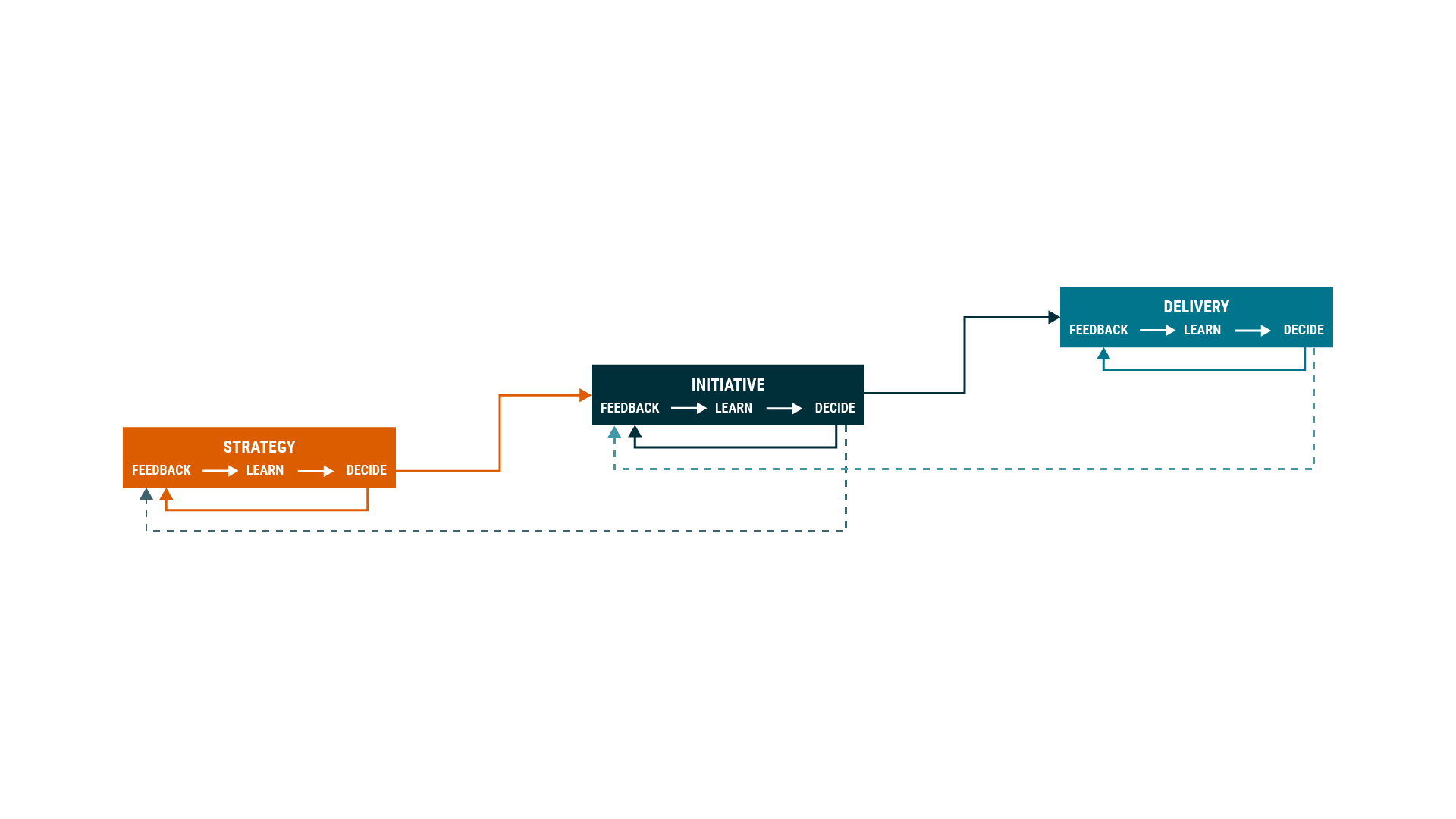
Product value creation needs to align with customer needs and organizational goals and objectives. An organization can align product build outcomes with organizational strategy by applying concepts described in the "Agile Extension to the BABOK Guide". Where strategic alignment is critical, a company should consider aligning with the three horizons:
To ensure products are strategically aligned, Product Owners and other individuals must understand:
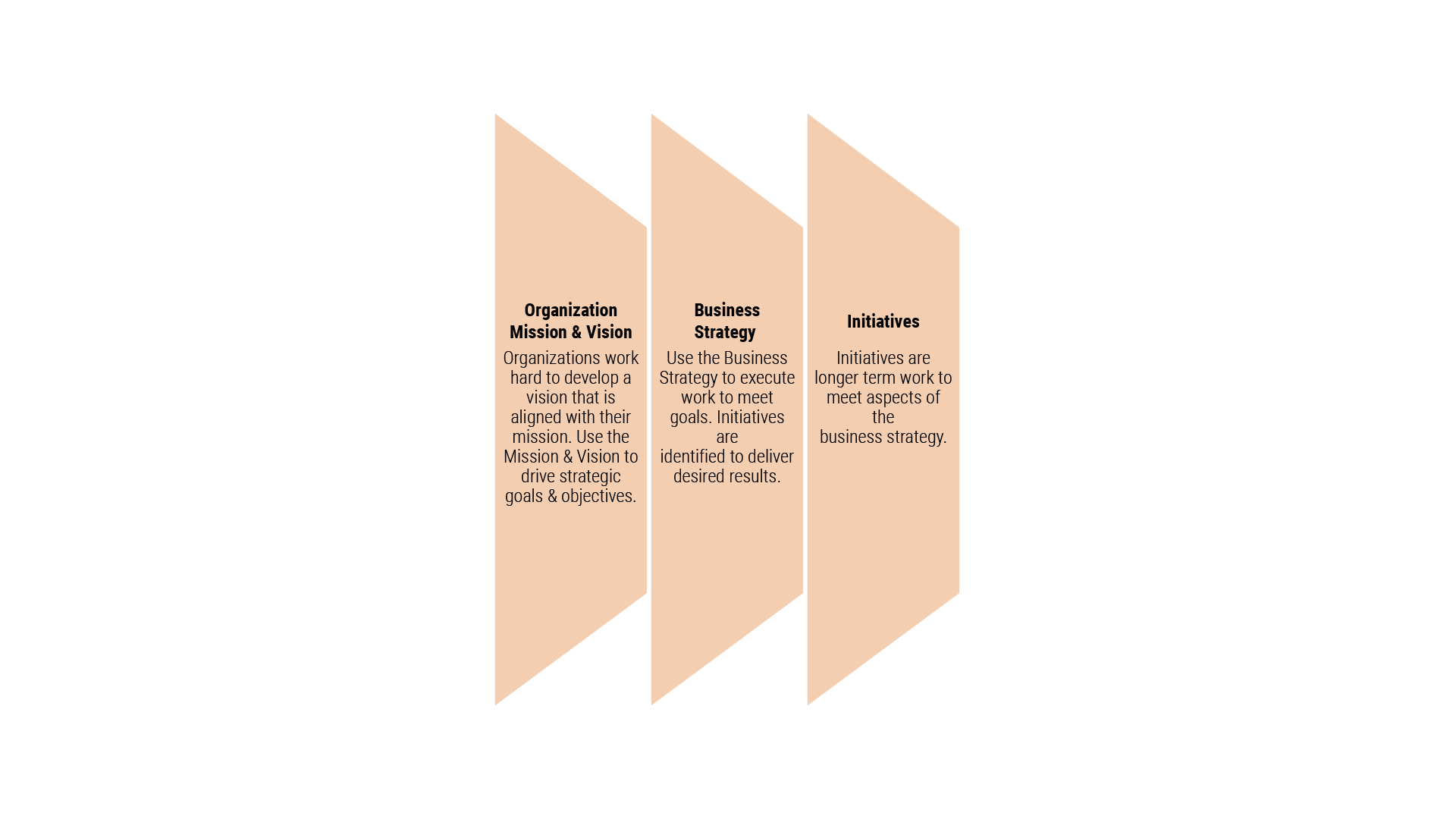
A Product Owner should strive to understand the organization's business strategy, which is formulated to give an organization a path to achieve its mission and vision and drives the rationale for the initiative. The business strategy is directly aligned with the organization's mission and vision.
Identified initiatives have focused outcomes that an organization wants. These outcomes enable a company to collectively realize its desired vision.
There are specific questions that need to be answered at the Strategy Horizon stage which lead to starting initiatives. Feedback is used to help decide whether initiatives continue or are cancelled.
The Strategy Horizon
Deliverables
The first set of deliverables needed for product build activities are:
The Delivery Horizon
Putting it all Together
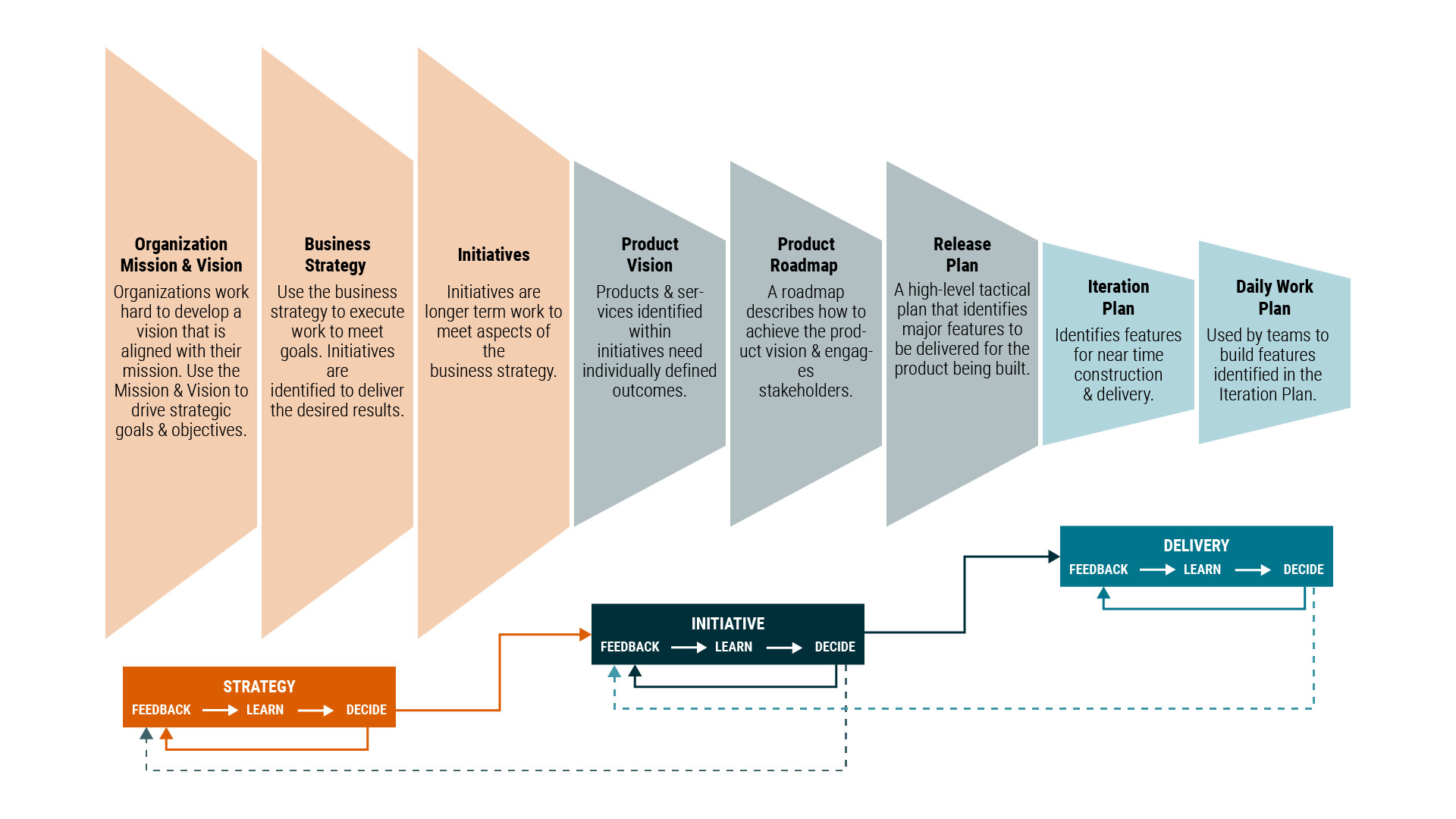
Putting everything together and incorporating the essential feedback- learning loops provides a blueprint for aligning the product being built to the organization's strategic goals and objectives. The feedback-learning loops across the Horizons give the organization the ability to ensure the evolving product builds are aligned with:
How POA Helps Align Across Planning Horizons
The POA Practitioner plays an active role in ensuring work across strategy, initiative, and delivery horizons remains aligned. Product Ownership analysis connects the work of the delivery team to the business strategy, providing the team with a sense of purpose, as well as awareness of their contribution in achieving strategic business goals. Sharing information across feedback loops allows better decision-making to:
Agile Extension Techniques
- Strategy horizon
- Initiative horizon
- Delivery horizon
To ensure products are strategically aligned, Product Owners and other individuals must understand:
- Strategic objectives
- Initiatives
- The team's work
- The importance of feedback
A Product Owner should strive to understand the organization's business strategy, which is formulated to give an organization a path to achieve its mission and vision and drives the rationale for the initiative. The business strategy is directly aligned with the organization's mission and vision.
Identified initiatives have focused outcomes that an organization wants. These outcomes enable a company to collectively realize its desired vision.
There are specific questions that need to be answered at the Strategy Horizon stage which lead to starting initiatives. Feedback is used to help decide whether initiatives continue or are cancelled.
The Strategy Horizon
| Questions to Ask | Decisions |
|
|
Deliverables
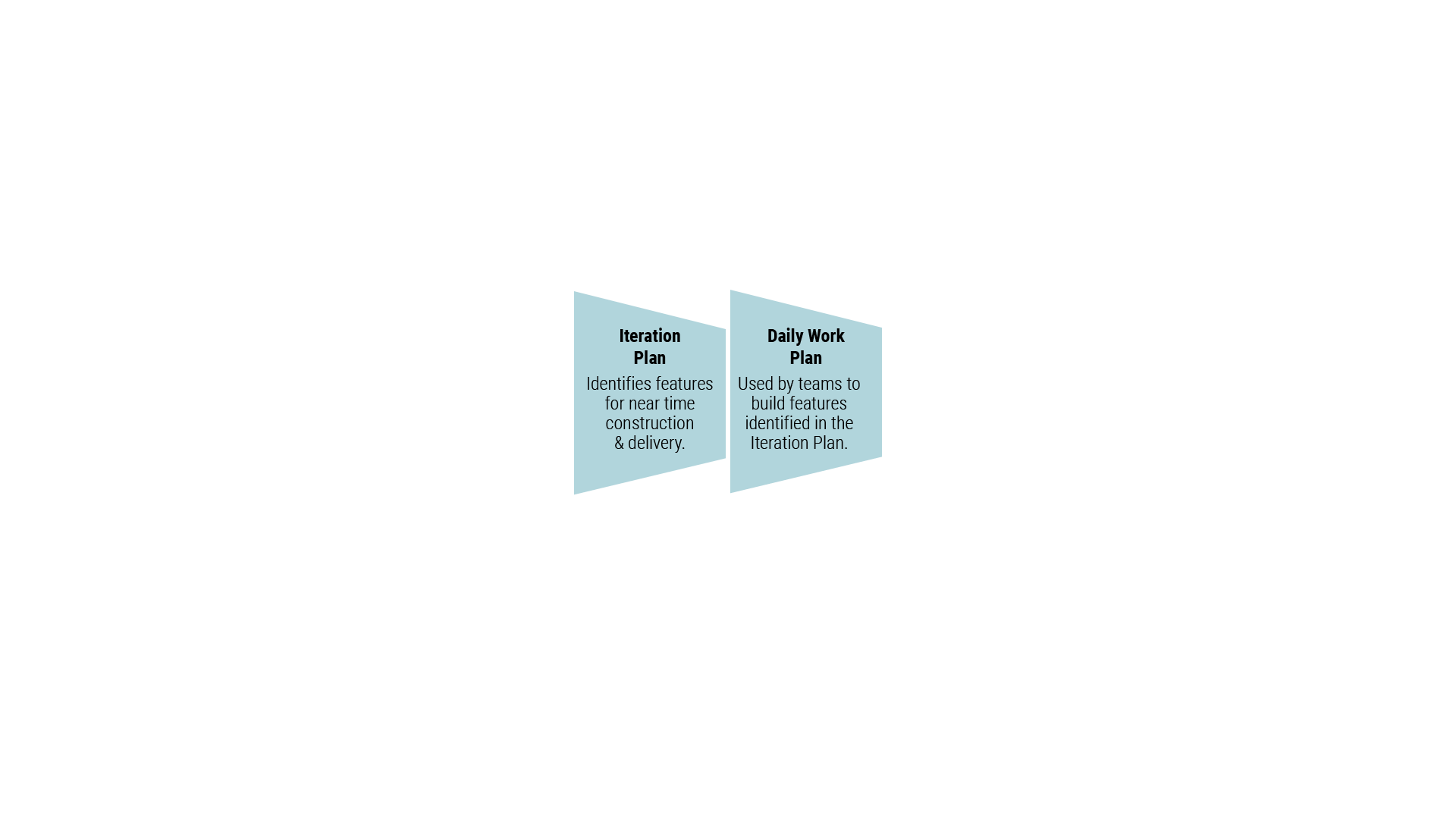
The first set of deliverables needed for product build activities are:
- Product vision
- Product roadmap
- Release plan
The Delivery Horizon
| Questions to Ask | Decisions |
|
|
Putting it all Together
Putting everything together and incorporating the essential feedback- learning loops provides a blueprint for aligning the product being built to the organization's strategic goals and objectives. The feedback-learning loops across the Horizons give the organization the ability to ensure the evolving product builds are aligned with:
How POA Helps Align Across Planning Horizons
The POA Practitioner plays an active role in ensuring work across strategy, initiative, and delivery horizons remains aligned. Product Ownership analysis connects the work of the delivery team to the business strategy, providing the team with a sense of purpose, as well as awareness of their contribution in achieving strategic business goals. Sharing information across feedback loops allows better decision-making to:
- Understand the organizational strategy.
- Encourage organizational leaders to discuss and align, from strategy to initiatives, the work that teams do.
- Be aware of all initiatives and how they may be related.
- Secure funding for changes where they align with strategic objectives.
- Understand how the product being built is an important component of the initiative.
- Understand the value of feedback loops.
- Use feedback at the product build level as critical information for those managing work at an initiative level.
- Drive the discussion and ask for information from those managing work at the initiative level.
- Be responsive to changes and adapt the build activities.
Agile Extension Techniques
- Kano Analysis: Reviewed to understand why specific initiatives were defined in the way they were.
- Portfolio Kanban: Provide real-time visibility to the initiatives across the organization.
- Purpose Alignment Model: Understand the overall focus and priority of initiatives across the organization.
- Value Stream Mapping: Understand the creation of value across the customer experience for the initiative.
- Business Cases: Describe initiatives that are underway.
- Metrics and Key Performance Indicators (KPIs): Communicate priorities and measure delivery across the organization.
- SWOT Analysis: Understand the context in prioritizing initiatives.
- Problem Definition and Analysis: Develop clarity about the challenges that need to be addressed at each horizon to ensure product alignment.
Case Study: Transitioning to Agile & Managing Change Processes - Cell Phone Manufacturer
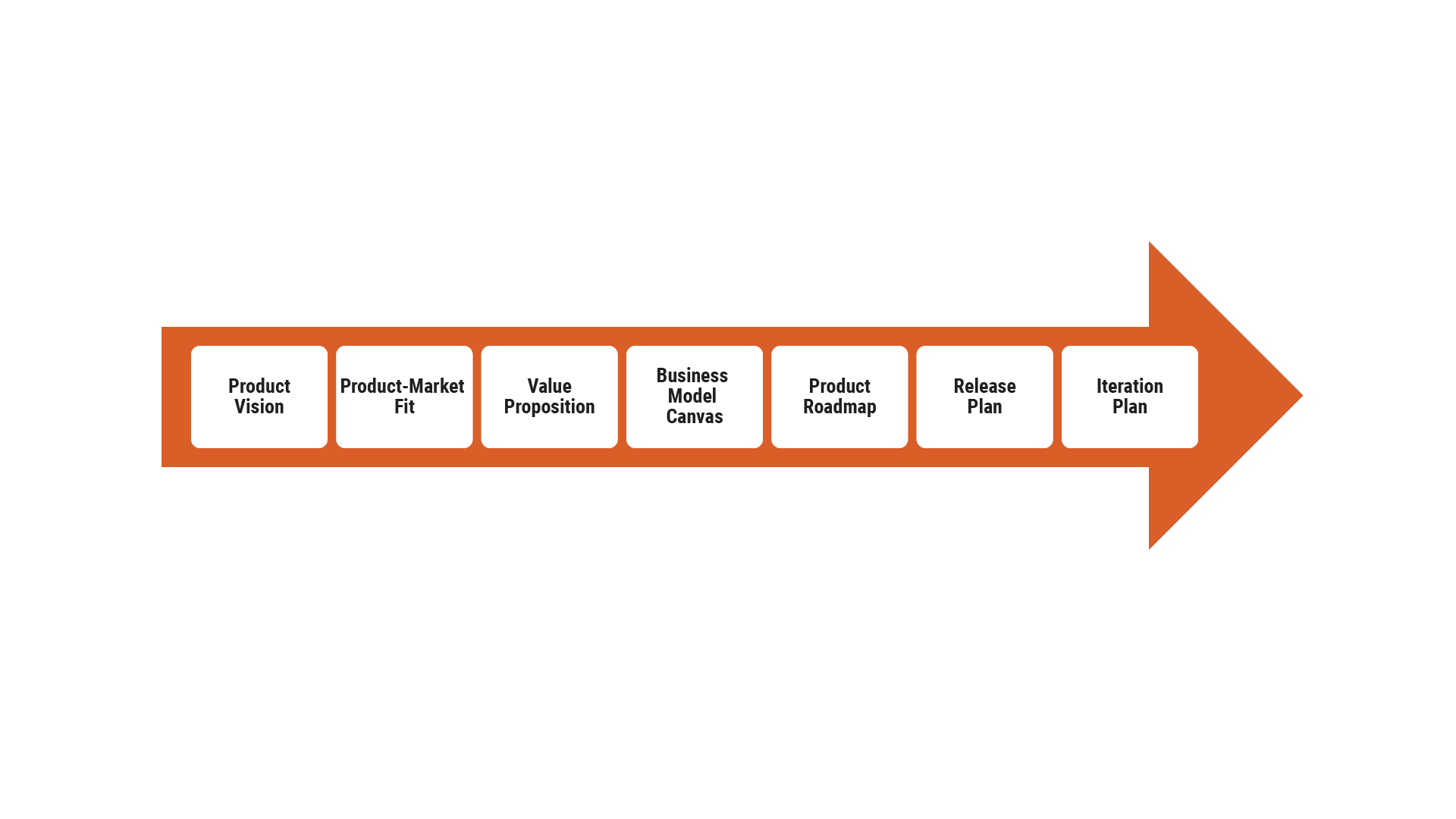
Several artefacts are produced to support product development and product growth strategies. Some of these are driven by POA-related work, and some are created by other functional units in the organization and used by POA Practitioners. These artefacts include describing strategic considerations and identifying the tactical execution that supports realization of the overall strategy. The key is to only create artefacts when they are needed, and to a level of detail that meets the purpose. Common understanding and shared understanding are more important than comprehensive documentation.
Here is an example of how high-value artefacts could be used to support organizational alignment:
How POA Helps Align Artefacts
The POA Practitioner can work to identify artefacts to describe the product being built with other functional areas, e.g.:
Good POA is required as input into the creation and use of artefacts:
Agile Extension Techniques
BABOK® Guide Techniques
| Background ABC Corp typically uses a standard business case to assess ideas for new products or services that are identified by senior managers. Although ideas can be generated at any time, the management team meets once a year at budget time to select the most promising ideas. Those that are most likely to help ABC Corp meet its strategic objectives for the coming year are selected. Resources are committed to finalizing the details of the business case, and those that demonstrate a strong financial outcome are selected for further work. ABC Corp slowly transitioned to using agile practices. The organization used a hybrid set of practices, some of which were agile and others that used a traditional plan-driven approach.
Challenges Although there was some effort to select work that addressed strategic objectives, once underway, little was done to maintain alignment. Given the dynamic nature of the cell phone industry, as well as the intense competition, some products brought to market were obsolete soon after launch. In other instances, a product was built and ready to launch, but when senior management decided it no longer met the organization's strategic needs, it was not launched. In addition, several initiatives were undertaken as a result of a particularly passionate leader, even if it did not align with other organizational initiatives. Actions The team responsible for adopting agile practices at ABC Corp was very vocal about changing well-entrenched traditional management practices. They had success with three separate delivery teams over a 12-month time period.
The agile team recommended implementing the three initiatives along with the recommended feedback loops. The team:
The senior management team agreed to monthly meetings to assess feedback at the initiative level and the strategy level. The agile team was confident that the process would become the standard at ABC Corp. Lessons Learned Changes in strategy development, strategic management, or annual budgeting processes are difficult to achieve. Management desires predictability and it is challenging to see how an adaptive process can provide the level of confidence needed. This explains why:
|
Several artefacts are produced to support product development and product growth strategies. Some of these are driven by POA-related work, and some are created by other functional units in the organization and used by POA Practitioners. These artefacts include describing strategic considerations and identifying the tactical execution that supports realization of the overall strategy. The key is to only create artefacts when they are needed, and to a level of detail that meets the purpose. Common understanding and shared understanding are more important than comprehensive documentation.
Here is an example of how high-value artefacts could be used to support organizational alignment:
How POA Helps Align Artefacts
The POA Practitioner can work to identify artefacts to describe the product being built with other functional areas, e.g.:
- Finance
- Product management, and
- Product marketing
Good POA is required as input into the creation and use of artefacts:
| Artefact | Description | POA Practitioner's Responsibility |
| Product Vision |
|
|
| Product-Market Fit |
|
The POA Practitioner should drive this work and collaborate with:
|
| Value Proposition |
|
The POA Practitioner should drive this work and collaborate with:
|
| Business Model Canvas |
|
The POA Practitioner should drive this work and collaborate with a Product Manager or the product management function, if it exists. |
| Product Roadmap | Describes how the product will achieve the vision. The product roadmap:
|
|
| Release Plan | Identifies product features planned for delivery over a specific time. It provides information that:
|
The POA Practitioner should drive this work and collaborate with a Product Manager or the product management function, if it exists. |
| Iteration Plan | Identifies the product features that will be created and delivered in the next product increment.
|
The team owns the iteration plan and decides what to include. The POA Practitioner:
|
Effective POA requires an individual to:
- Identifying artefacts to describe the product being built by working with other functional areas, including
- Finance,
- Product management,
- Product marketing, and
- Product Ownership.
- Ensure artefacts cover the entire product lifecycle.
- Agree on where each artefact aligns with the product lifecycle.
- Develop a Roles and Permissions Matrix, (e.g., a RACI) to identify responsibilities for artefacts.
- Determine how a Product Owner will use each artefact to communicate and engage key stakeholders during product build activities.
Agile Extension Techniques
- Planning Workshop: Identify artefacts to support the product lifecycle.
- Value Stream Mapping: Understand the creation of value across the customer experience and how the artefacts align with value creation processes.
- Visioning: Understand decision options for integrating the artefacts with the product lifecycle.
BABOK® Guide Techniques
- Benchmarking and Market Analysis: Understand the artefacts for effective product lifecycle management.
- Business Capability Analysis: Understand what an organization can do and how key artefacts support that capability.
- Decision Analysis: Assess options for integrating artefacts into the organization's product lifecycle management processes.
- Interviews: Elicit information, share data, or build support for the use of artefacts integrated into the organization's product lifecycle management processes.
- Organizational Modelling: Identify roles, responsibilities, and reporting structures within an organization for each of the artefacts.
- Process Analysis: Assess how well artefacts align with the organization's product lifecycle management processes.
- Process Modelling: Provide a standardized graphic model to describe how artefacts align with the organization's product lifecycle processes.
- Roles and Permissions Matrix: Ensure coverage of artefacts across the product lifecycle by
- Denoting responsibility,
- Identifying roles, or
- Communicating planned changes.
- Stakeholder List, Map, or Personas: Identify individuals who need to be involved in decision-making for the use of the artefacts.
| Background ABC Corp saw the benefits of two changes:
The management team noticed that some of the detailed work being completed by delivery teams seemed disconnected from the organizational strategy. Actions Workshops were held with a cross-functional team that included the Product Manager and the two Product Owners. A Business Analysis Professional facilitated additional sessions to identify root causes of misalignment and recommend what could be done to improve the situation. Outcomes The root cause analysis demonstrated that even where there was initial alignment with strategic objectives, little attention was paid to ongoing alignment as the work progressed. The cross-functional team brainstormed potential solutions to address the misalignment. After several weeks of work, the team recommended critical artefacts be produced at key points of the work.
Having a clearly defined process for product lifecycle management is a good start but often is not enough. Many organizations find that teams are busy and often get entrenched in the details of product development activities. The "big picture" gets lost. This can be problematic in fast- moving, dynamic environments. The discipline provided by standard artefacts, how to create and use them, can help teams maintain the link to strategy throughout the product lifecycle. Product Owners can help influence these discussions, provide insights, and identify the most important artefacts. |