
5.1 Apply Foundational Concepts
5.1.2 Set Up the Team for Success
Guide to Product Ownership Analysis


A team that confidently embraces the challenge of creating the next successful product has:
Every organization wants high performing teams. POA Practitioners can help support high performing teams by:
Every product, team, and organization have a different context. It is critical to consider context when modifying the approach. Several factors need to be considered to help individuals customize their interactions as POA Practitioners. Decisions made early in establishing team norms pay dividends in team communication and collaboration. The Product Owner does not own these processes but sets the example and tone for them.
Promote and support the use of analysis practices
Good analysis is a crucial part of a POA Practitioner's work. Business analysis is the practice of enabling change in an enterprise by defining needs and recommending solutions that deliver value to stakeholders. Its principles and practices are powerful when applied to product development in which the customer is the key stakeholder. Combined with the application of the seven principles of agile business analysis is a recipe for success.
When conducting analysis, Product Owners face challenges:
Embrace their multi-faceted role
Effective Product Ownership addresses tactical and strategic aspects of product development work. While providing daily guidance to the delivery team, the Product Owner also ensures that value being created by the team remains aligned with:
- Effective communication and collaboration,
- Use of analysis techniques, and
- Expanded Product Ownership role.
Every organization wants high performing teams. POA Practitioners can help support high performing teams by:
- Structuring the work effectively from day one,
- Promoting and supporting the use of effective analysis practices, and
- Embracing the multi-faceted aspects of their responsibilities.
Every product, team, and organization have a different context. It is critical to consider context when modifying the approach. Several factors need to be considered to help individuals customize their interactions as POA Practitioners. Decisions made early in establishing team norms pay dividends in team communication and collaboration. The Product Owner does not own these processes but sets the example and tone for them.
Promote and support the use of analysis practices
Good analysis is a crucial part of a POA Practitioner's work. Business analysis is the practice of enabling change in an enterprise by defining needs and recommending solutions that deliver value to stakeholders. Its principles and practices are powerful when applied to product development in which the customer is the key stakeholder. Combined with the application of the seven principles of agile business analysis is a recipe for success.
When conducting analysis, Product Owners face challenges:
- Shorter deliverable timeframes,
- Time and resource constraints, and
- Lack of business analysis experience.
Embrace their multi-faceted role
Effective Product Ownership addresses tactical and strategic aspects of product development work. While providing daily guidance to the delivery team, the Product Owner also ensures that value being created by the team remains aligned with:
- Customer needs,
- Organizational goals,
- Industry changes, and
- The dynamic marketplace.
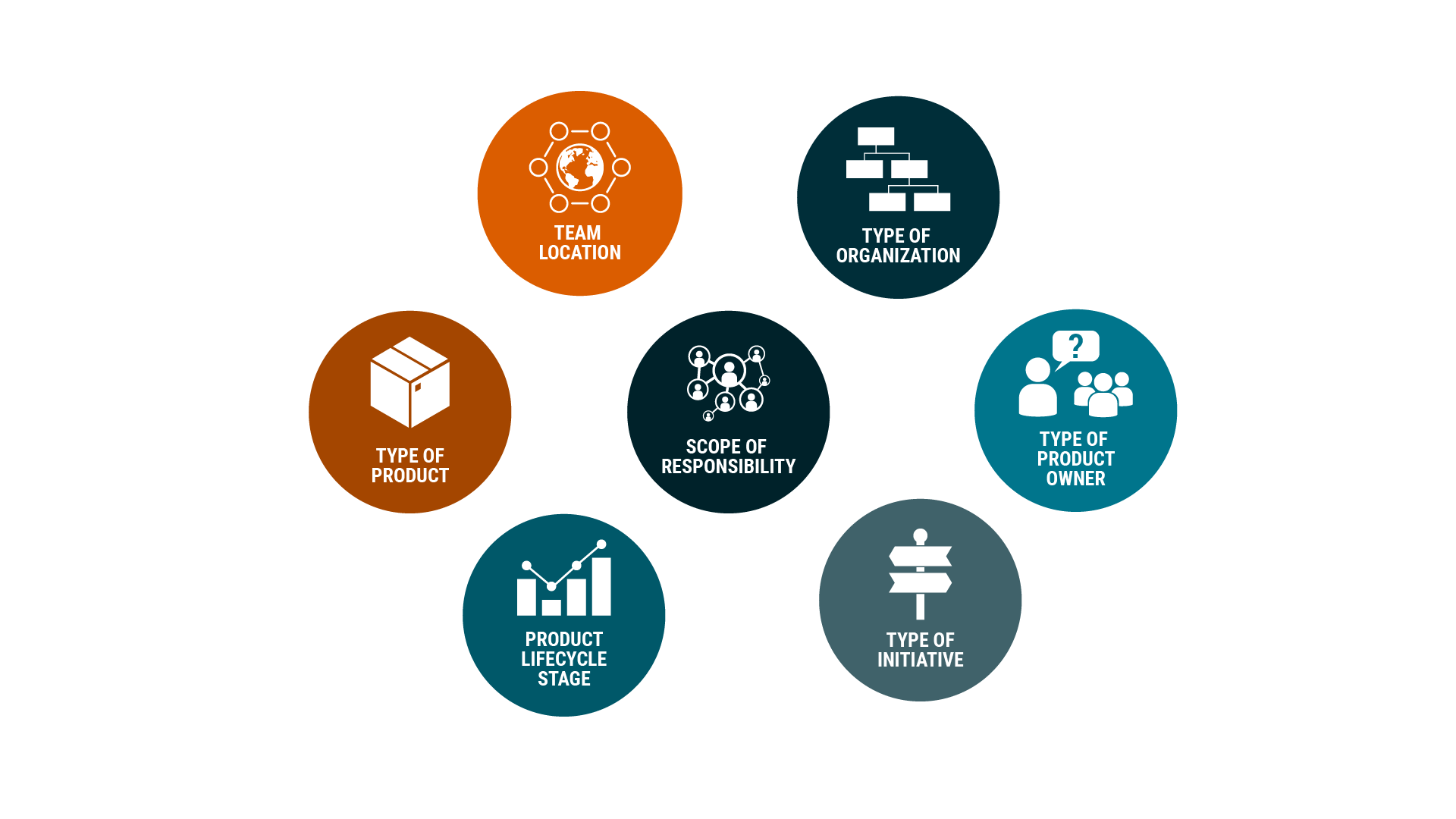
Given the complexity and urgency for creating products that resonate with customers, it is important to set up the team for success. Product Owners face a variety of circumstances that are organization-specific and may differ from one product build or delivery team to the next. Factors that influence working relationships and impact a team's ability to become a high performing team include:
Complicating matters, different types of organizations may partner to bring a shared product to market. Each scenario comes with challenges for the Product Owner, often stemming from organization culture associated with different types of organizations.
- Team Location: A co-located team is easier to work with, but many teams are distributed or virtual. Communication becomes more complex, making sharing pertinent information challenging across time zones. The POA Practitioner needs to understand this context and make themselves available to the team.
- Type of Organization:
- Corporations,
- Non-profit corporations,
- Government ministries, and
- Government agencies, etc.
- Functional,
- Divisional,
- Matrix, and
- Network, etc.
Complicating matters, different types of organizations may partner to bring a shared product to market. Each scenario comes with challenges for the Product Owner, often stemming from organization culture associated with different types of organizations.
- Type of Product Owner Role: Different types of products require a Product Owner or POA Practitioner with different skills and experience. However, sometimes the ideal skills may not be available. It is important that POA Practitioners acquire the support they need to successfully support the team.
- Type of Initiative:
- New product development,
- Upgrade to the existing product, and
- Implement a new product.
- Type of Product: Regardless of how an organization defines a product, it is important to understand that the type of product being created may determine what kind of Product Owner is needed.
- Example: If the team is delivering enhancements to a proprietary app for drop shipping and needs the app to integrate with a payments’ platform like Stripe, engaging a practitioner that has experience with these technologies, as well as knowledge of payment gateways, would be ideal.
- Product Lifecycle Stage: Recognizing where a product is in the product lifecycle is an important consideration for the Product Owner. A practitioner may be ideal for helping a delivery team create a new product but may not be a good choice to revive a previously successful product.
- Scope of Responsibility: The delivery team needs time and energy from their Product Owner to deliver. In many cases, it is impossible to get dedicated effort from a busy Product Owner who may be juggling numerous priorities, including other product deliveries and organizational commitments. The Product Owner's primary responsibility is to maximize the value being created by the team. That is impossible without focused effort. A Product Owner should not be responsible for more than two initiatives at a time.
Setting the team up for success requires customizing communication and collaboration strategies to effectively support the team. Having the right people in the team is key.
POA Practitioners should ask themselves if they are right for the job. If they are not, they should recommend someone else or identify what is needed for POA-related work. Product Owners must get the support they need. They need to develop communication and collaboration strategies to manage interactions with the team.
POA Techniques to Set Up the Team for Success
Agile Extension Techniques
Case Study: Identifying When Need is Needed- Cell Phone Manufacturer
POA Practitioners should ask themselves if they are right for the job. If they are not, they should recommend someone else or identify what is needed for POA-related work. Product Owners must get the support they need. They need to develop communication and collaboration strategies to manage interactions with the team.
POA Techniques to Set Up the Team for Success
Agile Extension Techniques
- Planning Workshop: Create a shared understanding of:
- The approach to product creation,
- Best structure for the work, and
- Set up the team for success.
- Decision Analysis: Assess the context, the challenges, and potential decisions to help make sound decisions.
- Interviews: Elicit information about the initiative to help determine the ideal Product Owner or help the Product Owner create communication and collaboration strategies.
- Risk Analysis and Management: Assess the context for the work to be done and make decisions on how to best support the team as a Product Owner.
Case Study: Identifying When Need is Needed- Cell Phone Manufacturer
| Background Natalia was one of two Product Owners at ABC Corp, a mid-sized cell phone manufacturing company. As a small organization, both Product Owners typically had three product build initiatives. One of the teams Natalia supported completed delivery, which reduced her workload to two initiatives. Cell phone manufacturers generally release new phones or upgrades in the fall to January timeframe, in order to coincide with major consumer electronics trade shows. A competitor announced the release of an upgraded cell phone three months prior to the typical new release timeframe. ABC Corp management decided to respond quickly, and Natalia met with her manager to discuss a new opportunity. Challenge At the meeting, Natalia's manager informed her that a team had been assembled to add the new features introduced by the competitor into an existing ABC Corp manufactured cell phone. The upgraded phone needed to be ready in three months to be unveiled at the fall trade shows. Natalia was concerned about the new commitment added to a busy workload. She asked for time to think about how to best address the challenge and scheduled a follow-up meeting. Outcome Natalia knew she could not say "No, I cannot do it." She took pride in her craft and always found a way to produce results. She assessed what it would take for her to support the team and help achieve the desired outcomes. She met with key people that she thought could provide information about the new initiative. Natalia spoke with two individuals who shared information about the competitors' upgraded phone. She also spoke with the ABC Corp manager for the cell phone that they were upgrading. During those discussions, Natalia considered:
Natalia met with her manager the next day and described what she needed to effectively support the new initiative as the Product Owner. Her manager congratulated Natalia on finding a way forward and agreed to make Raphael available. Lessons Learned Smaller organizations often have more work to do than people to do it, and new, urgent work routinely disrupts ongoing work. The challenge is to find a way to address these urgent challenges while minimizing any negative impact to ongoing work. For Product Owners in this situation, partnering with a Proxy Product Owner can be a powerful strategy. When a Business Analysis Professional is partnered with a Product Owner to support the POA-related work, success rates increase. The Product Owner partnering with a Proxy Product Owner can be a very powerful strategy, particularly when the Product Owner is constrained by other time commitments. |
Good analysis is a crucial part of a Product Owner's work.
Its principles and practices are powerful when applied to product development where the customer is the key stakeholder. Combining that with the seven principles of agile business analysis results in a recipe for success.
Effective analysis ensures a delivery team creates high-value products for their customers, and organizations deliver measurable value. It helps:
Regardless of the challenges, understanding the benefits of business analysis, and applying basic principles will help Product Owners be successful.
How POA Helps Create Customer Focused Products
Creating Products Customers Care About
Delivering high-value products requires the Product Owner to maintain focus and direct the team's attention.
BABOK® Guide Techniques
Any technique in the BABOK Guide can be used based on context and the outcomes including:
Case Study: Using Customer Feedback - Cell Phone Manufacturer
Business analysis is the practice of enabling change in an enterprise by defining needs and recommending solutions that deliver value to stakeholders.
— (BABOK® Guide).
Its principles and practices are powerful when applied to product development where the customer is the key stakeholder. Combining that with the seven principles of agile business analysis results in a recipe for success.
Effective analysis ensures a delivery team creates high-value products for their customers, and organizations deliver measurable value. It helps:
- Launch products that meet customer expectations,
- Improve competitive positioning, and
- Drive organizational success.
- Shorter deliverable timeframes,
- Time and resource constraints, and
- Lack of business analysis experience.
Regardless of the challenges, understanding the benefits of business analysis, and applying basic principles will help Product Owners be successful.
How POA Helps Create Customer Focused Products
Creating Products Customers Care About
Delivering high-value products requires the Product Owner to maintain focus and direct the team's attention.
| Objective | Rationale |
| Intimately understand customers |
|
| Engage key stakeholders |
|
| Define product value |
|
| Co-Create for maximum impact |
|
| Let the product emerge |
|
| Maximize product value |
|
POA Techniques to Create Customer Focused Products
Agile Extension Techniques
Any technique in the Agile Extension can be used based on context and the desired outcomes wanted, including:
|
|
BABOK® Guide Techniques
Any technique in the BABOK Guide can be used based on context and the outcomes including:
|
|
Case Study: Using Customer Feedback - Cell Phone Manufacturer
| Background Natalia was the Product Owner for a team upgrading an existing cell phone to incorporate features that a competitor recently released in a new phone. This competitive product launch was a surprise. ABC Corp wanted to react quickly by offering their own competing product. Challenge The team started the work and realized that simply including the same features as the competing phone would not be enough. First to market is a competitive advantage in the cell phone business. The upgraded cell phone needed to provide additional features to have a chance of winning over customers. Which features should be included was an important decision, one that the team struggled with. Natalia, the Product Owner, met with Raphael, an experienced Business Analysis Professional, to discuss how best to proceed. Natalia highlighted the main points as:
Raphael recognized that Natalia was talking about POA objectives and recommended business analysis techniques that could be used to meet those objectives. He explained how the BACCM helps the team focus on the fundamental concepts of designing a solution for the stakeholder (i.e., the cell phone customer), which can only be done by intimately understanding needs. He emphasized addressing the most important needs, which can only be achieved by understanding context and then enabling change to encourage customers to purchase the new phone. Raphael recommended:
Natalia saw the value of the approach. It would help ensure they were constantly working on features that were most important to customers and not just what they thought would be important. Natalia implemented the strategy and the team worked quickly to build one set of features after another, all steered by potential customers. A small group of potential customers turned into passionate advocates, and with each subsequent delivery of additional features, that group grew. Lessons Learned Applying the principles of agile business analysis, coupled with a toolbox of business analysis techniques, can be powerful in helping a team create desired outcomes effectively and efficiently. Having an experienced Business Analysis Professional on the team allows the team to 'right size' the practices and reduce the time it takes to elicit meaningful information. |
The Product Owner is responsible for maximizing the value of the product being created by the team. Responsibilities of the Product Owner (per The Scrum GuideTM - ©2020 Ken Schwaber and Jeff Sutherland) are:
Today's Product Owner
If the Product Owner is going to maximize the value being created by the team, the Product Owner's responsibilities need to evolve.
The expanded role gives rise to the emerging concept that the Product Owner role is a shared responsibility across the product team with many practitioners contributing.
How POA Helps the Product Owner
If the Product Owner is going to truly maximize the value being created by the team in today's much more complex and intensely competitive environment, then the role must expand. The Product Owner must embrace the following responsibilities and become a customer advocate, team vanguard, design partner, product strategist, learning champion, and value driver.
Considering the Product Owner role to be a shared responsibility also gives the opportunity for the entire team to share responsibility for Product Ownership Analysis. When a specific competency is required, any member of the product team can step up to perform the responsibilities.
POA Techniques to Help the Product Owner
Agile Extension Techniques
- Developing and explicitly communicating the Product Goal,
- Creating and clearly communicating Product Backlog Items,
- Ordering Product Backlog Items, and
- Ensuring that the Product Backlog is transparent, visible, and understood.
Today's Product Owner
If the Product Owner is going to maximize the value being created by the team, the Product Owner's responsibilities need to evolve.
| Product Owner | This Means |
| An advocate for customers |
|
| Champion the work of the team |
|
| Constantly envision and design for impact |
|
| Regularly assess the emerging product foralignment with the intended design |
|
| Embrace the unknown and be willing to learn |
|
| Develop a sharp focus on value creation |
|
The expanded role gives rise to the emerging concept that the Product Owner role is a shared responsibility across the product team with many practitioners contributing.
How POA Helps the Product Owner
If the Product Owner is going to truly maximize the value being created by the team in today's much more complex and intensely competitive environment, then the role must expand. The Product Owner must embrace the following responsibilities and become a customer advocate, team vanguard, design partner, product strategist, learning champion, and value driver.
Considering the Product Owner role to be a shared responsibility also gives the opportunity for the entire team to share responsibility for Product Ownership Analysis. When a specific competency is required, any member of the product team can step up to perform the responsibilities.
POA Techniques to Help the Product Owner
Agile Extension Techniques
- Planning Workshop: Discuss the future of POA and the expanded responsibilities.
- Value Stream Mapping: Understand how the expanded responsibilities for POA help create greater value across the entire customer experience.
- Visioning: Understand how the expanded responsibilities for POA integrate with existing roles within the product lifecycle.
- Benchmarking and Market Analysis: Understand how other successful organizations define and use the Product Owner role.
- Business Capability Analysis: Understand what organizational capabilities can be modified to integrate the expanded POA responsibilities.
- Decision Analysis: Assess options for integrating the expanded POA responsibilities into the organization's product lifecycle management processes.
- Interviews: Share information about how the expanded POA responsibilities can be integrated into the organization's product lifecycle processes.
- Organizational Modelling: Identify how the expanded POA responsibilities can be integrated into reporting structures.
- Roles and Permissions Matrix: Ensure coverage of activities across the product lifecycle by denoting responsibility, identifying roles, or communicating planned changes.
- Stakeholder List, Map, or Personas: Identify individuals who need to be involved in decision-making around changes to roles and responsibilities.
| Background It was performance review time. Natalia realized that despite ABC Corp having adopted agile practices, some of the traditional practices were still in place. She reflected on her experience over the last year. Prior to joining ABC Corp, she was a Product Owner in an IT department where the teams she worked with developed software applications for internal use. Although she enjoyed that work, she realized that her skills were getting stale, and a change was needed. Natalia realized she had adapted quickly to a more dynamic environment. She felt the new aspect of her job was the need to pay more attention to customers and their needs. Natalia thought about the changes she had witnessed over the last two years at ABC Corp. She reflected on several significant improvements:
Challenge Natalia realized that was a lot of change in a relatively short time. However, the success rate for new cell phone launches was still lower than what it needed to be. Only a small portion of ABC Corp's investment in products, new ones, and upgrades, was paying off. How much longer could ABC Corp survive before the next breakthrough product was produced? Natalia questioned, "As a Product Owner and someone who can strongly influence what a product looks like at launch, as well as its ultimate success, am I doing enough?" Action After the work Natalia and Ivan, the Product Manager, did to promote the use of a standard product lifecycle approach, they had continued to meet monthly. They developed an "emotional support team" and confided in each other. Their recent discussions had focused on what a Product Owner could do to increase the chances of creating a successful product. Their research led to an expanded view of POA which Natalia agreed to ‘test drive’ on her very next initiative.\ Outcomes Partway through that initiative, Natalia found that:
The need to create products that stand out and capture attention has increased with the confluence of:
|