5.2 Cultivate Customer Intimacy
5.2.1 Know the Customer
Guide to Product Ownership Analysis

Cultivating customer intimacy means understanding customers as real people by:
- Creating a relationship with the customer.
- Maintaining a presence so customers feel they are being heard and valued.
- Maintaining ongoing connection with feedback loops and engaging activities.
- Inspiring customers to contribute to ongoing improvements.
Personal and impersonal knowledge is enhanced with awareness and understanding. Awareness is knowledge and understanding that something is happening or something that already exists.
Understanding brings awareness to life through:
How POA Helps with Customer Understanding
Effective POA requires the team to invest in establishing personal relationships with customers by adopting the following values in their interactions:
Building strong relationships makes the difference in the quality of the customer insights that surface throughout the product lifecycle. The success of a product, or even a company, depends on these important relationships.
POA Techniques for Customer Understanding
Agile Extension Techniques
Case Study: Customer Experience - Shoe Retailer
Empathy is the capacity to understand or feel what another person is experiencing from their frame of reference. Empathy means knowing the language of the customer and the perspective of their world. It can influence the design of a solution so that there is a differentiator for why a customer chooses one product over another. Empathy may redirect the whole product concept. The team may be working with preconceived ideas or biases. The need for empathy has increased as people easily compare products and experiences online.
It is not enough to build a feature and claim success because it was delivered under budget and within schedule. The feature must emotionally connect with customers, and the team must focus on what customers feel and experience.
How POA Helps with Empathy
Teams may think they know what customers want, but that is not enough. Building insight and emotional connection invoke a team's passion to help their customers.
Product ownership analysis helps teams crystalize product ideas and distill understanding of customer experiences through empathy. The team can act based on customer experience findings.
Effective POA helps generate empathy for the customer within the team. Empathy enables the team to make informed decisions throughout the design, development, and testing of the product.
Crucial insights to build empathy come from:
Agile Extension Techniques
Engage in Observation
Observation elicits information through viewing and understanding activities, as well as their context. Observation (BABOK Guide, Observation 10.31) is a basis for:
Qualitative information from customer interaction with the product in its natural environment is gathered. This is real-world use of the product and enables the ability to track the sequence of activities when interacting with the product. This analysis builds on the knowledge about customer expectations for the product, which can be leveraged for product development.
BABOK Guide v3 identifies two observation approaches:
Observations collect qualitative information from customer interaction with the product. This information reflects real-world use of the product and tracks the sequence of activities that may have gone unnoticed. Effective analysis builds on the knowledge about customer expectations for the product which could be leveraged for product development.
Observations continue to grow in popularity due to the value that is gained through the analysis of real-life scenarios. Hackathons, observation labs, and observation tools are expanding the opportunities for teams and companies to gain insights through observing how customers use and experiment with a product. Qualitative data collected from a customer's interactions with a product or prototype can be analyzed to uncover ways to improve product design. Sometimes it is good to find people where they would use the product. Take into consideration research ethics, privacy, and permission for the observation activities.
The opportunity to observe the customer in action provides a heightened awareness to see, hear, and feel the real experience. Observation is not looking over the customer's shoulder. It requires full attention and helps the team gain perspective into the customer process and product performance and reveals value-add opportunities.
POA Techniques for Observation
Agile Extension Techniques
Understanding brings awareness to life through:
- Comprehension,
- Perspective,
- Context, and
- Intrigue.
How POA Helps with Customer Understanding
Effective POA requires the team to invest in establishing personal relationships with customers by adopting the following values in their interactions:
- Trust,
- Respect,
- Empathy,
- Appreciation,
- Communication, and
- Commitment.
Building strong relationships makes the difference in the quality of the customer insights that surface throughout the product lifecycle. The success of a product, or even a company, depends on these important relationships.
POA Techniques for Customer Understanding
Agile Extension Techniques
- Personas: Identify deeper motivations, attitudes, and insights into customers and other stakeholders.
- Value Stream Mapping: Understand the delivery of value to customers and depict how it could potentially be improved based on an intimate understanding of customer needs.
- Interviews: Interact with specific stakeholders to gain more information or knowledge about stakeholder groups.
- Mind Mapping: Identify potential stakeholders and help understand the relationships between them and how they can influence product decisions.
- Organizational Modelling: Determine if the organizational units, or people listed, have any unique needs and interests that should be considered for the product roadmap.
- Stakeholder List or Map: Depict the relationship of stakeholders to the product and to one another.
- Survey or Questionnaire: Understand groups of customers by collecting opinions or feedback about specific topics.
- Customer Journey Map: Understand the pain points and points of delight as the customer interacts with the product.
- Empathy Map: Understand customer thinking, behaviour, and desires to determine customer pain points and aspirations.
- Stakeholder Lists and Maps – Customer Grouping: Derive commonalities between customers to establish archetypes and their common needs and wants. Those needs should be addressed through the product.
Case Study: Customer Experience - Shoe Retailer
| Background Jen was a Product Owner at a shoe company very successful with online sales. They considered developing their own shoe brand. Given the popularity of mud running, and statistics from their sales experience, they were interested in starting with Trail Running shoes. Challenge Given the large number of customers, it was difficult for Jen to analyze the customer needs for the new shoe line. Jen did not know how to discover what the product features should be. Action Although it is not feasible to interview all customers, it is beneficial to make personal connections with some of them. Jen asked Peyton, a shoe customer, questions based on responses to prior questions. 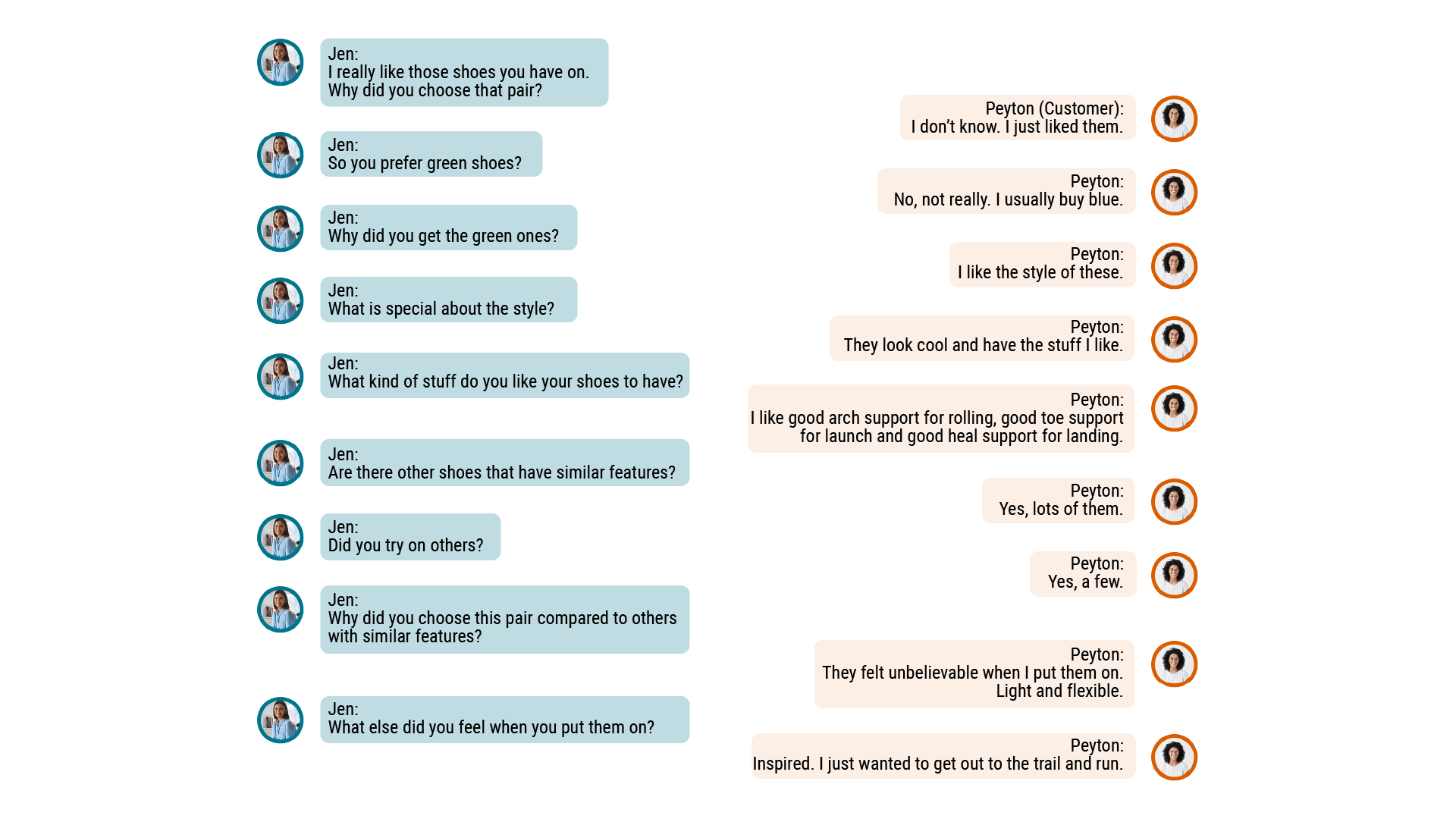 Jen thought about her conversation with Peyton. She learned some key information and was a little surprised by some of her comments. Outcomes
Trying to formulate an approach to discover product features for a large group of customers can be daunting. In this example, discovering Trail Running shoe features required starting with the customer. Creating personal connections by conversation (e.g., interview) with some customers can provide guidance for the POA Practitioners. Some of the POA tools and techniques, such as personas and surveys, can be applied for a deep dive into customer preferences, motivations, and attitudes. |
Empathy is the capacity to understand or feel what another person is experiencing from their frame of reference. Empathy means knowing the language of the customer and the perspective of their world. It can influence the design of a solution so that there is a differentiator for why a customer chooses one product over another. Empathy may redirect the whole product concept. The team may be working with preconceived ideas or biases. The need for empathy has increased as people easily compare products and experiences online.
It is not enough to build a feature and claim success because it was delivered under budget and within schedule. The feature must emotionally connect with customers, and the team must focus on what customers feel and experience.
How POA Helps with Empathy
Teams may think they know what customers want, but that is not enough. Building insight and emotional connection invoke a team's passion to help their customers.
Product ownership analysis helps teams crystalize product ideas and distill understanding of customer experiences through empathy. The team can act based on customer experience findings.
Effective POA helps generate empathy for the customer within the team. Empathy enables the team to make informed decisions throughout the design, development, and testing of the product.
Crucial insights to build empathy come from:
- Establishing trust and safety
- Making personal connections,
- Demonstrating sincere interest, and
- Creative and perceptive questioning:
- Setting aside personal experiences and biases,
- Building awareness and clarification of assumptions, and
- Using the "5 Why's" technique to get deeper answers.
- Active Listening
- Understanding the language of the customer, clarifying the meaning of words that can be understood in different ways.
- Paying attention to body language (non-verbal communication), questioning if it does not fit with words that are spoken.
- Providing compassionate understanding and responses.
Agile Extension Techniques
- Personas: Understand the customer better, which helps in empathizing with their pain points.
- Interviews: Interact with specific customers, make it more personal and focus on key issues with customer experience.
- Observation: Passive and active observation helps in gaining a deep understanding of customers so the practitioners can empathize better with the issues and challenges.
- Empathy Maps: A visual tool to establish a shared understanding of the customer and their experience.
- Customer Journey Map: Understand the pain points, and points of delight, as the customer interacts with the product.
| Background Jen was a Product Owner at a company that is very successful with online shoe sales. The company shifted its focus to an online shopping portal. The product management team had a program to reach out to customers to improve their online shopping experience. Challenge Jen made it a point to keep the personas real and reached out to customers through surveys to understand the shopping experience for shoes. She realized that the survey design was flawed as most questions were general, such as, "How likely is it that you will refer others to our product?" and "Are you happy with the time online cart check-out takes?" These questions provided Jen with a notion about the product but not any concrete desired features. Actions Jen tried to keep a personal relationship with customers. She invited some of the regular customers to an experience sharing session. Jen asked one of her customers, Jasmine, to relate her last experience of buying shoes. Example Customer Experience Jasmine related that last time she was looking for a pair of shoes, she was planning to go to a meet-up for the first time. She wanted to make the right first impression while showing her creativity and individualism. Jasmine: Had the perfect outfit but did not have shoes. She felt frustrated as she searched online. Wished that she could enter a few descriptive words and be matched to a designer and options. Saw a dressy Lug boot in camel brown, which she thought was a perfect complement to her artsy professional look. Realized that the boot looked brown, but the colour was called "olive." She was not sure if the boot would be a drab green. Wished she could download a picture of her outfit and match it to the picture of the boot to be sure the colours would harmonize. Outcome There are many direct and indirect clues Jen could gather from this conversation and from generating an Empathy Map and Customer Journey Map. The conversation helped Jen understand Jasmine better in the context of the situation and the motivation she had when searching for a pair of shoes. Lessons Learned By visualizing Jasmine's experience buying shoes, the Product Owner can identify with her. The insight and emotional connection invoke passion within the Product Owner to help this customer, by building better products (in this instance, the online shopping portal). By sharing these insights with the team, they can be reflected in the product. |
Engage in Observation
Observation elicits information through viewing and understanding activities, as well as their context. Observation (BABOK Guide, Observation 10.31) is a basis for:
- Identifying needs and opportunities,
- Understanding a business process,
- Setting performance standards,
- Evaluating solution performance, or
- Supporting training and development.
Qualitative information from customer interaction with the product in its natural environment is gathered. This is real-world use of the product and enables the ability to track the sequence of activities when interacting with the product. This analysis builds on the knowledge about customer expectations for the product, which can be leveraged for product development.
BABOK Guide v3 identifies two observation approaches:
- Active/Noticeable: The observation is an engagement with the customer, allowing for questions and clarifications while observing an activity.
- Passive/Unnoticeable: The customer is uninterrupted, allowing observation of a natural flow of events without intervention by the observer. Evaluation and discussion about the observation are done afterwards.
Observations collect qualitative information from customer interaction with the product. This information reflects real-world use of the product and tracks the sequence of activities that may have gone unnoticed. Effective analysis builds on the knowledge about customer expectations for the product which could be leveraged for product development.
Observations continue to grow in popularity due to the value that is gained through the analysis of real-life scenarios. Hackathons, observation labs, and observation tools are expanding the opportunities for teams and companies to gain insights through observing how customers use and experiment with a product. Qualitative data collected from a customer's interactions with a product or prototype can be analyzed to uncover ways to improve product design. Sometimes it is good to find people where they would use the product. Take into consideration research ethics, privacy, and permission for the observation activities.
The opportunity to observe the customer in action provides a heightened awareness to see, hear, and feel the real experience. Observation is not looking over the customer's shoulder. It requires full attention and helps the team gain perspective into the customer process and product performance and reveals value-add opportunities.
POA Techniques for Observation
Agile Extension Techniques
- Personas: Build a preliminary understanding of customers before engaging in observation and detailed later to reflect any remarkable observation.
- Focus Groups: Include observation to identify insights about specific topics or product features that resonate with groups of participants.
- Interviews: Interact with specific customers. Questions aid in active observations about the customers' environment and the experiences.
- Observation: Passive and active observation helps in gaining a deep understanding of customers in their environment, which can uncover relevant insights.
- Process Modelling: Provide a structure to the observations so they can be recorded as a set of activities, and analyzed later, for better comprehension.
| Background Karin was a single mom with two kids, one an active 11-year-old boy and one an adventurous 9-year-old girl. She juggled her role as a dedicated mom and her work in the Customer Service Call Centre for a national commercial P & C insurance company. She loved her job. She worked with a team of great people, but she really loved helping customers. They called her with their frustrations and concerns (for example, their equipment inspections were near or past due, they needed an appointment, and they did not know what to do to report accurately to the state). She enjoyed solving their problems. An internal process improvement initiative was underway and Jaci was the Proxy Product Owner, in addition to servicing some ongoing projects. Challenge Being a single mother, Karin valued spending her personal time with her kids. She wondered if she was productive and if she solved the customer issues. Action Jaci spent time with Karin doing observation for an internal process improvement initiative. Karin greeted Jaci and had a chair for her in her cubicle. She walked with Jaci to get some coffee. Karin initiated the boot- up of her system. It would take 20 to 25 minutes for the multiple applications her customer service work required to get up and running. She created an automated macro to start each application so that she could attend to other things and get her day organized while she waited. Karin's start time was 8:30 a.m. She had to arrive at 8 a.m. to get the system booted up to be ready to start taking customer calls. For Karin, the additional half hour meant that her kids must be enrolled in pre-school daycare, and she must drive them to school. She had originally requested the 8:30 a.m. start time so that she could put them on the bus and then head to work. But that request was before she understood the challenges with booting up the systems. She was grateful to have a job that she enjoyed and gave her purpose. Jaci spent an hour observing Karin. She watched, listened, drew visuals, and took notes. She was inspired watching Karin navigate various systems to get information for the customer. Jaci focused on Karin even though her mind was racing with possibilities for improvements. The development team from out-of-state came to the service centre for a visit. Jaci was determined to help them know and feel the experience of this internal customer. Outcome Jaci set up a video conference with the development team and the customer service team. The development team demonstrated a boot-up process that opened all the required applications in under five minutes. It generated a daily dashboard report that showed the timings and confirmed each application as "ready". If there were delays in overnight batch processes that impeded any application, an automated email went to the manager and the dashboard reported the discrepancy. The customer service team was surprised. They had not complained or asked for an improvement. The development team had watched the observation session that Jaci had initiated a few weeks prior with horror. They had no idea that the customer service team was dealing with this challenge. They were determined to help the 45 dedicated customer service team members. The development team worked on this improvement as a side project, with support from their supervisor since it did not cause any project delays. Jaci and her team calculated:
Lessons Learned Observation is a critical technique to discover gaps and issues in customer experience. It can be used to uncover unknown issues. Jaci demonstrated true empathy for the customer service team, and Karin in particular, by engaging in observation and generating empathy with the development team. This resulted in the entire team resolving an issue as a unit. |